Vermont Quitclaim Deed (Two Grantors)
County Specific Legal Forms Validated as recently as October 13, 2026 by our Forms Development Team
About the Vermont Quitclaim Deed (Two Grantors)
How to Use This Form
- Select your county from the list
- Download the county-specific form
- Fill in the required information
- Have the document notarized if required
- Record with your county recorder's office
What Others Like You Are Saying
"It would be nice to get a reply in a small window that says "Your request package has been subm…"
"I was actually quite pleased with the ease of use of this site. I really, really liked the step by s…"
"The website is so easy to use. I was able to purchase and download my documents within seconds!"
"Easy download, informative examples. Very good experience."
"Very User friendly site"
4.8/5 from 4,832 reviews. Read all
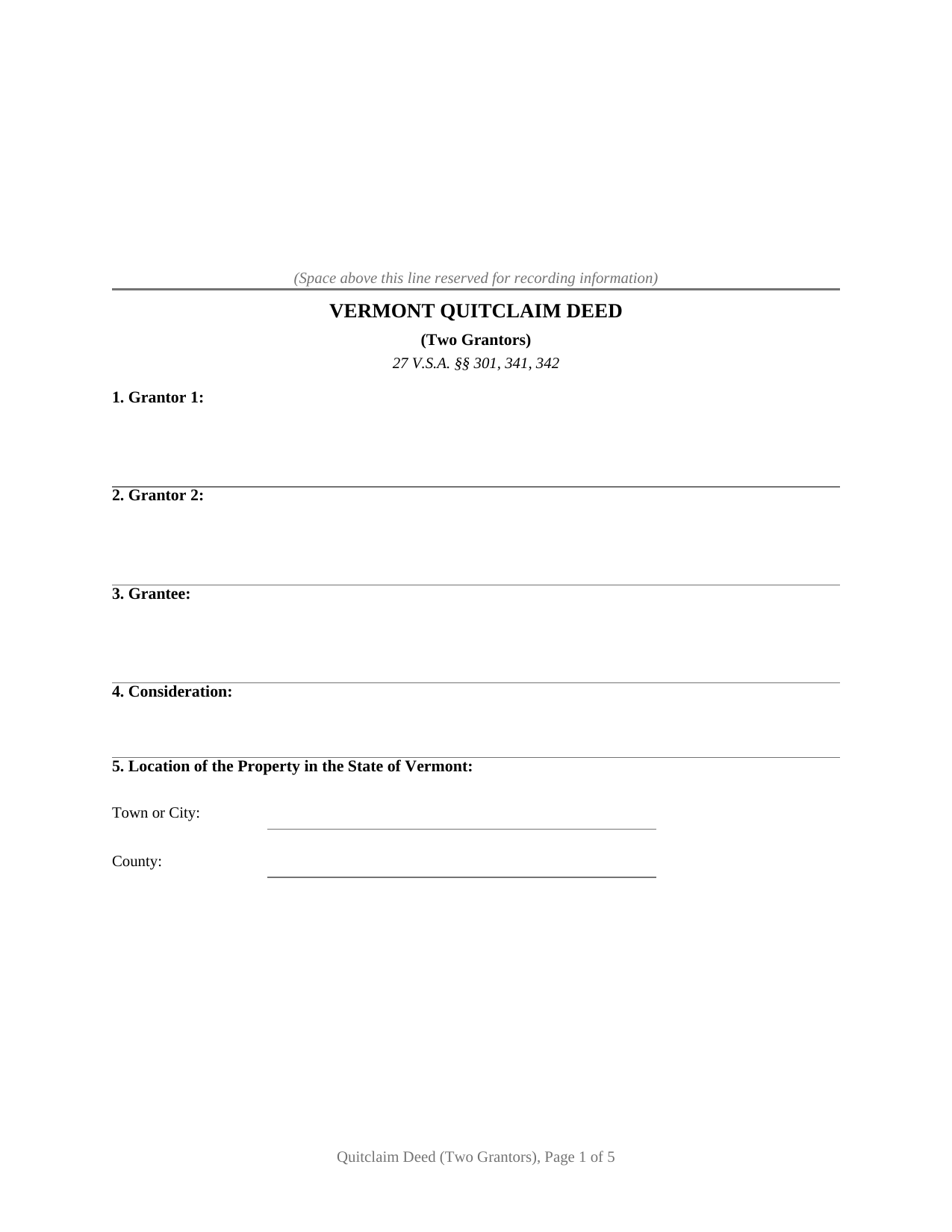
Two signature blocks anchor this deed, and each one feeds its own acknowledgment certificate, so a pair of Vermont co-owners can release their interests in a single recorded instrument even when they sign on different days, in different places, before different notaries. This is a Vermont quitclaim deed configured for two grantors, the co-owner build of the form that shoppers also type as a quit claim deed or a quick claim deed.
Both releases in one instrument
Each grantor on this deed remises, releases, and forever quitclaims that grantor's own right, title, and interest, so the grantee collects whatever the two interests add up to in one recording. Vermont supplies no statutory quitclaim form and implies no covenants into an ordinary deed, and this instrument states what that means in its operative text: it conveys only the interest each grantor holds at delivery, if any, and it carries no covenant or warranty of title. What makes the two-grantor build more than a second name line is the execution architecture. Under 27 V.S.A. section 341, each grantor's acknowledgment before a notary public is a separate notarial act, so the form carries a separate certificate for each grantor in the wording of Vermont's statutory short form, with lines for the notary's printed name, commission number, and commission expiration. One grantor can acknowledge in Brattleboro on a Tuesday while the other appears before a different notary in another state the following week, and the deed is still one instrument when it reaches the clerk.
The configuration: two grantors, one grantee entry, a joinder block in reserve
The form recites exactly two grantors, each with a numbered identity section, and a single grantee entry that accepts one or more grantees together with any Vermont vesting words, from tenancy in common to joint tenancy or tenancy by the entirety under 27 V.S.A. section 2. Two co-owners passing an entire parcel to one grantee, spouses moving jointly held land out of their two names, and co-owners consolidating a shared camp under a single owner present the two-grantor pattern this deed recites. A sole owner's release follows a one-signature architecture this form does not carry, and three or more co-owners present more signature and acknowledgment blocks than it holds. The deed also carries Vermont's homestead joinder machinery in a conditional twelfth section: under 27 V.S.A. section 141, a conveyance of a Vermont homestead by a married owner is inoperative as to that homestead without the spouse joining in both execution and acknowledgment. On a two-grantor deed that requirement often satisfies itself, because grantors who are married to each other supply the joinder by signing as grantors; the joinder block and its third acknowledgment certificate wait for the case where a married grantor's spouse is not the other grantor, and in every other case the section recites that it is unused.
At the town clerk's counter
Vermont land records live with town and city clerks, so this deed records in the municipality where the land lies, at $15 per page statewide. Two grantors do not change the tax paperwork: one Vermont Property Transfer Tax Return, Form PTT-172, covers the conveyance, and 32 V.S.A. section 9608 bars the clerk from recording the deed without a complete return and the required Act 250 certificate. The return is also where an exemption, including the no-consideration family transfer exemptions many two-grantor conveyances claim, is asserted, and the transferee is the party the statute makes liable for any tax due. The accompanying guide walks through the return, the current rates, and the survey citation rule of 27 V.S.A. section 341(b), which reaches a deed whose description refers to a recorded survey.
Inside the download
The package holds the two-grantor quitclaim deed as a fillable PDF fronted by a non-recorded instructions page, a completed example filled in end to end for a Brattleboro, Windham County fact pattern in which married co-owners deed their property to the next generation and the joinder section properly stays unused, and a plain language guide covering each numbered section, the ways Vermont grantees may hold title, the notarization details, and the recording and transfer tax steps. The materials describe Vermont law in general terms and are not legal advice.
Important: County-Specific Forms
Our quitclaim deed (two grantors) forms are specifically formatted for each of the 14 counties in Vermont.
After selecting your county, you'll receive forms that meet all local recording requirements, ensuring your documents will be accepted without delays or rejection fees.