Washington Quitclaim Deed (Trustee Grantor)
County Specific Legal Forms Validated as recently as October 4, 2026 by our Forms Development Team
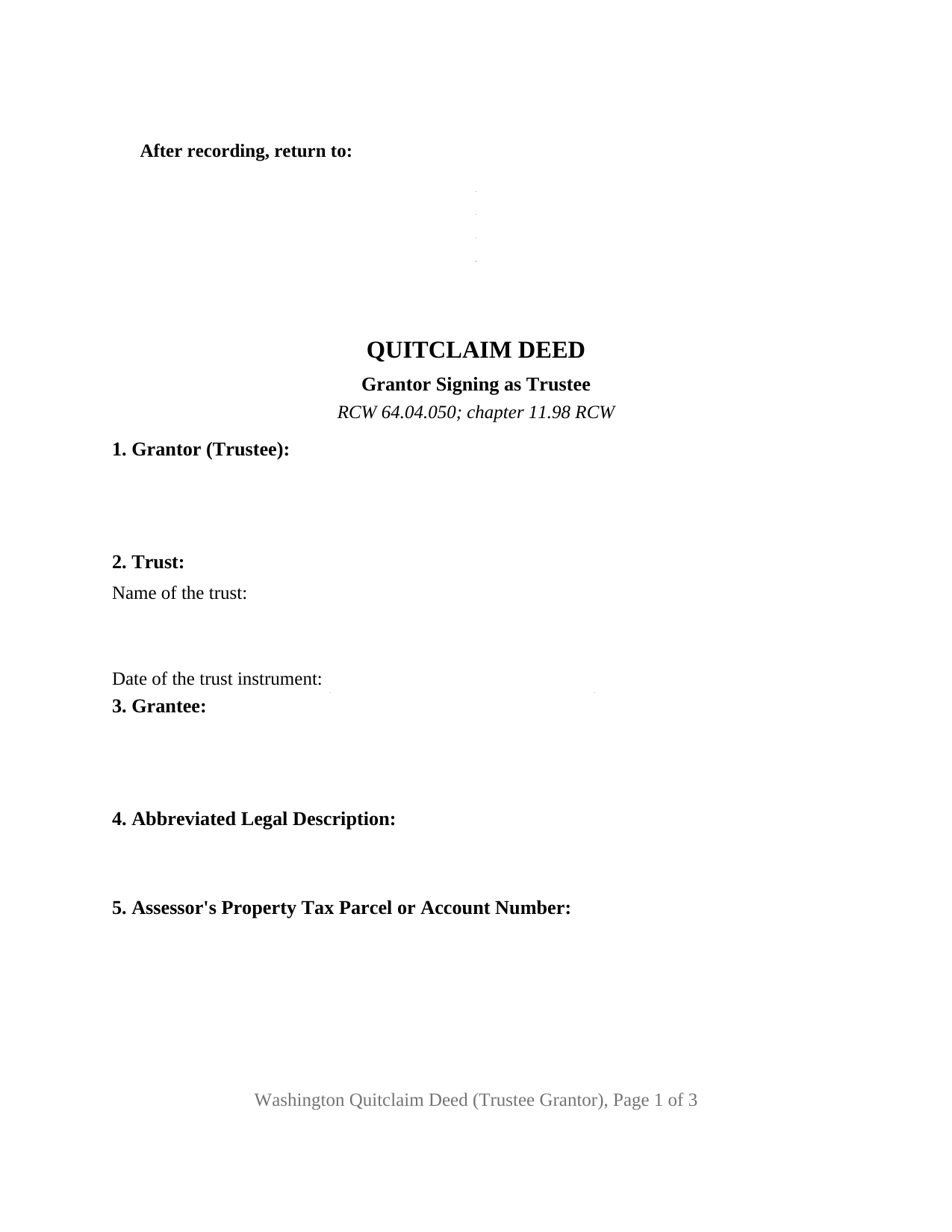
About the Washington Quitclaim Deed (Trustee Grantor)
How to Use This Form
- Select your county from the list
- Download the county-specific form
- Fill in the required information
- Have the document notarized if required
- Record with your county recorder's office
What Others Like You Are Saying
"process was easy and simple to do"
"ok"
"This looks easy enough. Thanks. Very simple and efficient navigating the site."
"Whomever "KCH" is, that person was of great help. It took me several tries due my inexperi…"
"This company gets it right! All the forms you need for your jurisdiction along with guides, and more"
4.8/5 from 4,832 reviews. Read all
The grantor on this Washington quitclaim deed holds the property for someone else. Record title stands in a trustee's name, and the trustee signs in that office to move a parcel out of the trust. The grantor entry names the office held, a numbered section of its own records the authority behind it, and the certificate at the end is taken in a representative capacity.
The power a Washington trustee brings to the signature line
RCW 11.98.070 is the source. A trustee, or the trustees jointly, hold discretionary power, in addition to the authority otherwise given by law, to acquire, exchange, sell, convey, partition, and manage trust property in accordance with the standards provided by law. Section 9 is where that authority gets written down: the article of the trust instrument granting the power to sell or convey, alongside the statute. A successor trustee completes the same entries as an original one, because RCW 11.98.039(1) entitles a successor named in the governing instrument to act as trustee except for good cause or disqualification. Evidence of authority travels separately, through the RCW 11.98.075 certification of trust, prepared apart from this deed and not included in this package.
A release with nothing added to it
The conveyance runs on the statutory words of RCW 64.04.050, releasing to the grantee the legal and equitable rights held at delivery and stopping there. Recorded encumbrances keep their hold, and none of the covenants that the statutory warranty deed of RCW 64.04.030 supplies comes along. Title reaching the trust later stays put, because the statute extends a quitclaim to after acquired title only where a deed adds words saying so, and this one adds none.
One trustee, one certificate, capacity on every line
The form recites exactly one grantor: one grantor entry, one signature line carrying a printed name and a date, and one acknowledgment certificate. The certificate follows the RCW 42.45.140 short form wording, whose representative version at subsection (2) calls for three items after the date, the individual who appeared, the type of authority such as officer or trustee, and the party on behalf of whom the record was executed, so the name blank is a full width entry holding all three. Where cotrustees act only together, RCW 11.98.070 speaks of the trustees jointly, and the record then shows two signature blocks and two certificates, an arrangement this form does not hold. It is not built for the opposite direction, a conveyance into a trust, where the capacity phrase belongs to the grantee entry.
Where the parcel goes decides the excise tax
A deed out of a trust can be exempt or taxable, and the Department of Revenue rules turn on the destination. WAC 458-61A-211(2)(h) treats a conveyance from the trustee of a revocable trust to the original grantor, or to a beneficiary, as a mere change in identity or form where no valuable consideration passes. The same subsection is blunt in the other direction: a sale by the trustee to a third party, or to a beneficiary for valuable consideration, is subject to the tax. For an irrevocable trust, WAC 458-61A-210(1) keeps a distribution to the beneficiaries outside the tax where no valuable consideration is given and the distribution follows the trust instrument.
A recording package that can run to three documents
Some trust conveyances reach the counter with company. Under WAC 458-61A-210(5), a transfer to or from an irrevocable or testamentary trust carries either a certified death certificate with the portion of the trust instrument showing the grantor's authority, or a signed trustee statement holding the information that rule lists, and it goes to the treasurer and is recorded with the auditor. The deed itself arrives ready to index, its first six numbered sections holding the page one content of RCW 65.04.045(1), the trust name and trust instrument date beside the party names, the short legal description, and the parcel number. WAC 458-61A-303 calls for an affidavit on a transfer of ownership, and RCW 82.45.090 stops the auditor from accepting a taxable instrument before the treasurer verifies the tax.
This package delivers the blank deed as a fillable PDF, one completed example filled in for a Kitsap County distribution out of a family living trust, and a plain language guide to the entries, the signing, the affidavit, and the treasurer step. Searchers also look for a trustee quitclaim deed, or a quit claim deed out of a living trust. The materials describe Washington law in general terms and are not legal advice.
Important: County-Specific Forms
Our quitclaim deed (trustee grantor) forms are specifically formatted for each of the 39 counties in Washington.
After selecting your county, you'll receive forms that meet all local recording requirements, ensuring your documents will be accepted without delays or rejection fees.