Washington Quitclaim Deed (Interspousal)
County Specific Legal Forms Validated as recently as October 4, 2026 by our Forms Development Team
About the Washington Quitclaim Deed (Interspousal)
How to Use This Form
- Select your county from the list
- Download the county-specific form
- Fill in the required information
- Have the document notarized if required
- Record with your county recorder's office
What Others Like You Are Saying
"Easy to use and excellent software."
"Great service they had what i need easy to use on printing as soon as you pay you can print also as …"
"So far its been good. The David Jr Hall Estate Trust is a Business Blind Trust and we are looking fo…"
"DEEDS.COM IS THE BEST WAY TO E-RECORD DEEDS. THEY ARE FAST, POLITE AND A FANTASTIC DEAL FOR THE SERV…"
"Awesomeness a true life saver I'm very appreciative."
4.8/5 from 4,829 reviews. Read all
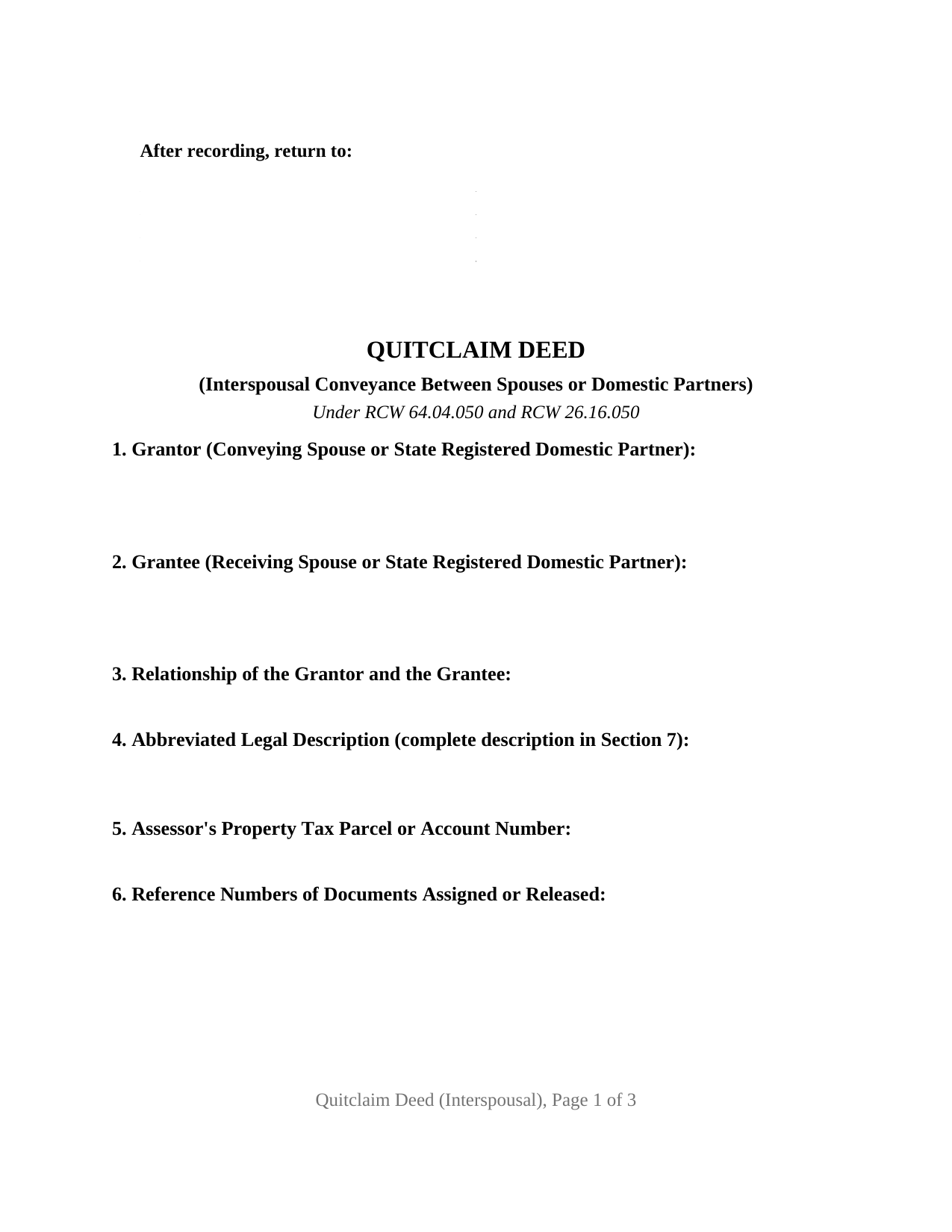
Washington law puts a single signature on a deed between spouses. RCW 26.16.030(3) keeps one spouse or one state registered domestic partner from conveying community real property alone, and RCW 26.16.050 opens a door for the transfer that runs from one of them directly to the other: the grantor signs and acknowledges that deed as a single person, without the joinder of the party the deed names as grantee. This quitclaim deed is configured for that transfer: one grantor entry, one signature line, one acknowledgment certificate, and an entry for the marriage or partnership the conveyance rests on.
The section that changes what the property is
RCW 26.16.050 does more than permit the conveyance: it states an outcome. Every deed made between spouses or domestic partners under that section operates to divest the real estate recited in it from any or every claim or demand as community property, and to vest that real estate in the grantee as separate property. The parcel leaves the community and becomes separate property, which RCW 26.16.010 and RCW 26.16.020 let its owner manage, encumber, sell, or devise without the other joining. A proviso in the same section leaves creditors where they were: the conveyance does not affect existing equity in favor of the grantor's creditors.
Quitclaim words, measured at delivery
The conveyance uses the statutory words of RCW 64.04.050, conveys and quitclaims, so the grantee receives the rights the grantor holds when the deed is delivered and nothing beyond them. No covenant of title accompanies the transfer. Encumbrances of record continue to bind the parcel, and better title the grantor picks up later stays with the grantor, because the statute reaches after acquired title only where a deed adds words expressing that intention. This form adds none.
One grantor, one certificate, and a relationship entry
The form recites exactly one grantor and exactly one grantee, describing each as the spouse or state registered domestic partner of the other, with a blank where that relationship is stated. One signature line with a printed name and a date follows, then one certificate in the individual capacity short form of RCW 42.45.140(1). Two title situations present the configuration. Community real property may stand in both names, and one of them conveys that interest so the other holds the parcel separately. Or it may stand in one name alone, because record title never showed the community character RCW 26.16.030 draws from the source of the acquisition. What the form is not set up as: a deed placing two record owners in the grantor position, a deed carrying a separately labeled block for a joining party who is not a grantor, or a conveyance of community real property to a third party.
An exempt transfer that still meets the treasurer
Excise tax treatment is where this deed parts from a sale. WAC 458-61A-203(1) provides that transfers from one spouse or domestic partner to the other that establish or separate community property are not subject to the real estate excise tax. Exempt is not the same as unreported. WAC 458-61A-303 calls for a real estate excise tax affidavit on a transfer of ownership generally, the exemption is claimed by code with its section and subsection, and the Department of Revenue collects a 5 dollar technology fee, another 5 dollars for a claimed exemption, and a 10 dollar minimum. The affidavit goes to the county treasurer first.
Sections one through six, where the auditor looks
RCW 65.04.045(1) assigns the first page of a recorded Washington deed specific content, and this form devotes its first six numbered sections to it: the party names, the relationship entry, an abbreviated legal description keyed to the complete one later in the deed, the assessor's parcel or account number, and reference numbers of documents assigned or released. The return name and address sit in the statutory upper left position, inside three inches held at the page top for the auditor. Body type runs at 12 point; cost at the counter turns on statutory add ons: the RCW 36.22.185 covenant homeownership assessment and the RCW 36.22.250 surcharge.
The download contains the blank deed as a fillable PDF, a completed example prepared for a Clark County transfer between spouses, and a plain language guide to each entry, the notarization, the excise tax affidavit, and recording. Searchers reach it as a quit claim deed between spouses or an interspousal transfer deed. The materials describe Washington law in general terms and are not legal advice.
Important: County-Specific Forms
Our quitclaim deed (interspousal) forms are specifically formatted for each of the 39 counties in Washington.
After selecting your county, you'll receive forms that meet all local recording requirements, ensuring your documents will be accepted without delays or rejection fees.