Washington Quitclaim Deed (Reserving Life Estate)
County Specific Legal Forms Validated as recently as October 4, 2026 by our Forms Development Team
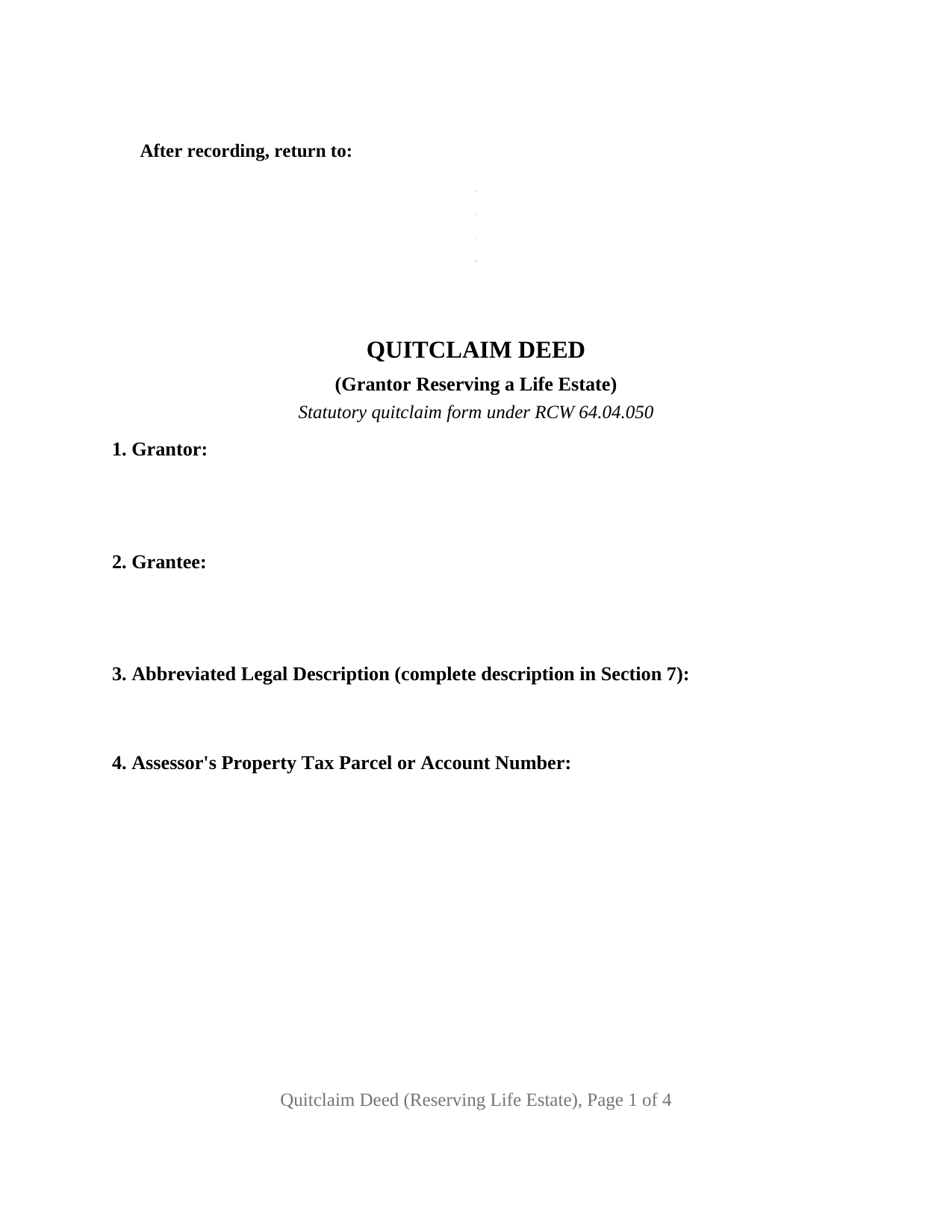
About the Washington Quitclaim Deed (Reserving Life Estate)
How to Use This Form
- Select your county from the list
- Download the county-specific form
- Fill in the required information
- Have the document notarized if required
- Record with your county recorder's office
What Others Like You Are Saying
"This is the best resource I have found for documents related to beneficiary deeds!"
"Very happy with the product and really appreciated being able to get it on line."
"Thank you, easy to fill out forms. Now I can relax, knowing that this is done."
"The site made everything very easy to understand and access. I was able to get everything I needed a…"
"Great service"
4.8/5 from 4,829 reviews. Read all
Two estates come out of this Washington quitclaim deed the moment it is delivered. The grantee takes the remainder, a present ownership interest in the property. The grantor keeps a life estate, the right to occupy and use the property for the rest of the grantor's life. Both halves are made by one instrument, signed and recorded once.
The words that carve out the life estate
The conveyance runs on the statutory quitclaim form of RCW 64.04.050, which makes a deed in its substance a conveyance, release, and quitclaim of the grantor's then existing legal and equitable rights. Section 8 adds the reservation in terms: the grantor conveys and quitclaims to the grantee, reserving to the grantor a life estate for the term of the grantor's natural life. Washington prescribes no statutory form for a deed of this kind. The life estate and the remainder behind it are common law estates that the language of the instrument brings into being, a task RCW 64.04.060 eases by dispensing with the word heirs and other technical words of inheritance. No covenant of title comes with any of it, and the statute withholds after acquired title unless the deed asks for it, which this one does not.
A future interest that already exists
The remainder is property, not an expectancy. From delivery forward the grantee owns something presently, may convey or encumber that interest subject to the life estate, and passes it under a will if the grantee dies first. The other side is finality: a delivered deed cannot be pulled back by the grantor alone, by a later instrument or by a will, so unwinding it takes a conveyance from the grantee. At the grantor's death the life estate ends by its own terms and the remainder becomes a present estate.
Waste, and what the deed can allocate
Washington hands the remainder holder a statutory remedy against damage to the property. RCW 64.12.020 places a tenant for life among the persons an injured party may sue for waste, with treble damages or fifty dollars, whichever is greater, and a reasonable attorney fee fixed by the court. Everyday obligations stay where the parties put them, which is why the form carries an optional section for life estate provisions. The completed example uses it to place general property taxes, insurance premiums, and ordinary maintenance on the grantor while the life estate lasts.
Consideration decides the excise tax
Two Department of Revenue rules meet this deed at the treasurer's counter. WAC 458-61A-102(20) brings the grant, relinquishment, or assignment of a life estate inside the definition of a sale of real property. The life estates and remainder interests provision of WAC 458-61A-202 then supplies the test: the transfer of a life estate to the grantor with a remainder interest to another party is not a taxable transfer if no consideration passes. The department illustrates it with parents who deed their home to a son and retain a life estate: untaxed, because the son pays nothing. Anything paid for the remainder flips that result. Exempt or taxable, an affidavit rides along, and RCW 82.45.090 holds the auditor back until the treasurer verifies the tax.
One grantor, one signature, one reserved life
The form recites exactly one grantor, with one signature line, a printed name and date, and one acknowledgment certificate in the individual capacity short form of RCW 42.45.140(1). The reservation is measured by the life of that grantor and runs to that grantor alone. Ownership patterns presenting the configuration in the Washington record include an owner deeding a residence to one adult child and living there afterward, and an owner passing rural acreage along while keeping lifetime possession. What the form is not set up as: two grantor entries, a life estate measured by the life of someone other than the grantor, or a certificate in representative capacity. Community real property and homestead property are governed instead by RCW 26.16.030(3) and RCW 6.13.060, each calling for both spouses or both state registered domestic partners to execute and acknowledge the instrument.
The download holds the blank deed as a fillable PDF, a completed example prepared for a Chelan County conveyance from a mother to her daughter, and a plain language guide covering the blanks, the signing, the affidavit, and the trip past the treasurer to the auditor. Searchers also look for a quit claim deed reserving a life estate, or a life estate deed. These materials describe Washington law in general terms; they are not legal advice.
Important: County-Specific Forms
Our quitclaim deed (reserving life estate) forms are specifically formatted for each of the 39 counties in Washington.
After selecting your county, you'll receive forms that meet all local recording requirements, ensuring your documents will be accepted without delays or rejection fees.