Washington Quitclaim Deed
County Specific Legal Forms Validated as recently as October 4, 2026 by our Forms Development Team
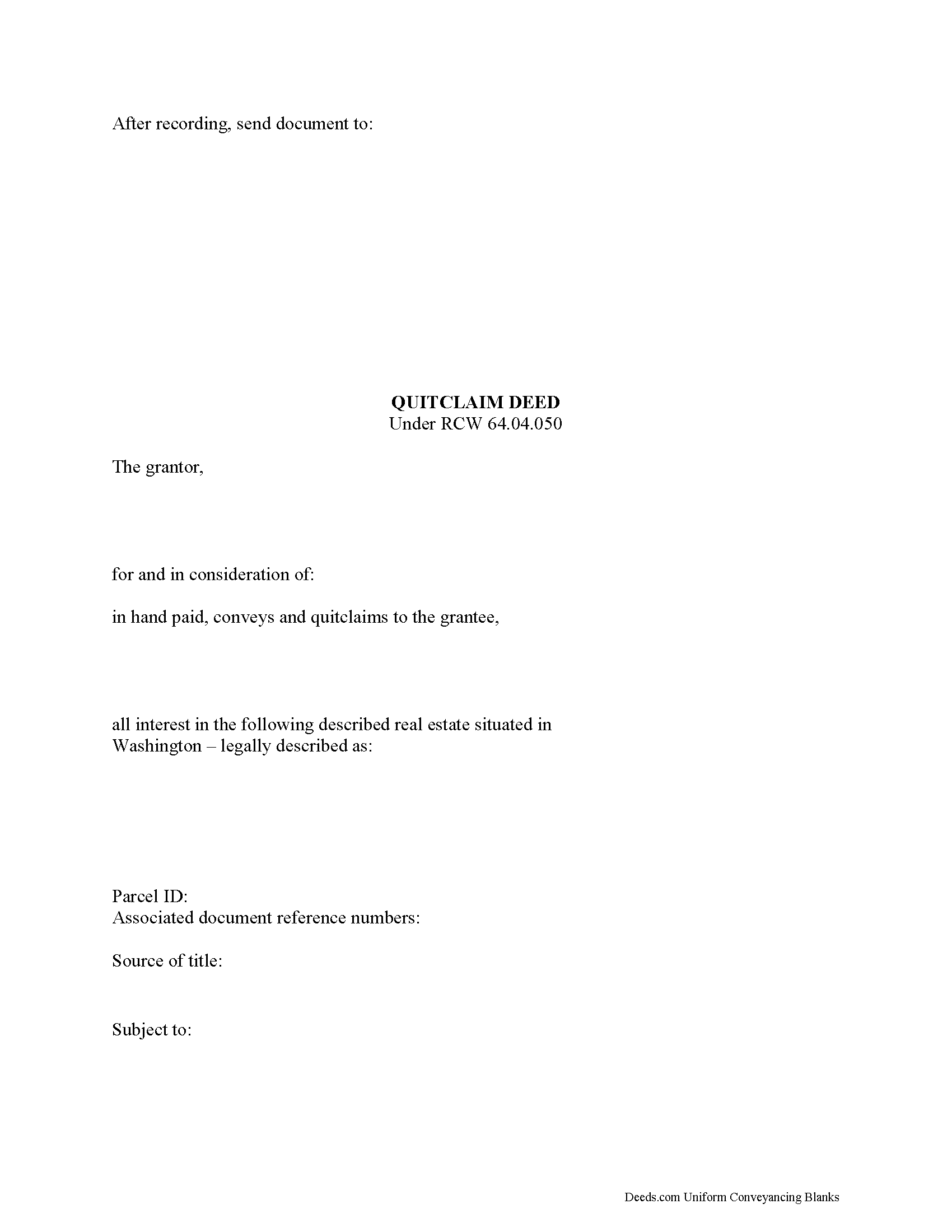
About the Washington Quitclaim Deed
How to Use This Form
- Select your county from the list
- Download the county-specific form
- Fill in the required information
- Have the document notarized if required
- Record with your county recorder's office
What Others Like You Are Saying
"Very helpful and efficient"
"I am still in the trial stage. I am an older lawyer. Any help I can get is worth it. Once you get us…"
"Fast,quick and easy to work with. Not confusing."
"Thanks for the complete and reasonably priced set of docs. I was specifically looking for and glad t…"
"Very helpful and easy to access."
4.8/5 from 4,833 reviews. Read all
Washington keeps three deed forms in one chapter of its code, and what separates them is not what passes to the grantee but what travels alongside it. Chapter 64.04 RCW prints a warranty deed at RCW 64.04.030, a bargain and sale deed at RCW 64.04.040, and a quitclaim deed at RCW 64.04.050. This is the third, in its general configuration: natural persons conveying in their own names, promises left out, the interest measured on the day of delivery.
A statute that withholds two things
The operative phrase is conveys and quitclaims. A deed in the substance of the RCW 64.04.050 form is deemed a good and sufficient conveyance, release, and quitclaim of the rights the grantor holds in the premises it describes, and it withholds two things the neighboring forms supply. It attaches no covenant, so nothing in the deed answers for the condition of the title, where RCW 64.04.030 would add covenants of seisin, freedom from encumbrances, and quiet possession. It also stops at the title on hand: RCW 64.04.070 sends after acquired title to a grantee under a deed purporting to convey a greater estate, and RCW 64.04.050 excepts the quitclaim unless the parties add words asking for that reach. Those two absences are why the instrument, often searched as a quit claim deed, releases and reorganizes interests rather than selling with assurances.
Blanks that hold what the parties actually are
Washington characterizes property by the source of its acquisition rather than by the words on the last recorded deed, and this form prints no status or vesting language. Section 1 takes one or two grantors with any status they state, and Section 2 takes one or two grantees with any vesting designation they choose. Two signature blocks follow, headed GRANTOR and SECOND GRANTOR (if applicable), each carrying a printed name, a date, and its own acknowledgment certificate, so two signers may appear on different days or before officers in different counties; a single grantor leaves the second block and certificate blank. Four count patterns fit that architecture: one or two names conveying to one or two names. What the form is not set up as: an entity grantor signing through an officer in a stated capacity, a signer acting under a power of attorney or in a fiduciary office, or three or more record owners on either side.
What the grantees write after their names
Under RCW 64.28.020 an interest created in two or more persons in their own right is an interest in common unless the instrument declares a joint tenancy, and RCW 64.28.010 makes an express written declaration the only route to survivorship. Where spouses or state registered domestic partners take as declared joint tenants, RCW 64.28.040 presumes the interest to be community property while still passing it to the survivor. RCW 11.04.071 abolished survivorship as an incident of tenancy by the entirety, so that designation now carries no effect.
Built for the auditor's first page
The first four numbered sections sit on recorded page one and carry the content RCW 65.04.045(1) assigns there: the party names, an abbreviated legal description keyed to the complete one, and the assessor's parcel or account number; Section 5 holds reference numbers of documents assigned or released, an item an ordinary deed lacks. The return name and address sit at the statutory top left, inside the three inch band held for the auditor, the title directly beneath. Body type is set at 12 point against an 8 point statutory minimum, and no blank asks for a social security number, a birth date, or a parent's maiden name, which RCW 65.04.045(3) keeps off a recorded instrument.
The treasurer, then the auditor
WAC 458-61A-303 calls for an excise tax affidavit on a transfer of ownership, and under RCW 82.45.090 the auditor waits on the county treasurer, who verifies that the tax is paid or notes that none is owed. The state rate begins at 1.10 percent of the selling price and steps up through higher bands, with a local rate on top and exemptions claimed by code. Counter cost turns on the page fees of RCW 36.18.010, the RCW 36.22.185 covenant homeownership assessment, and the RCW 36.22.250 surcharge.
The download holds the blank deed as a fillable PDF, a completed example prepared for a Thurston County conveyance, and a plain language guide covering the entries, the acknowledgment, the excise tax affidavit, and recording. This package describes Washington law in general terms and is not legal advice.
Important: County-Specific Forms
Our quitclaim deed forms are specifically formatted for each of the 39 counties in Washington.
After selecting your county, you'll receive forms that meet all local recording requirements, ensuring your documents will be accepted without delays or rejection fees.