Washington Quitclaim Deed (Corporation Grantor)
County Specific Legal Forms Validated as recently as October 4, 2026 by our Forms Development Team
About the Washington Quitclaim Deed (Corporation Grantor)
How to Use This Form
- Select your county from the list
- Download the county-specific form
- Fill in the required information
- Have the document notarized if required
- Record with your county recorder's office
What Others Like You Are Saying
"So far this looks like exactly what I need and at a reasonable price. Glad it was so easy to find on…"
"Really great forms. Did the quitclaim, everything was perfect, recorded with no problems at all. Tha…"
"Deeds.com was a very efficient and simple website to use in preparing my documents needed to complet…"
"I was very impressed on what I needed to get the Deed I requested. Everything was there and I got it…"
"I cannot believe how fast your service is! Thank you!"
4.8/5 from 4,829 reviews. Read all
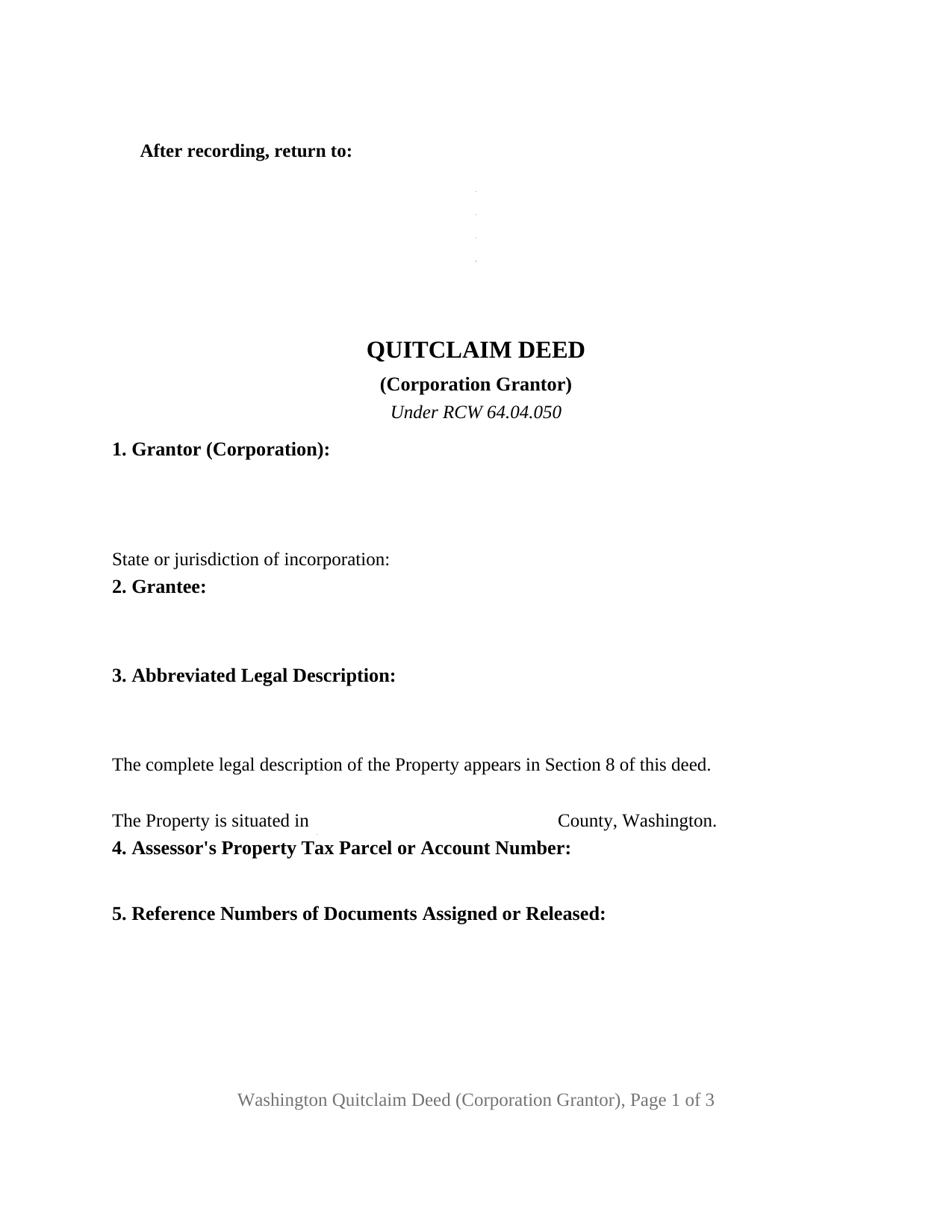
A corporation conveys through two layers of authority: the board's, and the officer's. This Washington quitclaim deed is built around that structure, with one corporation named as grantor, one signature line for the individual who signs for it, a numbered section for the office held and the authority relied on, and one acknowledgment certificate taken in representative capacity.
Two layers of corporate authority
Chapter 23B RCW supplies both. RCW 23B.03.020(2) gives a corporation, unless its articles provide otherwise, the same powers as an individual to carry out its business and affairs, subsection (2)(e) naming the power to sell, convey, and otherwise dispose of all or any part of its property. RCW 23B.08.010(2) places the exercise of corporate powers under the authority of the board of directors. The signer comes from the same chapter: RCW 23B.08.400(1) gives a corporation the officers described in its bylaws or appointed by the board under them, and RCW 23B.08.410 gives each officer the authority set out in the bylaws or, consistent with the bylaws, prescribed by the board.
Where the shareholders enter
Two sections mark that boundary. Under RCW 23B.12.010(1), unless the articles provide otherwise, shareholder approval is not required to dispose of corporate property in the usual and regular course of business, or to encumber it in or out of that course. RCW 23B.12.020 sets the other side: a disposition outside the usual and regular course takes shareholder approval where it would leave the corporation without a significant continuing business activity. Section 7 of the form is where the resolution or bylaw provision relied on gets written down.
The certificate Washington wrote for corporations
Washington keeps a corporate acknowledgment of its own. RCW 64.08.070 prints a long form certificate reciting the officer's appearance, the corporation's execution of the instrument as its free and voluntary act and deed, and the officer's sworn authority to execute it; the same section accepts the short form of RCW 42.45.140(2) instead. This deed carries the short form, whose entry after the date names the individual, the type of authority such as officer or trustee, and the party on behalf of whom the record was executed. A corporate seal is no condition of the deed: RCW 64.04.105 provides that its absence does not affect validity, legality, or character in any respect.
Quitclaim words, measured at delivery
The deed runs on the statutory phrase RCW 64.04.050 supplies. Conveys and quitclaims passes what the corporation actually holds on the day of delivery, unaccompanied by any covenant of title. Recorded encumbrances keep their hold, and better title the corporation picks up afterward stays with the corporation, because the statute reaches after acquired title only where a deed adds words expressing that intention, and this one adds none.
One corporate grantor, one signer
The form recites exactly one grantor, described as a corporation, with an entry for its state or jurisdiction of incorporation. Three record patterns present that architecture: a corporation conveying a parcel standing in its corporate name, a corporation releasing whatever interest its name carries in a parcel to settle a boundary question, and a corporation deeding property under a former name after a name change. What the form is not set up as: two grantor entries, a grantor signing in an individual right, or a certificate in individual capacity.
Two counters, one deed
Washington sends a conveyance to the treasurer before the auditor. WAC 458-61A-303 calls for a real estate excise tax affidavit on a transfer of ownership generally, and under RCW 82.45.090 no taxable conveyance reaches the auditor's counter until the treasurer has verified payment or noted that nothing is due. The state portion opens at 1.10 percent of the selling price, with the local rate added. Entity deeds also meet WAC 458-61A-211, which exempts a transfer amounting to a mere change in identity or form of ownership where beneficial ownership does not change. The first page is built to RCW 65.04.045, the return name and address sitting at the statutory top left inside a three inch band held for the auditor.
The download holds the blank deed as a fillable PDF, a completed example prepared for a Yakima County sale by a Washington corporation, and a plain language guide to every entry, the notarization, the excise tax affidavit, and the treasurer step. Searchers also look for a corporate quit claim deed, or a quit claim deed from a corporation. These materials describe Washington law in general terms; they are not legal advice.
Important: County-Specific Forms
Our quitclaim deed (corporation grantor) forms are specifically formatted for each of the 39 counties in Washington.
After selecting your county, you'll receive forms that meet all local recording requirements, ensuring your documents will be accepted without delays or rejection fees.