Washington Quitclaim Deed (Individual Grantor)
County Specific Legal Forms Validated as recently as October 4, 2026 by our Forms Development Team
About the Washington Quitclaim Deed (Individual Grantor)
How to Use This Form
- Select your county from the list
- Download the county-specific form
- Fill in the required information
- Have the document notarized if required
- Record with your county recorder's office
What Others Like You Are Saying
"very useful"
"I tried to use the free stuff you find on the internet. You quickly find out that free is rarely eve…"
"Easy process considering not too technical savvy!"
"Great company. I had some issues with what I had prepared on my end but my contact at Deeds.com help…"
"Deeds.com is an easy-to-use resource for the busy real estate practitioner ."
4.8/5 from 4,827 reviews. Read all
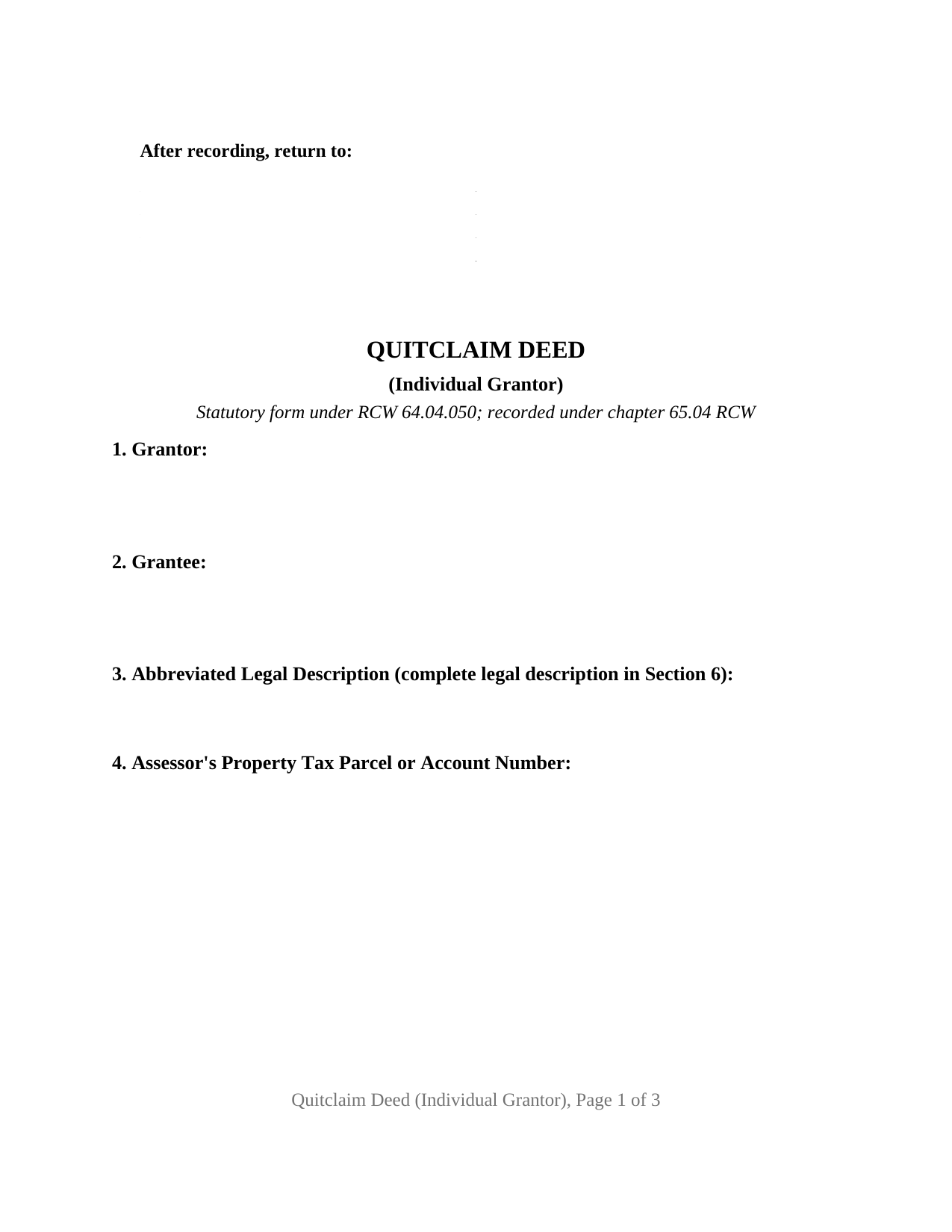
One person signs this Washington quitclaim deed, in that person's own name. It carries a single grantor entry, a single signature block headed GRANTOR, and a single acknowledgment certificate in the individual capacity short form: the configuration for one natural person releasing whatever interest that person holds in Washington real property under the statutory quitclaim form of RCW 64.04.050.
What the statute passes, and what it holds back
RCW 64.04.050 supplies the words and the effect. A deed in the statutory substance, using conveys and quitclaims, is deemed a good and sufficient conveyance, release, and quitclaim to the grantee of all then existing legal and equitable rights of the grantor in the premises described. No covenant of title travels with it, so the grantee receives exactly what the grantor holds at delivery. And it does not reach after acquired title: a better title the grantor gains later stays with the grantor unless the deed adds words expressing an intention to pass it. Searched also as a quit claim deed, it releases or rearranges an interest rather than selling one with assurances.
One natural person, one certificate
The form recites exactly one grantor, and its execution matches: one signature line with a printed name and date, then one certificate opening with This record was acknowledged before me on, the individual capacity sentence of RCW 42.45.140(1). Section 1 is a free text block for the grantor's name, stated status, and mailing address; nothing about marital status or how title is held is preprinted. Two ownership patterns present this configuration in the Washington record: an unmarried owner conveying a parcel held alone, and a married owner or state registered domestic partner conveying separate property that is not a homestead. The form is not set up with two grantor entries, an entity or trustee in the grantor position, an attorney-in-fact signer, or a separate block for a joining spouse. Where the parcel is community real property or a homestead of a spouse or domestic partner, RCW 26.16.030(3) and RCW 6.13.060 call for execution and acknowledgment by both on a conveyance to a third party, a two signer arrangement this form does not carry.
The grantee side stays open
Section 2 takes one grantee, or more than one with whatever vesting designation the grantees state. RCW 64.28.020 makes a deed to two or more persons an interest in common unless the instrument expressly declares a joint tenancy, RCW 64.28.010 makes that declaration the only path to survivorship, and RCW 64.28.040 presumes community property where spouses or domestic partners take as declared joint tenants while still passing the property to the survivor.
Page one as the auditor indexes it
RCW 65.04.045(1) assigns content to the first page of a recorded Washington instrument, and the form places each item there: the return name and address at the top left inside the three inch band reserved for the auditor, the title immediately beneath, the party names, an abbreviated legal description keyed to the complete one in Section 6, and the assessor's parcel or account number on its own line. Body type runs at 12 point against the 8 point minimum of RCW 65.04.045(2), and no blank asks for the identifiers RCW 65.04.045(3) bars from a recorded instrument.
The treasurer's counter comes first
A conveyance by quitclaim deed for valuable consideration is a sale under chapter 82.45 RCW, and WAC 458-61A-303 calls for a real estate excise tax affidavit on a transfer of ownership whether tax is owed or an exemption applies. Under RCW 82.45.090 the county auditor may not accept a taxable instrument until the county treasurer has verified the tax as paid or not due, so the affidavit, the deed, and any payment go to the treasurer first. The state portion begins at 1.10 percent of the selling price, a local rate rides on top, and an exempt transfer claims its exemption by code. That affidavit is a Department of Revenue form, obtained separately and not part of this package. The auditor's own charges stack the RCW 36.18.010 page fees with the covenant homeownership assessment of RCW 36.22.185 and the recording surcharge of RCW 36.22.250.
The download contains the blank deed as a fillable PDF, a completed example prepared for a King County conveyance from one unmarried owner to one grantee, and a plain language guide covering each blank, the acknowledgment, the excise tax affidavit, and recording. The materials describe Washington law in general terms and are not legal advice.
Important: County-Specific Forms
Our quitclaim deed (individual grantor) forms are specifically formatted for each of the 39 counties in Washington.
After selecting your county, you'll receive forms that meet all local recording requirements, ensuring your documents will be accepted without delays or rejection fees.