Washington Quitclaim Deed (Married Couple as Grantors)
County Specific Legal Forms Validated as recently as October 4, 2026 by our Forms Development Team
About the Washington Quitclaim Deed (Married Couple as Grantors)
How to Use This Form
- Select your county from the list
- Download the county-specific form
- Fill in the required information
- Have the document notarized if required
- Record with your county recorder's office
What Others Like You Are Saying
"Awesome....love the ease of use and response."
"Very easy to navigate and we get exactly what we need, when we need it! Also, they keep Tra k of pre…"
"The form was incompatible with my son's new computer. I do not have a printer. We did use your form …"
"I received exactly what I was looking for on Deeds.com. Not only that, but this website provided ins…"
"Service was fast and complete. Would use again."
4.8/5 from 4,832 reviews. Read all
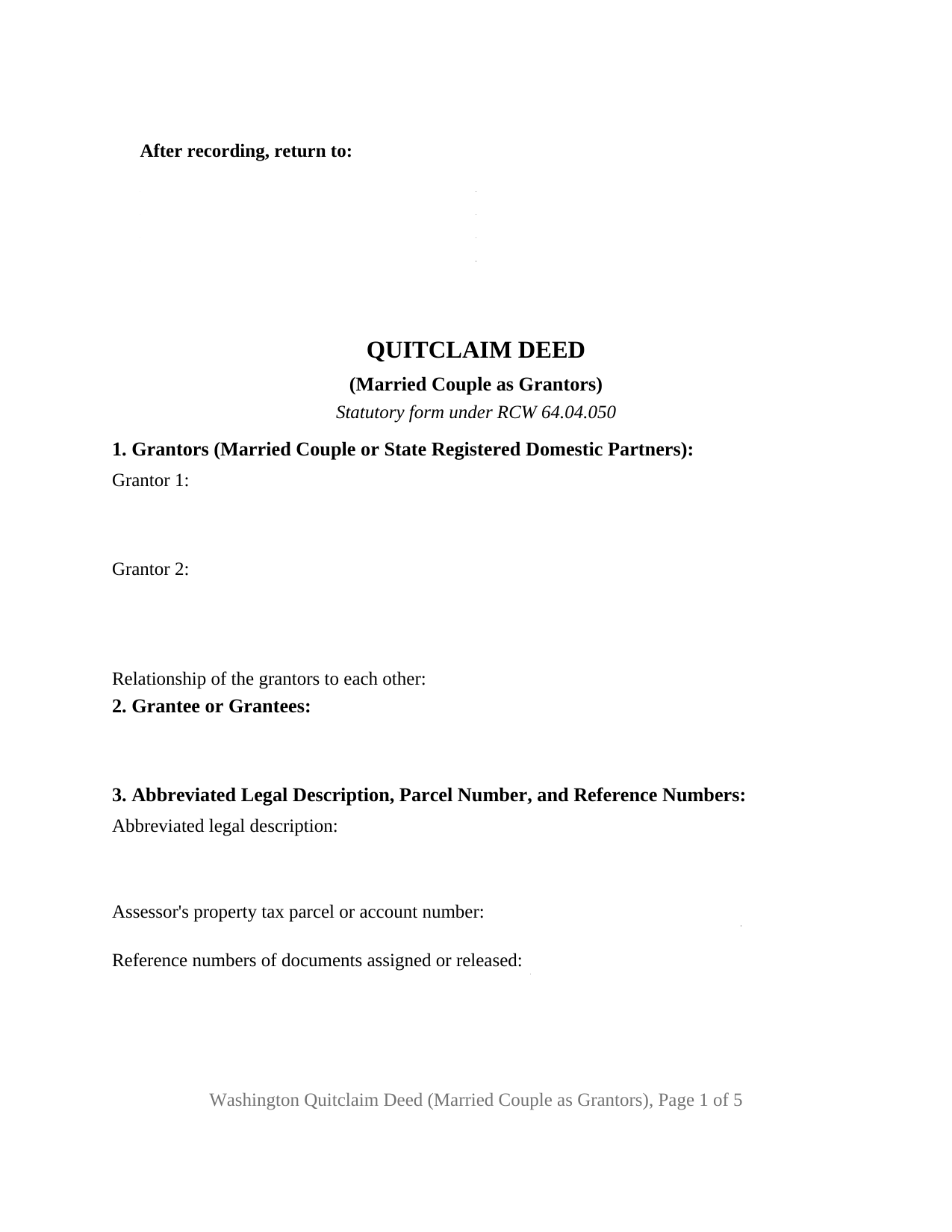
Washington asks something particular of a deed a married couple signs. Under RCW 26.16.030(3) one spouse or one state registered domestic partner cannot convey community real property alone: the other joins in executing the instrument, and both acknowledge it. This quitclaim deed is configured for that joinder. Section 1 names each grantor and states the relationship between them, and the conveyance section recites that both join in executing the deed and that each acknowledges it, so the instrument shows on its face why two signatures and two certificates appear.
One deed that reaches the whole community interest
A couple's deed reads as one act rather than two releases because of characterization. RCW 26.16.030 makes what a couple acquires after marriage or registration community property unless it is separate under RCW 26.16.010 or RCW 26.16.020, and neither spouse may devise more than half of it. A deed signed by both moves the entire community interest in one recording, with no half left behind for a will or a probate to sort out. Homestead property answers to a second rule, RCW 6.13.060, which reaches the conveyance whatever name record title carries.
What the form carries, and what it does not
The form recites exactly two grantors and describes them as married to each other or as state registered domestic partners of each other, with a blank for that relationship rather than preprinted boilerplate. Two signature lines with printed names and dates follow, each with its own certificate in the individual capacity short form of RCW 42.45.140(1), so the grantors may appear on different days. Washington does not make separate certificates a requirement, the statutory short forms naming the individuals in the plural; the paired layout is a drafting choice in this form. Community real property titled in both names or in one, and a homestead conveyed by a couple, present this configuration. A single owner conveying separate property, or the interspousal transfer RCW 26.16.050 authorizes, follows a one-signature pattern this form does not carry.
A family gift, and the statement that travels with it
Family transfers are where the configuration turns up most often in Washington land records: a couple deeding community real property to adult children, into a revocable living trust, or to an entity they own. Because the operative words are the statutory conveys and quitclaims of RCW 64.04.050, the grantees take the rights the couple holds on the date of the deed and nothing more, with no covenant or warranty and no reach to after-acquired title. A gift still meets the excise tax system: under WAC 458-61A-201 a real estate excise tax affidavit accompanies the deed, the gift exemption is claimed by code, and a completed Real Estate Excise Tax Supplemental Statement signed by grantor and grantee goes with it, both of them Department of Revenue forms obtained separately and not part of this package. Where the grantees take over payments on a mortgage, the same rule treats the debt relief as consideration.
How the grantees take, and what Washington no longer recognizes
RCW 64.28.020 makes an interest created in two or more people a tenancy in common unless the instrument expressly declares a joint tenancy under RCW 64.28.010, and where a couple takes as declared joint tenants, RCW 64.28.040 presumes community property while still passing it to the survivor. Two vestings are gone from Washington law: RCW 11.04.071 abolished survivorship as an incident of tenancy by the entirety, and RCW 11.04.060 abolished dower and curtesy, so no release of either belongs on a Washington deed.
At the recording counter
The treasurer sees the deed before the auditor does, because RCW 82.45.090 bars the auditor from accepting a taxable conveyance until the tax is verified as paid or not due. The auditor then indexes from the first page, built to RCW 65.04.045: a three inch recording band with the return name and address at the statutory top left, the title, the party names, an abbreviated legal description, the parcel number, and reference numbers of documents assigned or released. Statutory add-ons drive the cost: the RCW 36.22.185 covenant homeownership assessment and the RCW 36.22.250 surcharge.
This package includes the blank deed as a fillable PDF, one completed example prepared for a Snohomish County family gift, and a plain language guide to the blanks, the notarization, the excise tax affidavit, and recording. Many searchers spell the instrument as a quit claim deed. The materials describe Washington law in general terms and are not legal advice.
Important: County-Specific Forms
Our quitclaim deed (married couple as grantors) forms are specifically formatted for each of the 39 counties in Washington.
After selecting your county, you'll receive forms that meet all local recording requirements, ensuring your documents will be accepted without delays or rejection fees.