Washington Quitclaim Deed (Two Grantors)
County Specific Legal Forms Validated as recently as October 4, 2026 by our Forms Development Team
About the Washington Quitclaim Deed (Two Grantors)
How to Use This Form
- Select your county from the list
- Download the county-specific form
- Fill in the required information
- Have the document notarized if required
- Record with your county recorder's office
What Others Like You Are Saying
"Worked Great! First time go at the courthouse"
"I was skeptical when I first came upon this website. Not sure why I had such a negative feeling, but…"
"It was quick and easy to print and download the forms I needed."
"This makes it so easy and I'm so glad I found you. I visited two other sites before I found this one…"
"Deed.com is AMAZING! I only had about 2 weeks to get my quit claim deed recorded by my county office…"
4.8/5 from 4,828 reviews. Read all
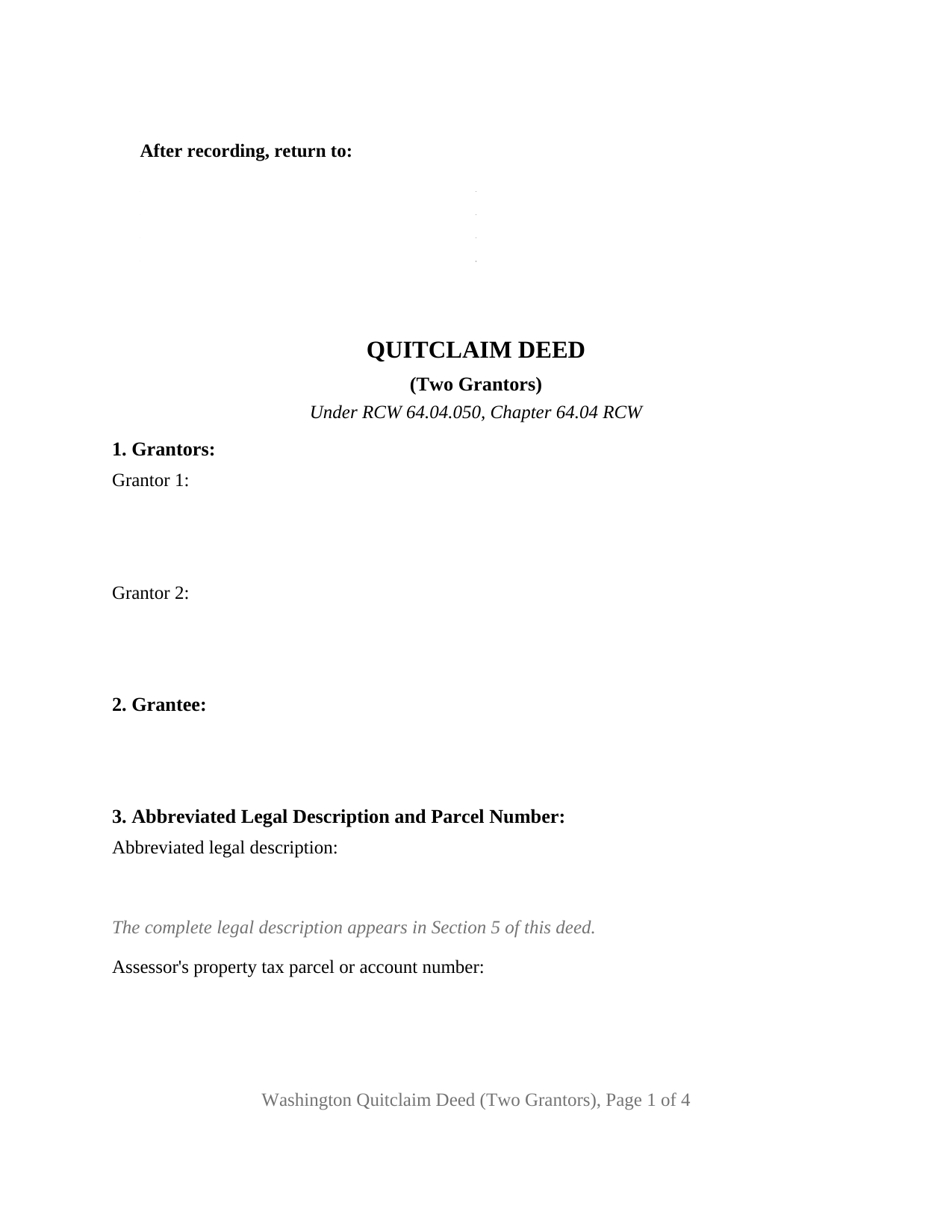
Two grantors sign this Washington quitclaim deed, and the form is built in pairs to match: two grantor entries in Section 1, two signature blocks headed GRANTOR 1 and GRANTOR 2, and two acknowledgment certificates in the individual capacity short form of RCW 42.45.140(1). It is the configuration that appears when two record owners release their interests in the same Washington real property through one instrument, on the quitclaim terms of RCW 64.04.050, without covenant or warranty of title.
One instrument where two co-owners each hold a share
Washington co-ownership runs on undivided interests. Under RCW 64.28.020 two people who take title in their own right hold as tenants in common unless the instrument declared a joint tenancy under RCW 64.28.010, and either way each owner holds a share that only that owner can convey. This deed names both owners as grantors and recites that the Grantors named in Section 1, and each of them, convey and quitclaim, so both shares pass in a single recording, under one auditor's file number, with one set of the per instrument charges of RCW 36.18.010, RCW 36.22.185, and RCW 36.22.250.
Two certificates, two notarizations
Each signature block is paired with its own acknowledgment certificate, so the two grantors may acknowledge on different dates, in different counties, or before different notarial officers, and the officer completing either finds a venue, date, and name entry dedicated to that signer. Washington law does not require separate certificates: the RCW 42.45.140 short forms are written in the plural, so one certificate may name both signers where they appear together, and the paired layout is how the form keeps a staggered signing from becoming a drafting problem. RCW 64.04.020 asks for a writing, the signature of the party bound, and an acknowledgment; no subscribing witness appears on a Washington deed.
A release measured at the moment of delivery
Because the operative words are the statutory conveys and quitclaims, the grantee takes all then existing legal and equitable rights of both grantors, and nothing more. Title a grantor acquires later stays with that grantor, since RCW 64.04.050 reaches after acquired title only when the deed adds words expressing that intention, and this form adds none. That measured scope is why the instrument, often searched as a quit claim deed, appears in record cleanup between people who know each other's positions: two heirs consolidating inherited fractional interests in one relative, or two co-owners ending a shared title without warranty exposure.
What the form recites, and what it does not
The form recites exactly two grantors, each identified in Section 1 by name and mailing address, and it recites no relationship between them: nothing in the deed states that the two are spouses, domestic partners, relatives, or strangers. The grantee entry in Section 2 is open to one grantee or two, with any vesting designation the grantees choose following their names. What the form is not set up as: a single grantor; an entity conveying through an officer or member in a stated capacity; a trustee, personal representative, or attorney in fact signing in a representative office; a separately labeled block for a joining party who is not a grantor; or three or more record owners in one instrument.
The path across the recording counter
A Washington deed package makes two stops. The deed and a real estate excise tax affidavit go first to the county treasurer, because RCW 82.45.090 bars the county auditor from accepting a taxable conveyance until the treasurer verifies the tax as paid or not due; WAC 458-61A-303 calls for the affidavit whether tax is owed or an exemption is claimed. The auditor then records the deed and returns it to the address printed in the upper left of the first page. The form arrives ready for that counter: letter size pages, a full 3 inch recording band, 12 point type over the 8 point floor of RCW 65.04.045, and a first page carrying the title, both grantor names, the grantee name, an abbreviated legal description keyed to the complete one, and the assessor's parcel number.
The package holds the blank two grantor quitclaim deed as a fillable PDF, a completed example filled in for a Spokane County conveyance by two grantors to one grantee, and a plain language guide covering every entry, both notarizations, the excise tax affidavit, and the recording steps. Searchers also reach it as a joint quitclaim deed. The materials describe Washington law in general terms and are not legal advice.
Important: County-Specific Forms
Our quitclaim deed (two grantors) forms are specifically formatted for each of the 39 counties in Washington.
After selecting your county, you'll receive forms that meet all local recording requirements, ensuring your documents will be accepted without delays or rejection fees.