Wisconsin Quitclaim Deed (Individual Grantor by Attorney-in-Fact)
County Specific Legal Forms Validated as recently as October 6, 2026 by our Forms Development Team
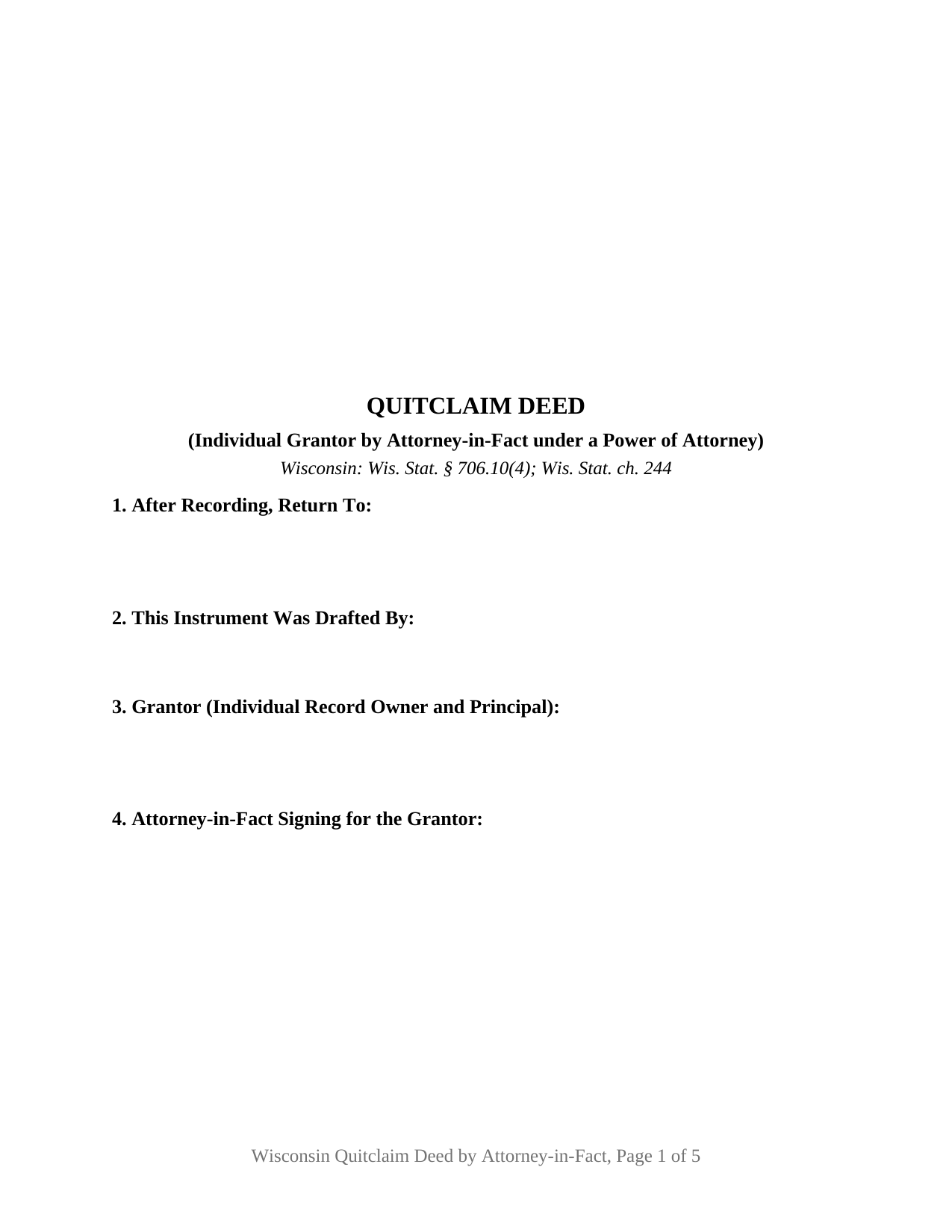
About the Wisconsin Quitclaim Deed (Individual Grantor by Attorney-in-Fact)
How to Use This Form
- Select your county from the list
- Download the county-specific form
- Fill in the required information
- Have the document notarized if required
- Record with your county recorder's office
What Others Like You Are Saying
"Quick and easy, but the 2MB file limit ended up causing some big headaches. Had I known the limit co…"
"Easy to use."
"Quick and easy download. Got everything I needed. I would recommend deeds.com"
"Information was very helpful and straight forward, Thankyou!"
"Very helpful! Unfortunately, they didn't have what I needed, but they got back to me quickly and did…"
4.8/5 from 4,828 reviews. Read all
Wisconsin's power of attorney statute names this deed inside the agent's toolkit: among the real property acts a general grant of authority carries, Wis. Stat. § 244.44(2) lists quit claim beside sell, exchange, convey, encumber, and partition. That is the instrument this form prepares: one individual record owner as grantor, one attorney-in-fact signing for that owner, no covenant of title.
What the deed can say about authority, and what it cannot
No instrument vouches for the authority behind its own signature. Wis. Stat. § 706.03(1m) reaches an agent's conveyance where the agent was expressly authorized and the principal is identified as such in the conveyance or in the signature or acknowledgment, and it leaves the burden of proof with whoever asserts the authority. The deed does the part a deed can do: Section 5 identifies the power of attorney by date, county, and document number, Section 11 states that the power is in force and unrevoked and that its real property authority reaches the § 244.44(2) quitclaim power, and the certificate carries the principal's name beside the signer's. The power of attorney itself, and the agent's certification under Wis. Stat. § 244.62, are furnished separately.
A recorded power, and a revocation that must be recorded too
That document number blank answers a recording rule: Wis. Stat. § 59.43(2s)(b)1 lets the register of deeds refuse a document referring to a previously recorded one that omits its document number. Recording the power carries weight of its own under Wis. Stat. § 706.08(7), where no act of the person who signed a recorded power to convey lands counts as a revocation unless the revoking instrument reaches the same office, a record that imports notice to everyone, the agent included.
Where Wisconsin draws the self-dealing line
Under Wis. Stat. § 244.41(2)(a), unless the power of attorney provides otherwise, an agent who is not a spouse or domestic partner of the principal may not exercise authority to create in the agent an interest in the principal's property, whether by gift, right of survivorship, beneficiary designation, or otherwise; paragraph (b) covers anyone the agent owes a legal obligation of support. Wisconsin's list is shorter than the uniform act's, which also spares an ancestor or descendant, so an adult child serving as agent sits inside the bar. Lucareli v. Lucareli, 2000 WI App 133, supplies the consequence: absent authority to exercise the power in the attorney-in-fact's own favor, a deed signed to the attorney-in-fact and others is void in its entirety under Wis. Stat. § 706.03(1m). Making a gift is its own express-grant item under § 244.41(1)(b).
What this configuration carries
Thirteen numbered sections carry the deed, opening with first page return information and the drafter statement of Wis. Stat. § 59.43(5)(a) and closing with the signatures. One signature block belongs to the attorney-in-fact, under a certificate in the representative capacity short form of Wis. Stat. § 140.16(2), whose blank takes the signer's name, the authority held, and the principal. A second, conditional block collects a spouse's signature where Wis. Stat. § 706.02(1)(f) reaches the conveyance. An owner who has moved into a care setting, an owner serving out of state on the closing date, and an owner who signed a durable power of attorney years earlier all present the pattern this deed recites, and customers search for it as a POA deed. It is not drawn for two record owners, co-agents acting together, an agent signing for an entity, a fiduciary holding title, or an owner able to sign personally.
No covenants, and two payments at the counter
Wis. Stat. § 706.10(4) keeps the promises out: the deed hands over the interest the grantor could lawfully convey and vouches for nothing about it, so a mortgage, easement, or lien of record survives it intact. The document fee is one number statewide, $30 under Wis. Stat. § 59.43(2)(ag)1. Wis. Stat. § 77.22(1) puts the transfer fee on the grantor, 30 cents per $100 of value, and Wis. Stat. § 706.05(12) sends the state's electronic transfer return along with the conveyance. An exemption names its § 77.25 subsection on the deed's face, on the line Section 8 provides.
Three files arrive in the download: the deed as a fillable PDF, a completed example filled in for a Sheboygan County conveyance signed by an agent under a recorded durable power of attorney, and a plain language guide to every blank, the execution rules, and recording. It states Wisconsin law generally, for information, and is not legal advice.
Important: County-Specific Forms
Our quitclaim deed (individual grantor by attorney-in-fact) forms are specifically formatted for each of the 72 counties in Wisconsin.
After selecting your county, you'll receive forms that meet all local recording requirements, ensuring your documents will be accepted without delays or rejection fees.