Wisconsin Quitclaim Deed (Married Couple as Grantors)
County Specific Legal Forms Validated as recently as October 6, 2026 by our Forms Development Team
About the Wisconsin Quitclaim Deed (Married Couple as Grantors)
How to Use This Form
- Select your county from the list
- Download the county-specific form
- Fill in the required information
- Have the document notarized if required
- Record with your county recorder's office
What Others Like You Are Saying
"I was skeptical when I first came upon this website. Not sure why I had such a negative feeling, but…"
"I believe you need more instruction on the use of the web site. I would type and nothing would appea…"
"Great examples on how to fill out the quitclaim deed, but no info on how to fill out the cover sheet…"
"Prompt and reliable service!!"
"Very helpful Got information and form I wanted."
4.8/5 from 4,828 reviews. Read all
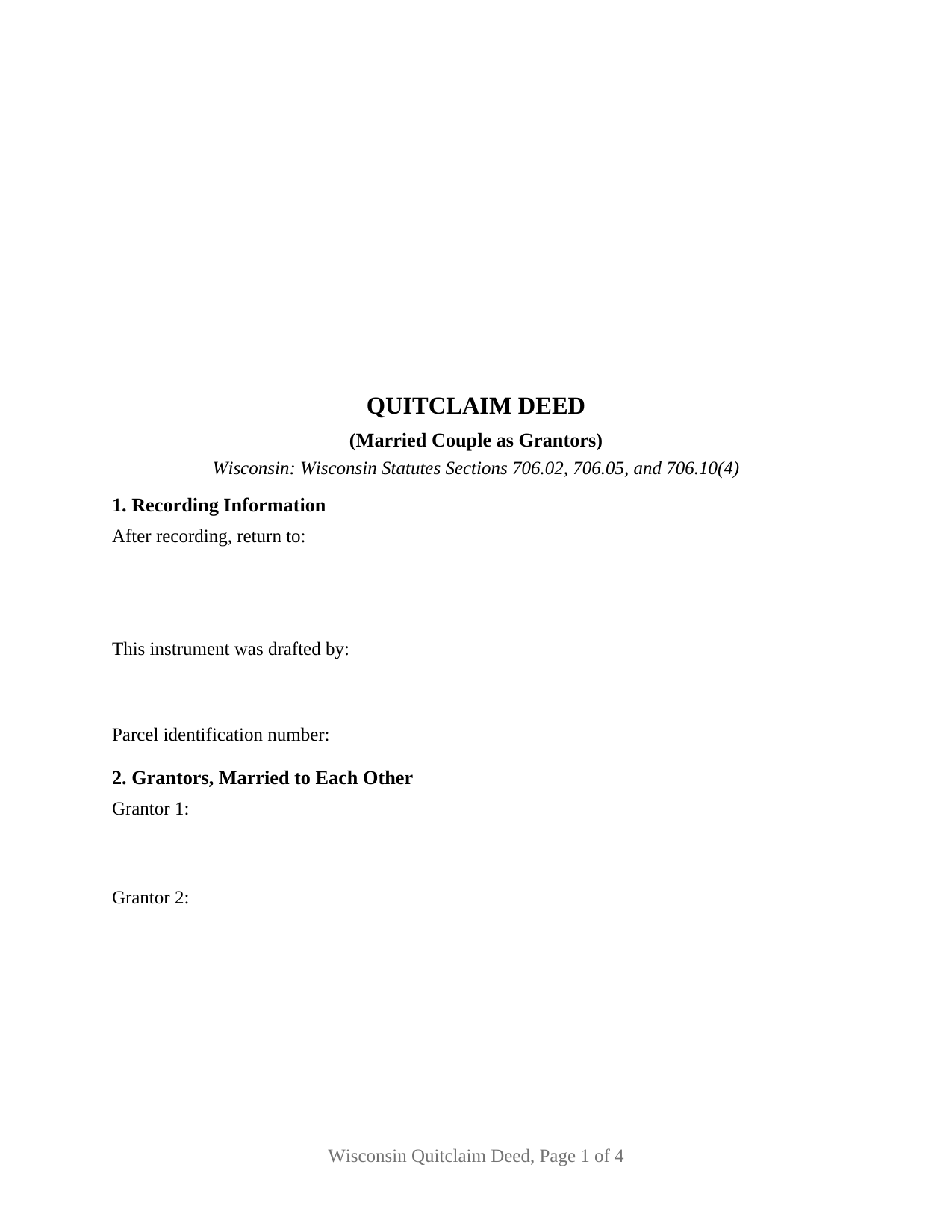
Both spouses sign here, and the deed says so on its face: the conveyance section of this quitclaim deed recites that each grantor is a spouse of the other and that each one signs, so a single recorded instrument carries the two signatures Wisconsin law looks for when married owners part with real estate. The form prepares that conveyance for a married couple as grantors, passing whatever interest the two of them hold, without warranty.
Two signatures, two separate Wisconsin rules
Wisconsin married owners answer to two rules that overlap without being the same rule. The first follows the title: under Wis. Stat. § 766.51(2), marital property held in the names of both spouses other than in the alternative is managed and controlled only by both spouses acting together. The second follows the property's use: under Wis. Stat. § 706.02(1)(f), a conveyance alienating any interest of a married person in a homestead is invalid without the signature or joinder of each spouse, and that rule reaches a spouse whose name never appears in the recorded chain, because Wis. Stat. § 766.31 gives each spouse a present undivided one-half interest in marital property regardless of what the vesting deed says.
Naming both spouses as grantors settles both rules in one place. There is no conditional joinder block on this form and nothing to leave blank at signing time: the grantor section takes two names and addresses, the signature section carries a block for each spouse, and a Wis. Stat. § 140.16(1) short form certificate follows each signature so the two acknowledgments can be taken on separate days or before separate notarial officers. The form is not set up for a single grantor, for three or more grantors, or for a grantor signing in a representative capacity, and it is not a deed by two people whose marriage has ended, since Wis. Stat. § 766.75 turns former marital property into a tenancy in common at dissolution.
Where the words survivorship marital property earn their keep
Retitling between the same two spouses is one of the patterns this deed carries most often in Wisconsin records, and the receiving side is where it happens. A marital property title form that lacks the words survivorship marital property creates no survivorship: Wis. Stat. § 766.60(5)(a) says so in terms, and Wis. Stat. § 766.605 reaches only a homestead acquired after the determination date and held by the spouses alone. A deed from both spouses back to both spouses that states those words is what puts the first death outside probate by operation of the title, whatever the earlier deed said, and the completed example in this package does exactly that for a Green Bay homestead in Brown County. The co-ownership line under the grantee names holds whatever recognized form the grantees state, from a tenancy in common to joint tenancy to the survivorship marital property designation, and the guide describes each one with the language that creates it.
An exemption that spouses claim, and a return they still file
A deed between spouses pays no Wisconsin real estate transfer fee. Exemption 8m of Wis. Stat. § 77.25, the exemption for a conveyance between spouses, is the subsection such a deed names, and Wis. Stat. § 77.22(1) is what makes the naming a recording condition: where a transfer is not subject to the fee, the reason is stated on the face of the conveyance by reference to the proper subsection, and section 5 of this form is that labeled line. The electronic transfer return still goes in, since Wis. Stat. § 77.255 releases only a short list of exemption classes from the return, and 8m is not one of them. The register of deeds collects the flat $30 document fee set by Wis. Stat. § 59.43(2)(ag)1.
What the deed does not promise
Under Wis. Stat. § 706.10(4) the instrument moves the grantors' lawful interest and makes no representation about the size or soundness of it, so mortgages, easements, and liens of record survive the transfer untouched. The document is drawn to the Wis. Stat. § 59.43(2m) standard format, with the upper right recording square left blank, the return address and drafter statement on page one, and a parcel identification number line for counties that use one.
The download includes the fillable quitclaim deed, the completed Brown County example, and a plain language guide to every blank, the signing rules, and the recording steps. The materials are informational and are not legal advice.
Important: County-Specific Forms
Our quitclaim deed (married couple as grantors) forms are specifically formatted for each of the 72 counties in Wisconsin.
After selecting your county, you'll receive forms that meet all local recording requirements, ensuring your documents will be accepted without delays or rejection fees.