Wisconsin Quitclaim Deed (Trustee Grantee)
County Specific Legal Forms Validated as recently as October 6, 2026 by our Forms Development Team
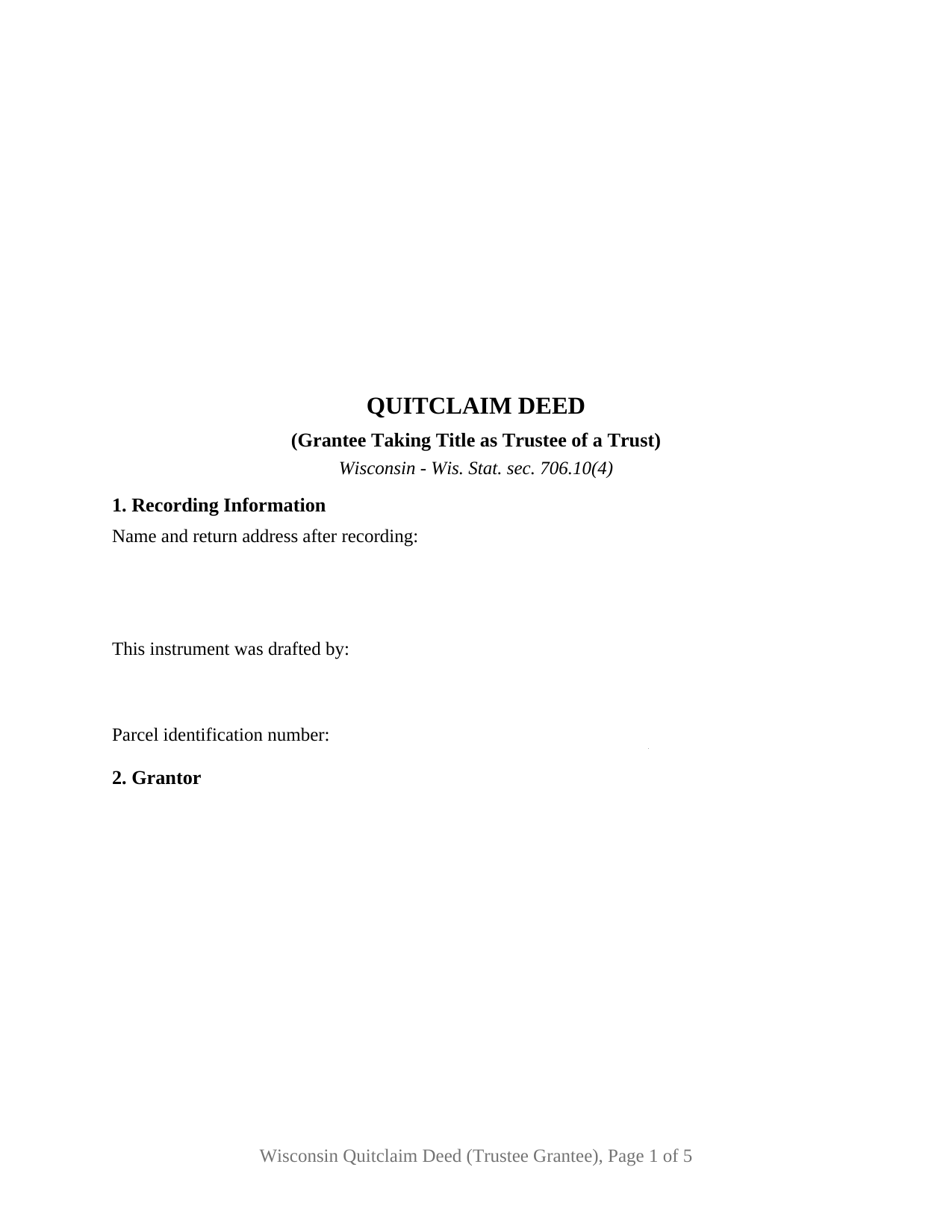
About the Wisconsin Quitclaim Deed (Trustee Grantee)
How to Use This Form
- Select your county from the list
- Download the county-specific form
- Fill in the required information
- Have the document notarized if required
- Record with your county recorder's office
What Others Like You Are Saying
"I needed more knowledge to feel comfortable for using this form. I am sure it will work great for so…"
"Worked well with clear guide!"
"very convenient and quick access"
"In a subject that is overbearing, this site made it simple and understandable, all was explained wel…"
"I often think I am smarter than I am. Thankfully there are people that know what they are doing so I…"
4.8/5 from 4,829 reviews. Read all
The grantee line on this deed names a person and a capacity, because a Wisconsin trust holds no title of its own. Chapter 701 puts trust property in the hands of the trustee, so the instrument that funds a trust with real estate runs to the trustee, identifies the trust behind that trustee, and says on its face that the grantee takes as trustee rather than personally. This form prepares that conveyance under Wis. Stat. § 706.10(4), with one individual grantor and no warranty of title.
Naming the trustee, the trust, and the date
Section 3 gathers four entries: the trustee named as trustee, the name of the trust, the date of the trust instrument, and a mailing address for the grantee. Wis. Stat. § 701.0816 lists the specific powers of a trustee, among them collecting trust property and accepting additions to the trust property from a settlor or any other person, the power a funding conveyance meets on the receiving end. Section 8 then puts the capacity into the deed's own text: title vests in the grantee as trustee and not individually, and it passes to the successor trustees of the named trust under the terms of that trust. A reader of the record years later finds that sentence beside the grantee's name.
What the deed leaves to the certification of trust
The trust's terms stay out of the deed. Wisconsin's certification of trust under Wis. Stat. § 701.1013 is what a title company, lender, or counterparty reads instead: it recites that the trust exists and the date its instrument was executed, the settlor and the acting trustee, whether the trust is revocable and who may revoke it, the authority of cotrustees, and the manner in which title to trust property may be taken. A person who acts in reliance on a certification without knowledge that its representations are incorrect is protected under § 701.1013(6). A certification of trust is signed by a trustee and furnished separately; it is not part of this package.
Exemption 16, and the return filed anyway
Funding a trust usually costs no transfer fee in Wisconsin. Wis. Stat. § 77.25(16) covers a conveyance to a trust where a transfer from the grantor straight to the beneficiary of that trust would itself be exempt, so the question runs through who the beneficiaries are, reaching the spouse exemption at § 77.25(8m) or the family exemption at § 77.25(8). Section 6 of the form is the printed exemption sentence with the subsection left open, because § 77.22(1) makes the stated reason a condition of recording an exempt conveyance. The electronic transfer return is filed regardless: § 77.255 excuses only conveyances exempt under § 77.25(1) or (10m), and a trust conveyance is in neither class. The register of deeds collects the flat $30 document charge set by § 59.43(2)(ag)1.
One grantor signs, and Wisconsin sometimes wants a second name
The grantor side is deliberately narrow: one individual, signing personally, with a marital status entry in Section 9 and a named spouse who joins in Section 11. That joinder answers Wis. Stat. § 706.02(1)(f), which invalidates a conveyance alienating a married person's homestead interest without the signature or joinder of each spouse, and a trustee stands outside the interspousal carve-out in that paragraph. Two short form certificates under Wis. Stat. § 140.16(1) follow the signatures, so the signers may appear before different notarial officers on different days. A settlor moving a homestead into a revocable living trust, an owner adding a rental parcel to a trust funded with other assets, and a relative releasing a fractional interest into a family trust all present the pattern this deed recites. The form is not set up for two grantors, for cotrustees named together on the grantee side, for a corporate or limited liability company grantor, or for a conveyance running the other direction, out of a trust to a beneficiary or a buyer, which is a different instrument entirely. Customers search for it as a quit claim deed to a trust, a deed transferring property into a trust, or a trust funding deed.
The download holds three files: the fillable trustee grantee quitclaim deed, a completed example filled in for an Outagamie County funding transfer with a joining spouse, and a plain language guide to every blank, the signing rules, and the recording package. These materials describe Wisconsin law in general terms, for information only, and are not legal advice.
Important: County-Specific Forms
Our quitclaim deed (trustee grantee) forms are specifically formatted for each of the 72 counties in Wisconsin.
After selecting your county, you'll receive forms that meet all local recording requirements, ensuring your documents will be accepted without delays or rejection fees.