Wisconsin Quitclaim Deed (Trustee Grantor)
County Specific Legal Forms Validated as recently as October 6, 2026 by our Forms Development Team
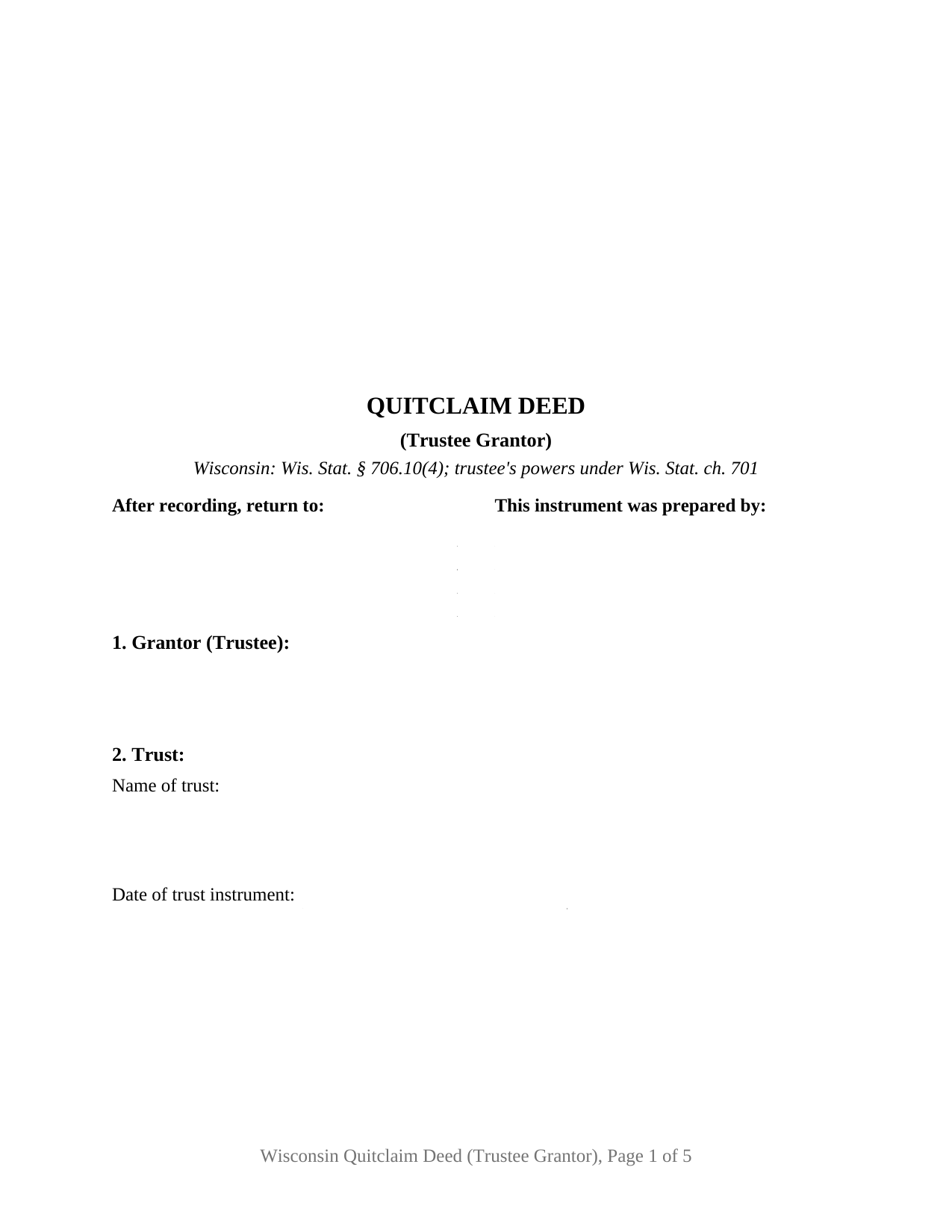
About the Wisconsin Quitclaim Deed (Trustee Grantor)
How to Use This Form
- Select your county from the list
- Download the county-specific form
- Fill in the required information
- Have the document notarized if required
- Record with your county recorder's office
What Others Like You Are Saying
"This is the first time I use this site, and it was very easy and user friendly. I was able to fill o…"
"The website is easy to navigate. Unfortunately, you were not able to record the deed. However, I app…"
"Very helpful and very quick to respond. Thank you!"
"Thank you so much for making this process seemless. We are very pleased with the service."
"This was perfect for providing the necessary forms. Easy to enter needed information. I would recomm…"
4.8/5 from 4,828 reviews. Read all
A Wisconsin trustee cannot hand out title covenants, and one line of the Trust Code says so: under Wis. Stat. § 701.0815(3) a trustee has no power to give warranties in a sale, mortgage, or lease that are binding on the trustee personally. This form prepares the deed that fits inside that rule: a Wisconsin quitclaim deed signed by a trustee conveying trust real estate, with the fiduciary capacity stated in the instrument and no warranty of title.
A deed on its way out of a trust
Legal title to trust real estate sits with the trustee, so the deed carrying it out is signed by the trustee, names the trust behind that signature, and recites that the grantor acts as trustee and not individually. Wis. Stat. § 701.0815(1)(b)1 gives a trustee an owner's powers over trust property, and § 701.0816(2) names the power to sell it at public or private sale. The conveyance runs on Wis. Stat. § 706.10(4), under which a quitclaim deed passes the interest the grantor could lawfully convey and neither warrants nor implies the existence, quantity, or quality of that interest. The instrument is searched for as a trustee quitclaim deed, a quit claim deed from a trust, or a deed out of a living trust.
Capacity that is disclosed rather than assumed
Section 11's capacity language does statutory work. Wis. Stat. § 701.1010(1) provides that a trustee is not personally liable on a contract properly entered into in the trustee's fiduciary capacity if the trustee in the contract disclosed that capacity, so the printed disclosure does more than describe the signer. The acknowledgment follows the same logic into chapter 140, where Wis. Stat. § 140.16(2) supplies the representative capacity short form: the officer certifies that a named individual acknowledged the record as the stated type of authority, such as trustee, of the party on whose behalf it was executed. The trust's own terms stay out of the deed and reach a title company through a certification of trust under Wis. Stat. § 701.1013, which a trustee signs separately and is not included here.
What this configuration carries
The form recites one trustee as grantor, the trust identified by name and by the date of its instrument, a grantee section closing with a co-ownership designation line, a transfer fee line, and a conditional homestead block for a spouse joining under Wis. Stat. § 706.02(1)(f). The trustee signs one block under a certificate whose name line takes the representative capacity; a conditional second block and certificate serve a joining spouse. A successor trustee distributing a residence to the beneficiary entitled to it, a trustee releasing a parcel back out of a revocable trust during the settlor's life, and a trustee moving a rental parcel into another trust all present the pattern this deed recites. The configuration is not drawn for cotrustees who act together, for a corporate trustee signing through an officer, for a personal representative or a guardian, or for a conveyance carrying the warranty covenants of Wis. Stat. § 706.10(5).
Exemption 9, and the money at the counter
A conveyance from a trustee to a beneficiary without actual consideration escapes the Wisconsin real estate transfer fee under Wis. Stat. § 77.25(9), and Section 5 is the labeled line naming that subsection, which Wis. Stat. § 77.22(1) makes a condition of recording. A sale out of a trust pays 30 cents for each $100 of value instead. The electronic transfer return travels with the deed either way, because § 77.255 releases only conveyances exempt under § 77.25(1) or (10m) from filing one. The register of deeds collects $30 under Wis. Stat. § 59.43(2)(ag)1.
Format, and what the record protects
The instrument is drawn to the standard format of Wis. Stat. § 59.43(2m): the upper right three inch square of page one blank for the register, the document name and return information high on that page, the drafter statement of § 59.43(5)(a), and a parcel number line for counties that require one. Format failure brings refusal rather than a surcharge, and priority then follows the record under the race notice rule of § 706.08(1)(a).
The download holds three files: this quitclaim deed as a fillable PDF, a completed example filled in for a La Crosse County distribution from a successor trustee to a trust beneficiary, and a plain language guide covering every blank, the execution rules, and the recording package. The material describes Wisconsin law in general terms for information and is not legal advice.
Important: County-Specific Forms
Our quitclaim deed (trustee grantor) forms are specifically formatted for each of the 72 counties in Wisconsin.
After selecting your county, you'll receive forms that meet all local recording requirements, ensuring your documents will be accepted without delays or rejection fees.