Wisconsin Quitclaim Deed (Corporation Grantor)
County Specific Legal Forms Validated as recently as October 6, 2026 by our Forms Development Team
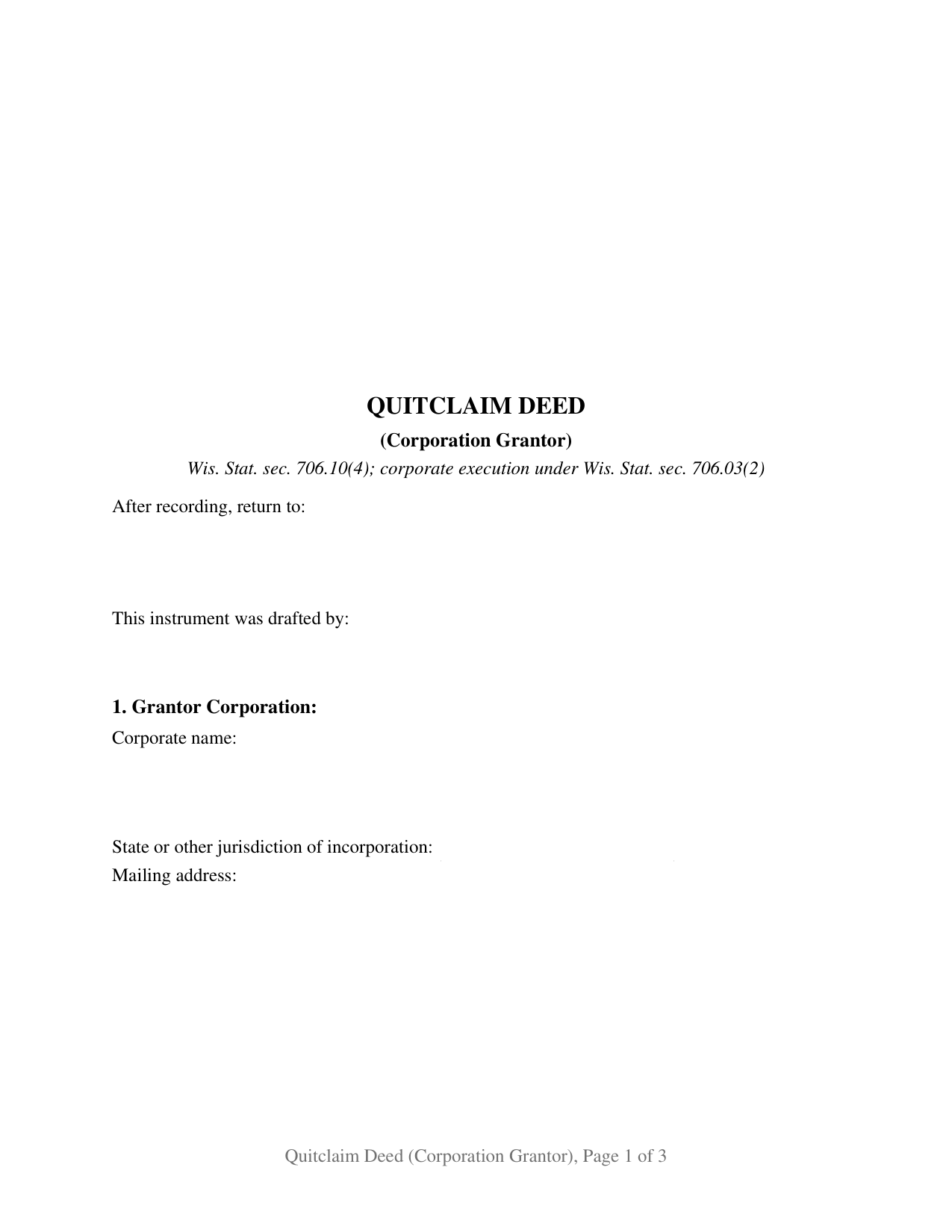
About the Wisconsin Quitclaim Deed (Corporation Grantor)
How to Use This Form
- Select your county from the list
- Download the county-specific form
- Fill in the required information
- Have the document notarized if required
- Record with your county recorder's office
What Others Like You Are Saying
"Great product. They processed and transmitted the deed promptly. A small question I had was answered…"
"very simple and complete"
"Received the forms I ordered, found them to be easy to complete with the guide and example that was …"
"I was very pleased with the document I downloaded. I was able to edit it easily and save a copy both…"
"Great product. It would be better if the document files were not embedded within other files. It mad…"
4.8/5 from 4,828 reviews. Read all
Wisconsin answers the who-signs question for a corporation in a single sentence. Under Wis. Stat. § 706.03(2), unless a recorded authorization or the articles say otherwise, any one officer of a private corporation may sign conveyances in the corporate name, and the absence of a corporate seal invalidates nothing. This form prepares that instrument: one corporation as grantor, one officer signing in a stated office, no covenant of title.
One officer, one signature line
That default has three edges. It reaches a private corporation, not the public bodies defined in Wis. Stat. § 706.03(1)(b). It gives the signing power to an officer singly, so no attesting secretary and no second signature belong on the page. And it yields to two documents: the articles of incorporation, and a board resolution adopted, certified, and recorded with the register of deeds of the county where the deed will be recorded, which Wis. Stat. § 706.03(3) uses to authorize signers by name or title, generally or with stated limits.
Where the deed stops and the corporate record starts
An instrument cannot prove its own authority. Wis. Stat. § 706.03(1m) leaves the burden of proving an agent's authority on whoever asserts it, and Wyss v. Albee, 193 Wis. 2d 101 (1995), draws the line between an entity statute's own agency provisions and that general rule. What a deed can do is identify its principal, which the statute accepts in the deed's text or in the signature and acknowledgment; this deed does both.
The vote behind the deed
Chapter 180 governs what the corporation settled first. A disposition inside Wis. Stat. § 180.1201, which covers regular-course sales, mortgages, and transfers to a subsidiary, needs no shareholder approval unless the articles call for it. All or substantially all of the corporate property is the other case: Wis. Stat. § 180.1202 puts a disposition outside the usual and regular course of business to a board resolution plus a shareholder vote, on 20 days notice and a majority of all votes entitled to be cast, and Wis. Stat. § 180.1813(2)(a) raises that to two thirds of each class for a statutory close corporation. None of that paperwork is recorded with the deed or included here.
What this configuration carries
The form recites one grantor corporation by name, jurisdiction, and address; a grantee section closing with a co-ownership designation line; consideration and transfer fee lines; the corporate authority section, which takes the signer's office and any recorded resolution; one signature block; and one certificate in the representative capacity short form of Wis. Stat. § 140.16(2), naming the individual, the authority held, and the entity behind it. No spousal joinder block and no marital property line appear, because the homestead signature rule of Wis. Stat. § 706.02(1)(f) reaches a married person's interest, not title standing in a corporate name. A corporation deeding a parcel to its shareholders, one releasing a fractional interest to clear a chain of title, and one moving real estate to an affiliate all present the pattern this deed recites. Searched as a corporate quitclaim deed or a quit claim deed from a corporation, it is not drawn for two grantor corporations, an individual grantor, a limited liability company, a trustee, or a public body.
Exemption 15 and its three year clock
Wisconsin writes its transfer fee exemptions entity by entity, and the corporate one carries a waiting period. Wis. Stat. § 77.25(15) reaches a conveyance between a corporation and its shareholders where all the stock is held by persons related as spouses, lineal ascendants or descendants, siblings, or spouses of siblings, where the only consideration is assumed debt or stock, and where the corporation has owned the property for at least 3 years. Under Wis. Stat. § 77.25(9), Gottfried, Inc. v. DOR, 145 Wis. 2d 715 (Ct. App. 1988), treats corporate stock as actual consideration. Whichever subsection is claimed goes on the face of the deed, as Wis. Stat. § 77.22(1) directs, and Section 5 is that line. A taxable conveyance pays 30 cents for each $100 of value, the electronic transfer return travels with the deed either way, and the register of deeds charges $30.
The download contains the fillable corporate quitclaim deed, a completed example filled in for a Winnebago County conveyance from a family contracting corporation to its two shareholders, and a plain language guide covering each blank, the signing and notarial rules, and what reaches the register of deeds. It describes Wisconsin law in general terms for information and is not legal advice.
Important: County-Specific Forms
Our quitclaim deed (corporation grantor) forms are specifically formatted for each of the 72 counties in Wisconsin.
After selecting your county, you'll receive forms that meet all local recording requirements, ensuring your documents will be accepted without delays or rejection fees.