Wisconsin Quitclaim Deed (Two Grantors)
County Specific Legal Forms Validated as recently as October 6, 2026 by our Forms Development Team
About the Wisconsin Quitclaim Deed (Two Grantors)
How to Use This Form
- Select your county from the list
- Download the county-specific form
- Fill in the required information
- Have the document notarized if required
- Record with your county recorder's office
What Others Like You Are Saying
"I was glad that I paid to get a copy of the gift deed it help me out a lot and the copy of the examp…"
"Excellent source for obtaining documents and instructions."
"It was so quick and easy to access.. Thank you!!"
"Accurate information and easy to use website."
"It is easy to use but difficult to know when the document has been reviewed for recording and when t…"
4.8/5 from 4,828 reviews. Read all
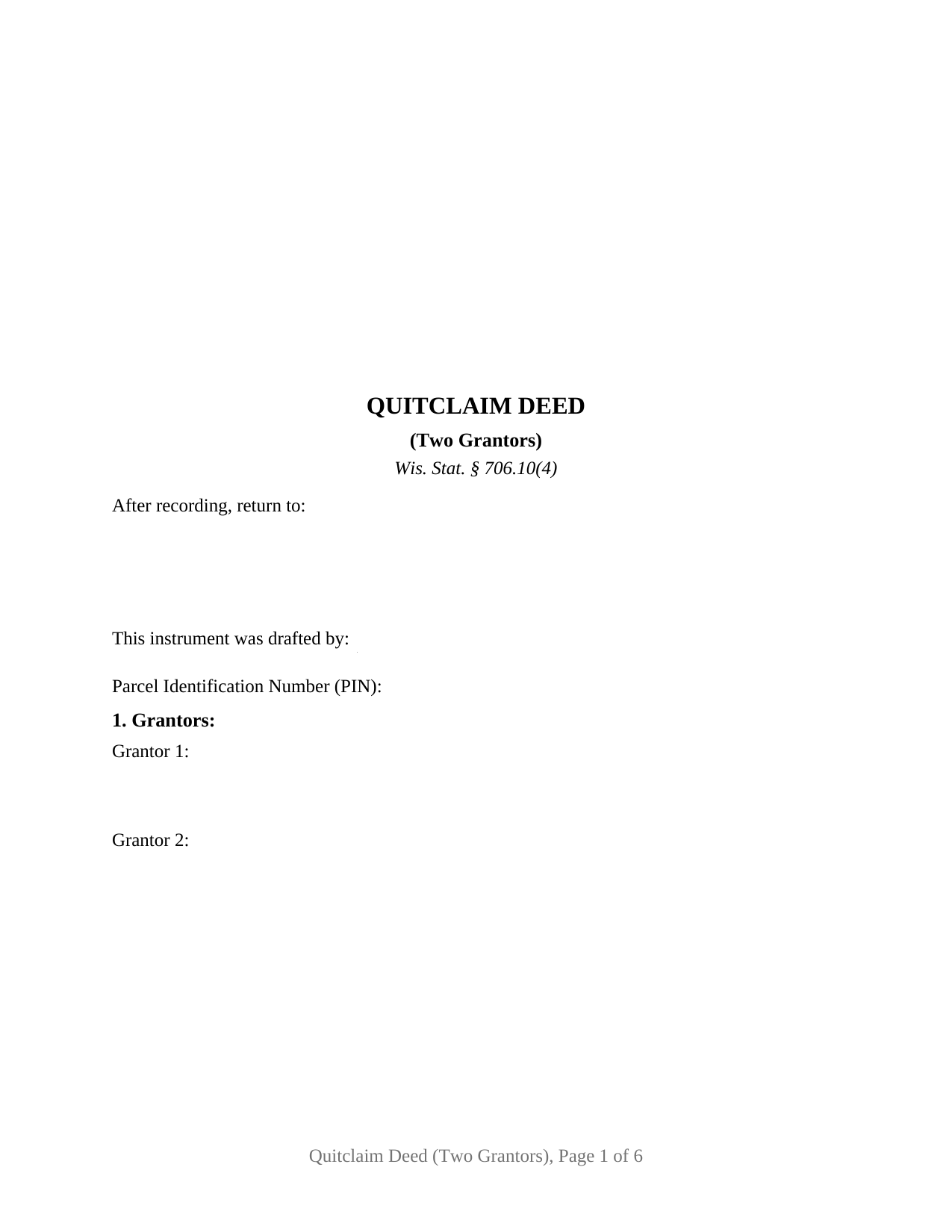
A Wisconsin quitclaim deed configured for two grantors puts both record owners into one instrument: two grantor blocks, two personal signature lines, and an acknowledgment certificate for each signer, so one recorded document moves both interests to the grantee at the same time. This form prepares that two grantor conveyance of Wisconsin real estate, each owner passing whatever interest that owner holds, without warranty.
Two grantors, one recorded conveyance
The form recites exactly two grantors of record, each an individual signing personally. Two heirs passing inherited fractional interests to a single relative, co-owners consolidating scattered interests after an estate settles, and two unmarried co-owners who bought a parcel together and now part with it together present the pattern this deed recites. The grantee side stays flexible: a single grantee takes the interest the two grantors held, and two or more grantees may state a recognized Wisconsin co-ownership form, such as joint tenancy or survivorship marital property, following their names in the grantee section.
The deed is not set up as a sole owner conveyance, an entity or trustee deed, or an instrument for three or more grantors; each of those carries a different execution pattern than the two personal signatures here. Below the grantor signatures sit two conditional spousal joinder blocks, one for each grantor, tied to the homestead signature rule described below; a block that does not apply remains blank.
A conveyance without warranty
Wis. Stat. § 706.10(4) supplies the quitclaim effect: each grantor's lawful interest passes to the grantee, and the deed neither warrants nor implies that any interest exists. Customers reach the instrument under both spellings, quitclaim deed and quit claim deed, and Wisconsin treats them as the same instrument.
Priority runs on recording order. Under the race notice rule of Wis. Stat. § 706.08(1)(a), a conveyance left unrecorded loses to a later good faith purchase for value that reaches the record first, so a two grantor deed ordinarily travels to the register of deeds promptly after the second signature.
Two joinder blocks and four certificates
Two grantors can be married to two different people, and that is what makes this deed's execution section longer than its signature count suggests. Wis. Stat. § 706.02(1)(f) makes a conveyance alienating a married person's homestead interest invalid without each spouse's signature or joinder, apart from conveyances directly between spouses, and it asks that question of each grantor separately. So below the two grantor signature blocks sit two conditional joinder blocks, one matched to each grantor, and the operative section confines a joining spouse's signature to the homestead interest, with no other grant or covenant. A dedicated acknowledgment certificate in the Wis. Stat. § 140.16(1) short form sits under each of the four possible signatures, so four people may appear before four different notarial officers on four different days. A block whose grantor is unmarried, or whose grantor's spouse is the other grantor, stays blank, as does its certificate.
Wisconsin's marital property system under ch. 766 sits behind that arrangement: each spouse holds a present undivided one half interest in marital property, and Wis. Stat. § 766.51(8) keeps the homestead signature rule standing apart from that chapter's title based management rules.
The recording package in Wisconsin
Recording carries a flat $30 charge for the deed itself, set statewide by Wis. Stat. § 59.43(2)(ag)1, and a real estate transfer fee that falls on the grantors at 30 cents per $100 of value through the state's electronic transfer return, the eRETR. A qualifying family conveyance for no consideration claims its exemption on the deed's face by subsection reference to Wis. Stat. § 77.25, on the labeled line the form provides; nearly every exempt conveyance still files the return, since Wis. Stat. § 77.255 excuses only two narrow exemption classes from the eRETR itself.
The document is drawn to the standard format of Wis. Stat. § 59.43(2m), with the blank three inch square recording area at the first page's upper right corner, return information and the drafter statement on the first page, and a parcel number line for counties that require one.
What the purchase delivers
The download delivers the two grantor quitclaim deed as a fillable PDF, a completed example filled in for a Waukesha County transfer from two parents to their daughter, and a plain language guide to each blank, the signing and notarization rules, and the recording steps. The materials describe Wisconsin statutes in general terms; they are informational only and are not legal advice.
Important: County-Specific Forms
Our quitclaim deed (two grantors) forms are specifically formatted for each of the 72 counties in Wisconsin.
After selecting your county, you'll receive forms that meet all local recording requirements, ensuring your documents will be accepted without delays or rejection fees.