Coconino County Assignment of Deed of Trust Form
Last validated September 2, 2026 by our Forms Development TeamFormatted for recording in Coconino County, for property anywhere in the county: rural and unincorporated areas as well as Bellemont, Cameron, Flagstaff, Forest Lakes, Fredonia, Grand Canyon, Gray Mountain, Happy Jack and 13 more.
- 6 documents included
- Immediate PDF download
- Formatting guarantee
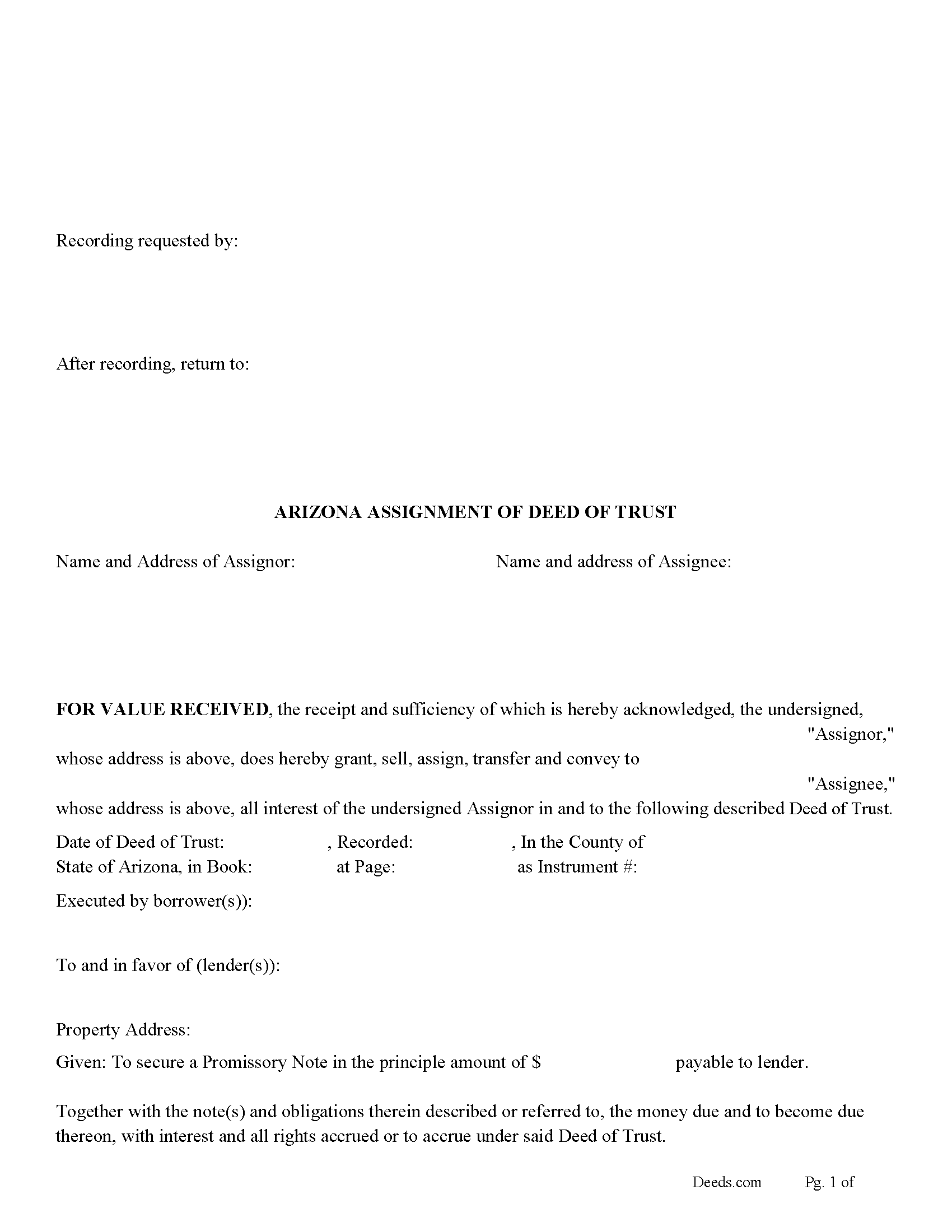
Coconino County Assignment of Deed of Trust Form
Fill in the blank form formatted to comply with all recording and content requirements.
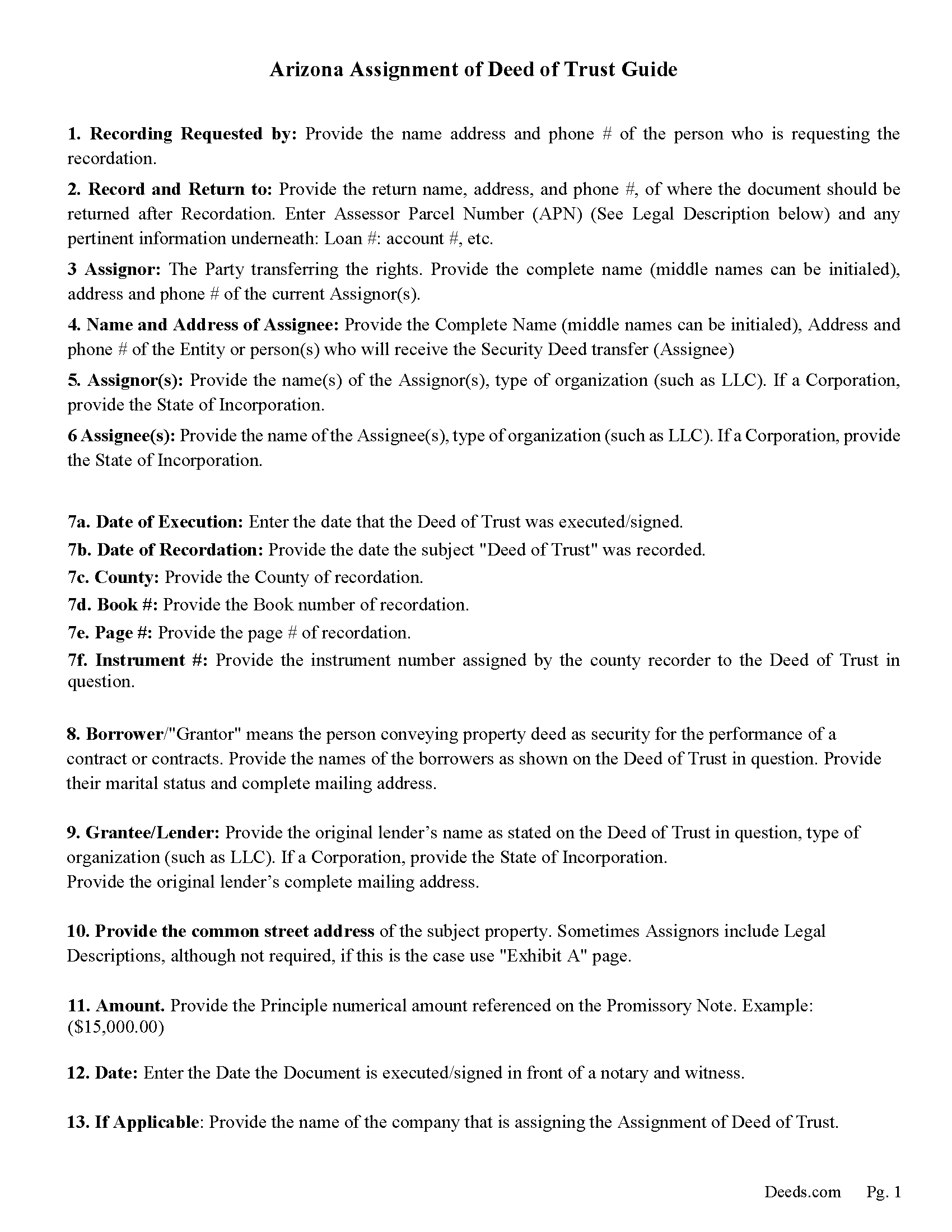
Coconino County Guidelines for Assignment of Deed of Trust
Line by line guide explaining every blank on the form.
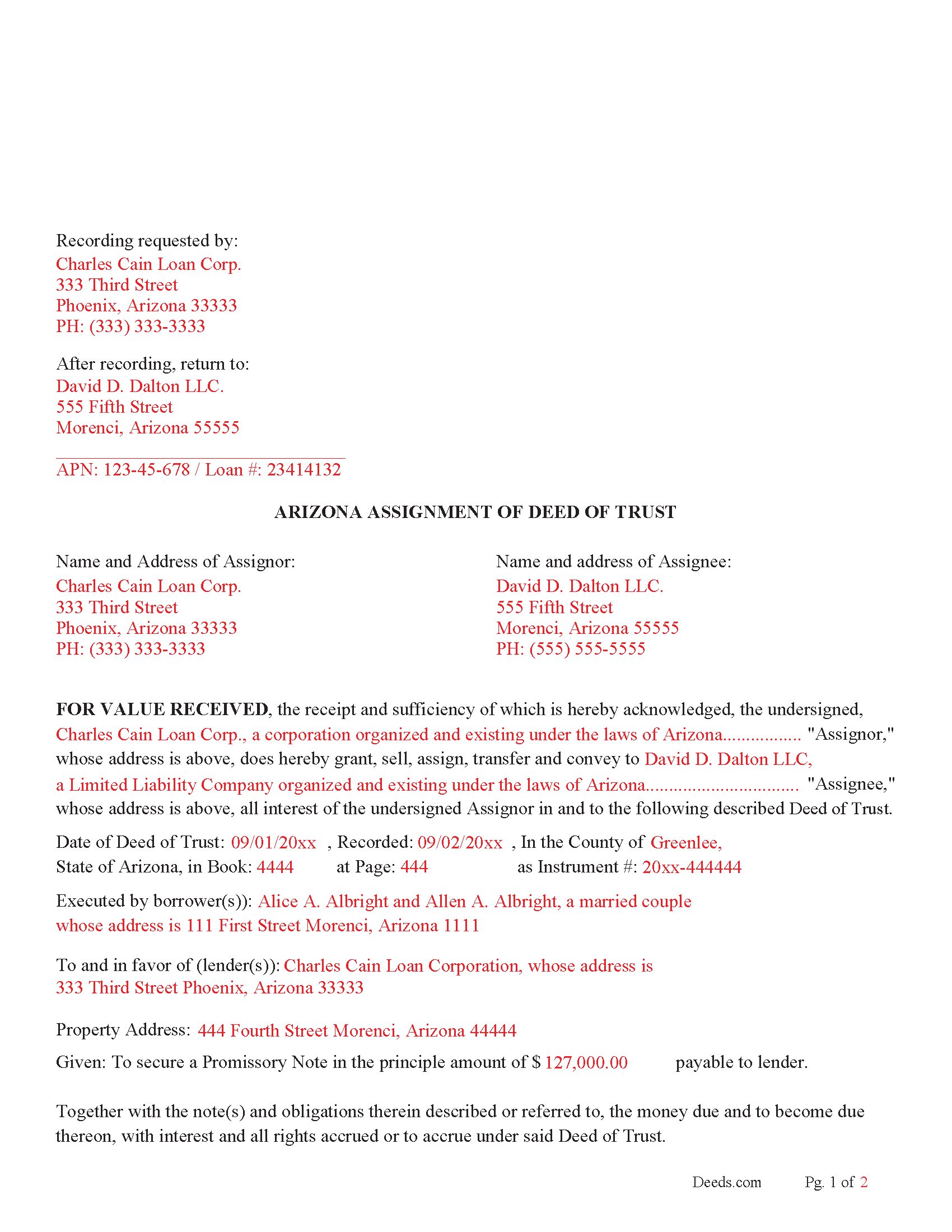
Coconino County Completed Example of the Assignment of Deed of Trust Document
Example of a properly completed form for reference.
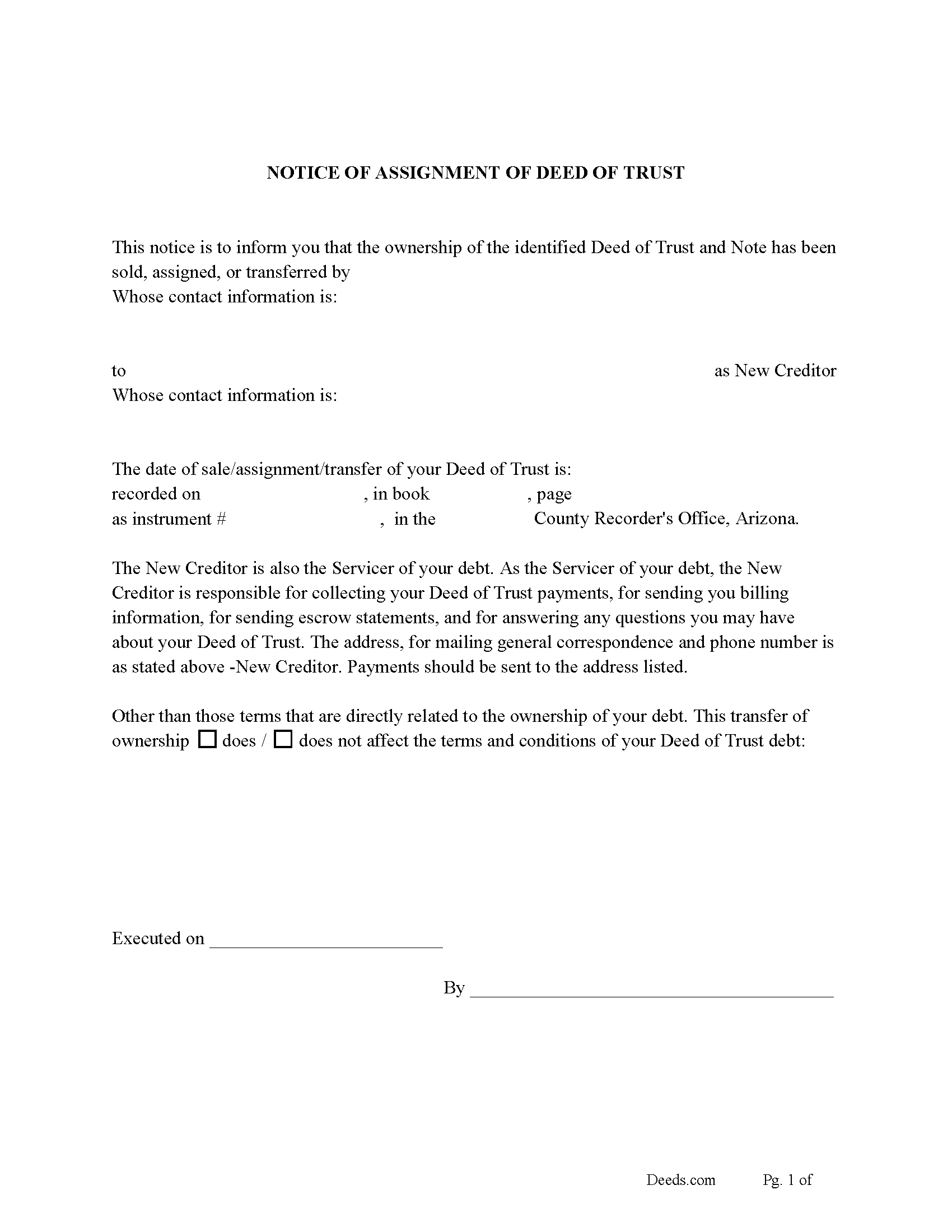
Coconino County Notice of Assignment of Deed of Trust Form
Fill in the blank form formatted to comply with content requirements.
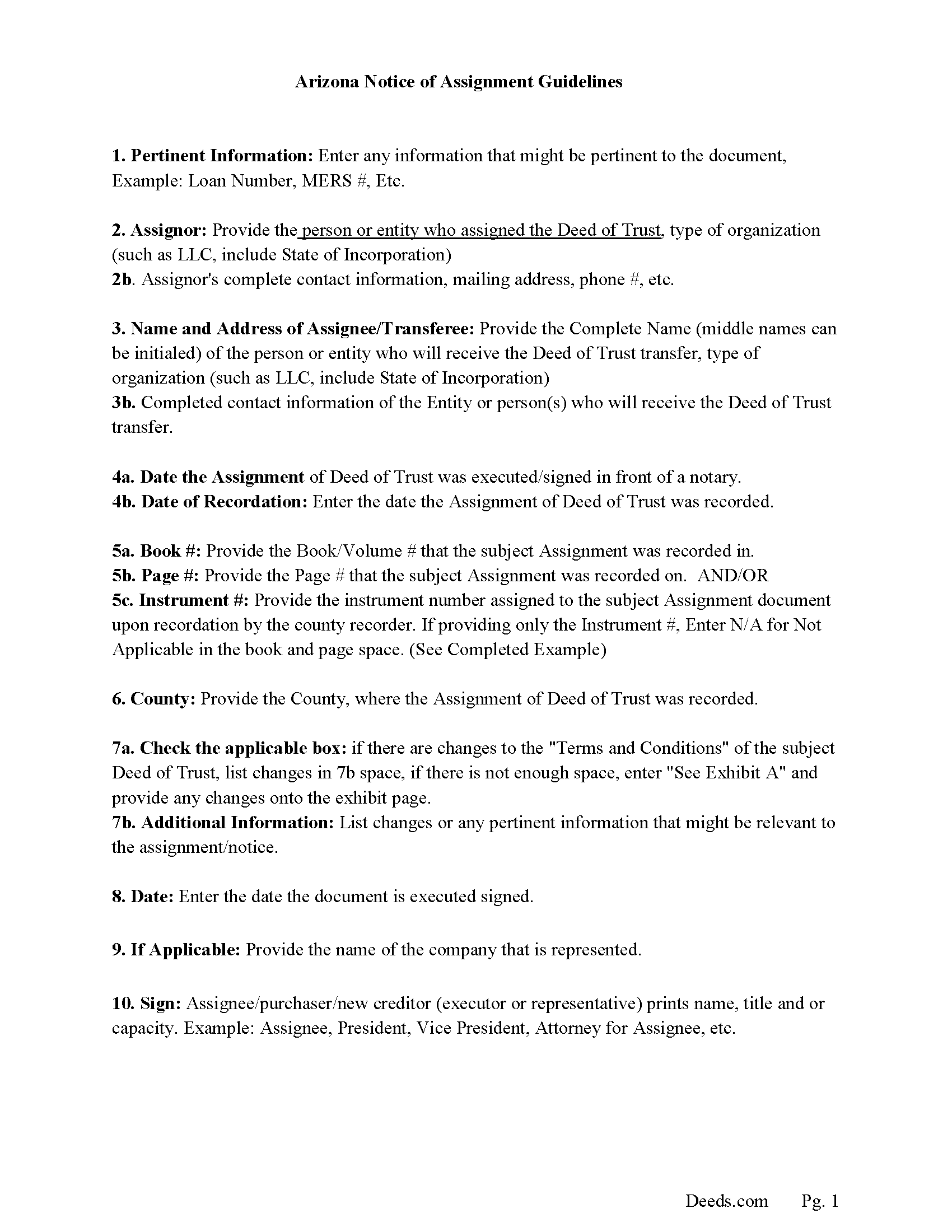
Coconino County Notice of Assignment Guidelines
Line by line guide explaining every blank on the form.
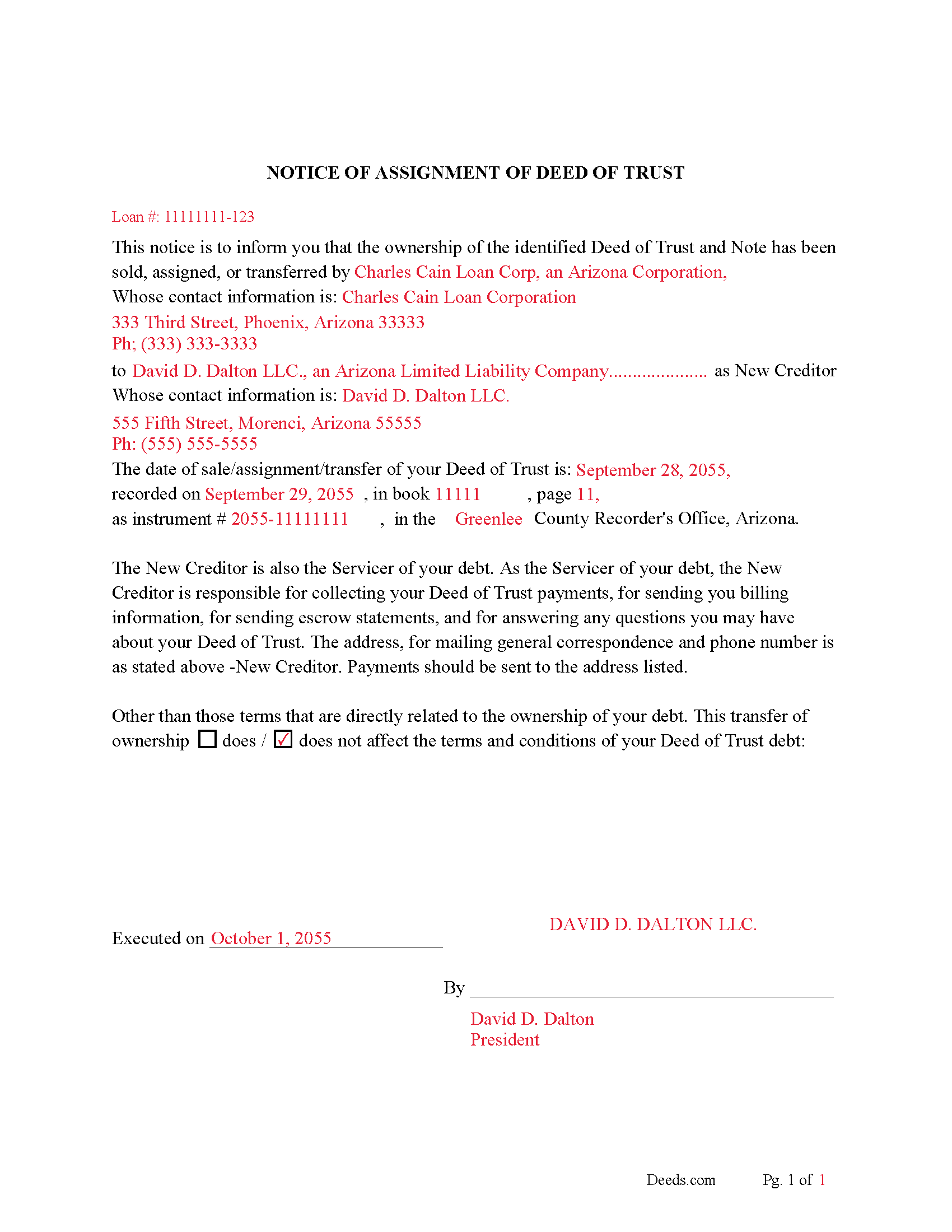
Coconino County Completed Example of Notice of Assignment Document
Example of a properly completed form for reference.
All 6 documents above included • One-time purchase • No recurring fees
Immediate Download • Secure Checkout
Additional Arizona and Coconino County documents included at no extra charge:
Where to Record Your Documents
County Recorder Office
Flagstaff, Arizona 86001
Hours: 8:00am to 5:00pm Monday - Friday
Phone: 928-679-7850 or 800-793-6181
Recording Tips for Coconino County:
- Bring your driver's license or state-issued photo ID
- Ensure all signatures are in blue or black ink
- White-out or correction fluid may cause rejection
- Ask about their eRecording option for future transactions
- Avoid the last business day of the month when possible
Cities and Jurisdictions in Coconino County
Properties in any of these areas use Coconino County forms:
- Bellemont
- Cameron
- Flagstaff
- Forest Lakes
- Fredonia
- Grand Canyon
- Gray Mountain
- Happy Jack
- Kaibeto
- Leupp
- Marble Canyon
- Mormon Lake
- Munds Park
- North Rim
- Page
- Parks
- Sedona
- Supai
- Tonalea
- Tuba City
- Williams
Hours, fees, requirements, and more for Coconino County
How do I get my forms?
Forms are available for immediate download after payment. The Coconino County forms will be in your account ready to download to your computer. An account is created for you during checkout if you don't have one. Forms are NOT emailed.
Are these forms guaranteed to be recordable in Coconino County?
Yes. Our form blanks are guaranteed to meet or exceed the applicable formatting requirements used for recording in Coconino County, including margin requirements, font requirements, and other layout standards. This guarantee applies to formatting, not to the legal sufficiency of information entered by the user or the suitability of a form for a particular transaction.
Can I reuse these forms?
Yes. You can reuse the forms for your personal use. For example, if you have multiple properties in Coconino County you only need to order once.
What do I need to use these forms?
The forms are PDFs that you fill out on your computer. The free Adobe Acrobat Reader is recommended, and most PDF apps also work. You do NOT enter your property information online - you download the blank forms and complete them privately on your own computer.
Are there any recurring fees?
No. This is a one-time purchase. Nothing to cancel, no memberships, no recurring fees.
How much does it cost to record in Coconino County?
Recording fees in Coconino County vary. Contact the recorder's office at 928-679-7850 or 800-793-6181 for current fees.
Questions answered? Let's get started!
The Arizona Assignment of Deed of Trust is the recorded instrument that transfers the beneficiary's interest — the right to receive payments and to enforce the security — from the original lender to a new party who is buying the note and deed of trust. The mechanics sit at the intersection of Arizona recording law and federal consumer protection law. Under ARS 33-818, a properly acknowledged and recorded assignment gives constructive notice of the transfer to all subsequent purchasers and encumbrancers, fixing the new beneficiary's position in the chain. Under the federal Truth in Lending Act's assignment-notification rule at 15 U.S.C. 1641(g), the new creditor must also send the borrower a written notice of the transfer within thirty days — a separate statutory duty that the recording does not satisfy. Getting both right is what a careful assignment accomplishes; failing either one creates exposure.
When the Arizona Assignment of Deed of Trust Is Used
Assignments are used whenever the holder of an Arizona deed of trust transfers the underlying loan to a new party. Typical scenarios include an originating lender selling a newly closed loan into the secondary market, a mortgage servicing transfer where the beneficial ownership changes hands, a private investor selling a seller-financed note to another investor as part of a portfolio liquidation or estate disposition, a lender transferring a loan between affiliated entities for servicing or accounting purposes, a trustee of a deceased lender's estate assigning notes to the heirs as part of estate administration, and lender-to-lender assignments in restructuring and workout situations. The form is the same mechanic regardless of whether the underlying loan is an institutional residential mortgage, a commercial loan, or a private seller-financed note secured by a deed of trust.
Recording Requirement and Constructive Notice
ARS 33-818 is the specific statute that makes a recorded assignment effective against third parties. The statute provides that an assignment of a deed of trust, when acknowledged as provided by law, imparts notice from the time of recording to all persons, including subsequent purchasers and encumbrancers for value. Translated to practice: the assignment becomes part of the chain of title the moment it is recorded, and anyone subsequently acquiring an interest in the property — a later purchaser, a later lender, a subsequent judgment creditor — takes subject to the new beneficiary's position. Conversely, an unrecorded assignment is effective between the old and new beneficiaries (the assignor has in fact transferred its rights to the assignee) but does not protect the new beneficiary against intervening events that would be resolved against it in a race to record.
The practical consequences of failing to record are specific and sometimes painful. Releases of the deed of trust signed by the original beneficiary after the note has been assigned but before the assignment is recorded can appear valid on the record and may be relied upon by title insurers. Duplicate assignments — the original lender sells the same note to two different buyers — resolve on recording priority under Arizona's race-notice rule at ARS 33-412. Garnishments and judgment liens against the original beneficiary can attach to loans it no longer owns but still appears to own on the record. Recording promptly after the assignment is executed is the only reliable protection against these scenarios.
The Truth in Lending Act Notification Requirement
Federal law imposes a separate borrower-notification obligation that runs independently of the Arizona recording requirement. Under 15 U.S.C. 1641(g), when a mortgage loan is sold, transferred, or assigned to a new creditor, the new creditor must notify the borrower in writing within thirty days of the transfer. The notice must include the identity, address, and telephone number of the new creditor, the date of the transfer, contact information for a party authorized to receive notices about claims against the loan, and information about where the transfer is recorded if it has been recorded.
Compliance matters because the statute's remedies are real. A borrower who does not receive the required notice can recover actual damages plus statutory damages of up to $4,000 per violation (raised from the figure in older materials after legislative and regulatory updates), plus reasonable attorney's fees and costs. Class actions can reach substantially higher numbers, and the cap on class statutory damages has been set at the lesser of $1,000,000 or one percent of the creditor's net worth. The obligation applies to the new creditor — the assignee — not the original lender, which means the party newly holding the loan is responsible for sending the notice even if the original lender handled the sale. Assignees who fail to notify borrowers of the transfer face cumulative exposure across the portfolio if the failure is systematic, which is why institutional loan buyers build this notification into their onboarding process and private note buyers should do the same.
What the Notice to Borrower Should Contain
A compliant TILA assignment notice typically includes the name, address, and telephone number of the new creditor; the date the loan was transferred to the new creditor; the name, address, and telephone number of any agent or party authorized to receive notices and resolve issues on behalf of the new creditor; the loan account number or other identifier; the recording information for the assignment if recorded (recording date and instrument number, or docket and page reference, and the county of recording); a clear statement that the transfer has occurred and that future payments and communications about the loan should be directed as specified; and any change in the address for payments. The notice is separate from the borrower's monthly billing statement and separate from any servicing transfer notice required under RESPA (which runs on different rules and applies when the servicer changes rather than the creditor). A single document can satisfy multiple notification obligations if drafted to include the required content for each, but institutional practice typically uses separate standardized notices.
Who Signs the Assignment
The assignor — the current holder of the deed of trust — signs the assignment. When the assignor is the original beneficiary, the signatory's representative capacity (if a business entity) and authority should be reflected in the signature block. When the assignor is itself an assignee from an earlier transfer, the chain of prior assignments should be clear; a gap in the recorded chain is what title examiners call a "break" and produces real problems for later enforcement. When the deed of trust has been assigned multiple times without corresponding recordings — a common pattern when loans trade in bulk and recording is deferred to closing economies — the assignee should consider recording the entire chain, including any intermediate assignments in the assignee's possession, to close the record gap before seeking to enforce.
The assignee does not typically sign the assignment itself, because the assignment is a one-way transfer by the assignor. The assignee does, however, execute the TILA notice to the borrower, and in many transactions the assignee also executes a separate allonge to the promissory note — an endorsement showing the note has been transferred — because the note and the deed of trust are separate instruments and both need to follow the transfer.
The Note Must Follow the Deed of Trust
Arizona applies the principle that the deed of trust follows the note — the security instrument is incident to the underlying debt, and an assignment of the deed of trust without effective transfer of the note is potentially ineffective. For promissory notes, effective transfer is typically accomplished through either physical delivery of the original note endorsed to the new holder (or endorsed in blank), or through a written assignment referencing the note. In seller-financed transactions, the original note is held by the seller and physically delivered to the assignee at the time of the assignment. In institutional transactions, notes may be held by a document custodian under a master custodial arrangement, with the assignment effected through records rather than physical delivery. Either way, the assignee should confirm that both the deed of trust assignment and the underlying note transfer are in order; enforcement difficulties arise when the assignee can prove deed-of-trust ownership but not note ownership, or vice versa.
Partial Assignments
Assignments can be full or partial. A full assignment transfers the entire beneficiary interest to the assignee; a partial assignment transfers a fractional interest, creating co-beneficiaries who share the right to receive payments and the security position. Partial assignments are more common in investor-pool arrangements and in certain estate situations where multiple heirs each take a fractional interest in a note. The recorded assignment should state clearly whether it is full or partial, and if partial, the fractional interest being transferred. Ambiguity on this point creates expensive disputes at payoff or foreclosure when the various interest-holders need to act jointly.
Execution and Acknowledgment
Under ARS 33-401 and 33-818, the assignment must be in writing, subscribed by the assignor, and acknowledged before a notary public or other officer authorized to take acknowledgments. Arizona does not require subscribing witnesses. Acknowledgments taken outside Arizona must comply with ARS 33-501, which recognizes notaries, judges and clerks of courts of record, and other officers authorized to perform notarial acts in the jurisdiction where the acknowledgment is taken. Assignments of institutional loans are routinely executed outside Arizona — the assignor may be a Delaware or New York entity — and the acknowledgment must satisfy Arizona's foreign-acknowledgment rules to be recordable.
Affidavit of Property Value Exemption
Arizona requires an Affidavit of Property Value to accompany most instruments affecting interests in real property (ARS 11-1133), but an assignment of a deed of trust is generally exempt under ARS 11-1134 because the assignment transfers a security interest rather than fee title to the property. The exemption should be claimed on the face of the assignment with a statement that the transfer is exempt and a citation to the specific exemption subsection, placed below the legal description. Assignments that omit the exemption recital are sometimes rejected at the recorder's window even though the transaction is plainly exempt; including the recital as standard drafting practice avoids the rejection risk.
Formatting and Recording
ARS 11-480 sets the formatting requirements for every recordable instrument: legible type of at least ten points, white paper no larger than 8.5 by 14 inches, a caption identifying the document (for example, "Assignment of Deed of Trust"), a top margin of at least two inches on the first page reserved for the recorder's stamp, and minimum half-inch margins elsewhere. Record the assignment in the county where the original deed of trust was recorded — in each county, if the property spans more than one. Confirm current recording fees and accepted forms of payment with the county recorder in advance, and verify that the assignment has actually been indexed rather than relying on a drop-off or mailing receipt. The ARS 33-818 constructive-notice benefit attaches only when the assignment is actually indexed against the property.
Release on Payoff and Future Assignments
Once recorded, the assignment puts the new beneficiary in position to receive loan payments, handle any modifications or workouts, and — on payoff — execute the release of the deed of trust. The former beneficiary no longer has any authority over the loan, and a release purportedly signed by the former beneficiary after the assignment may be ineffective or create title questions. When the new beneficiary later assigns to another party, the process repeats: a new assignment is recorded, a new TILA notice is sent to the borrower within thirty days, and the chain extends. Maintaining a clean recorded chain across multiple assignments is materially easier than reconstructing it after the fact, and the assignee's interest in enforceability makes prompt recording a meaningful priority.
What's Included in the Download Package
The Arizona Assignment of Deed of Trust package includes the assignment form drafted around the ARS 33-818 recording and constructive-notice framework, notice of assignment forms designed to satisfy the TILA 1641(g) borrower-notification requirement, detailed guidelines covering the Arizona-specific drafting and recording requirements and the interaction between the Arizona recording rule and the federal notification obligation, and a completed example showing how the assignment should look for a typical transaction. All files are available for instant download after purchase.
Important: Your property must be located in Coconino County to use these forms. Documents should be recorded at the county recording office listed above.
This Assignment of Deed of Trust meets all recording requirements specific to Coconino County.
Our Promise
The documents you receive here are guaranteed to meet or exceed the applicable Coconino County recording format requirements. If there is a rejection caused by our formatting, we will correct the issue or refund your payment. This guarantee applies to document formatting only and does not extend to information entered by the user, the selection of the form, or the legal effect of the completed document.
Save Time and Money
Get your Coconino County Assignment of Deed of Trust form done right the first time with Deeds.com Uniform Conveyancing Blanks. At Deeds.com, we understand that your time and money are valuable resources, and we don't want you to face a penalty fee or rejection imposed by a county recorder for submitting nonstandard documents. We constantly review and update our forms to meet rapidly changing state and county recording requirements for roughly 3,500 counties and local jurisdictions.
4.8 out of 5 - ( 4,819 Reviews )
Randy T. 5 out of 5 stars
I gave your site and forms 5 stars because it is very easy to use and included all the information needed to complete the form without having had a legal background.
Thank you Randy. Have a great day!
Qingqiu H. 5 out of 5 stars
I ordered the wrong forms at first because I'm an idiot and didn't do my research. When I told the customer service about my error they were understanding.
Thank you for your feedback. We really appreciate it. Have a great day!
David J. 5 out of 5 stars
Very easy to use and saved a lot of time
Thank you!
Jamie F. 5 out of 5 stars
Your service was very helpful as we were able to obtain a form for another state for our client.
We appreciate your business and value your feedback. Thank you. Have a wonderful day!
Arthur M. 5 out of 5 stars
A good service that saves a lot of time and precludes making a trip to the County Assessors Office. Valuable service.
Thank you!
Steven b. 5 out of 5 stars
We used this document in 2018 and it was acceptable to Jackson County Missouri. It worked and is valid. Very happy with the product.
Thanks for the kind words, glad to see you back again. Have a great day!
Tyrone L. 5 out of 5 stars
Great time saver fast service
Your satisfaction with our services is of utmost importance to us. Thank you for letting us know how we did!
Sally F. 5 out of 5 stars
Amazing forms, thanks so much for making these available.
Thank you!
Kerrin S. 5 out of 5 stars
This was so efficient. Thank you for offering this service!
Thank you for your feedback. We really appreciate it. Have a great day!
Edward M. 5 out of 5 stars
Thank you very much Very satisfied
Thank you for your feedback. We really appreciate it. Have a great day!
Louise J. 5 out of 5 stars
I found your service to be very helpful. The documents were correct and comprehensive as well as easy to access. The cost is so reasonable. I think it's a great service and was impressed with it.
We appreciate your business and value your feedback. Thank you. Have a wonderful day!
Jan O. 5 out of 5 stars
This was so easy and just what I needed.
Thank you for your feedback. We really appreciate it. Have a great day!
Dorothy N. 5 out of 5 stars
The mortgage and note were thorough and very satisfactory for my purposes. The accompanying forms were excellent. I am very pleased with my purchase.
We welcome your positive feedback and are thrilled to have met your expectations. Thank you for choosing our services.
Karla L. 5 out of 5 stars
Perfect! Recorded my completed deed today with no problems.
Thank you!
brian p. 4 out of 5 stars
Good, easy to use, quit claim form worked as expected.
We appreciate your business and value your feedback. Thank you. Have a wonderful day!