Coconino County Trustee Deed Form
Last validated September 30, 2026 by our Forms Development TeamFormatted for recording in Coconino County, for property anywhere in the county: rural and unincorporated areas as well as Bellemont, Cameron, Flagstaff, Forest Lakes, Fredonia, Grand Canyon, Gray Mountain, Happy Jack and 13 more.
- 3 documents included
- Immediate PDF download
- Formatting guarantee
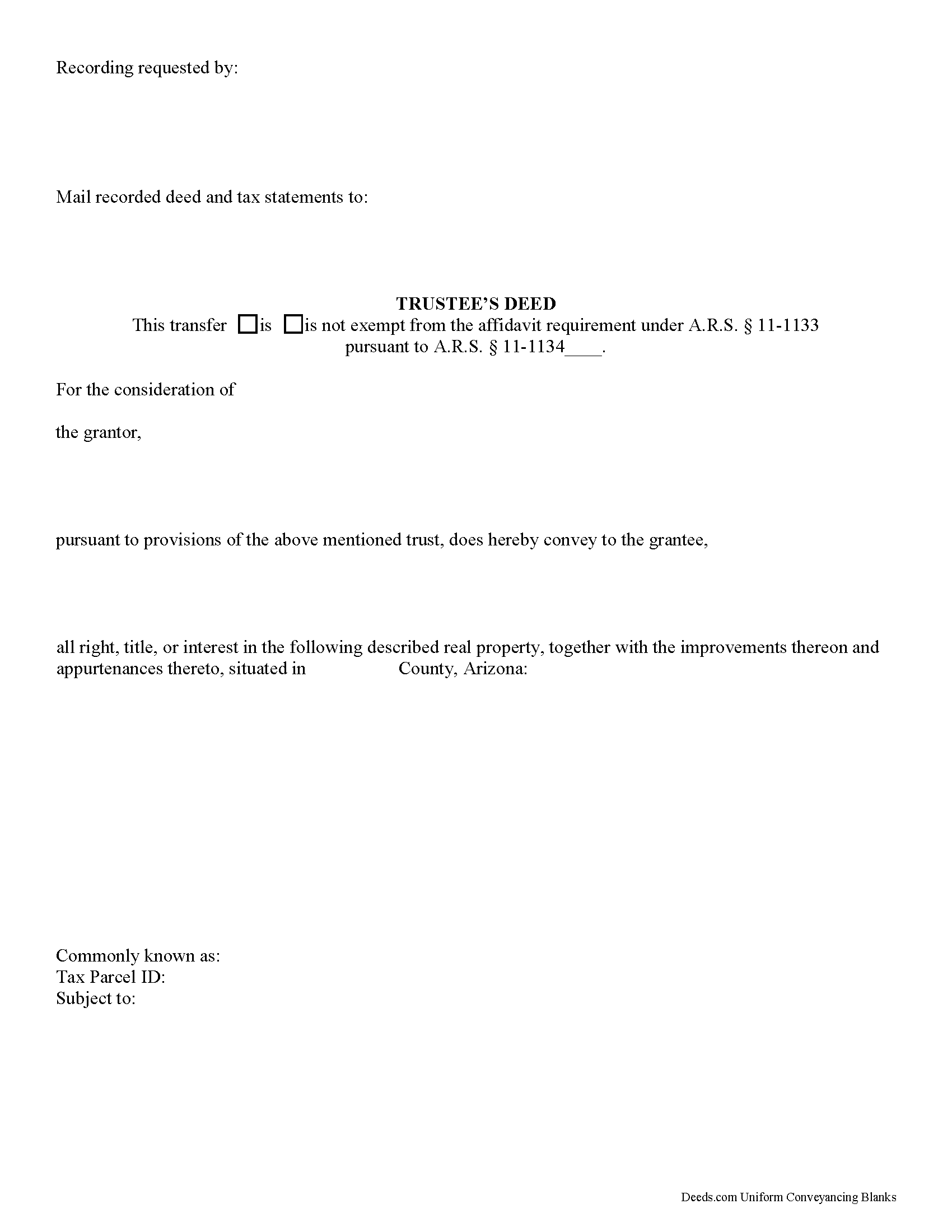
Coconino County Trustee Deed Form
Fill in the blank form formatted to comply with all recording and content requirements.
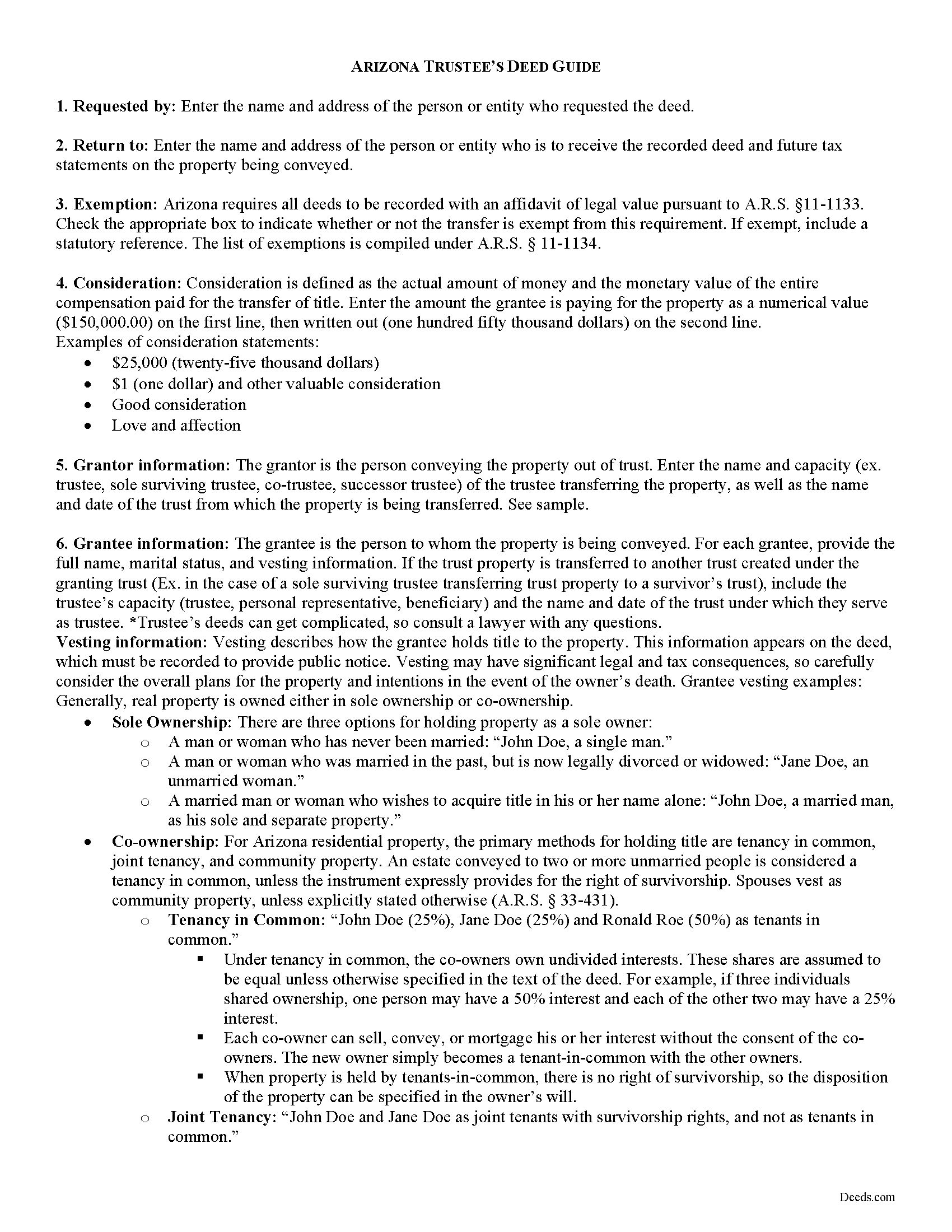
Coconino County Trustee Deed Guide
Line by line guide explaining every blank on the form.
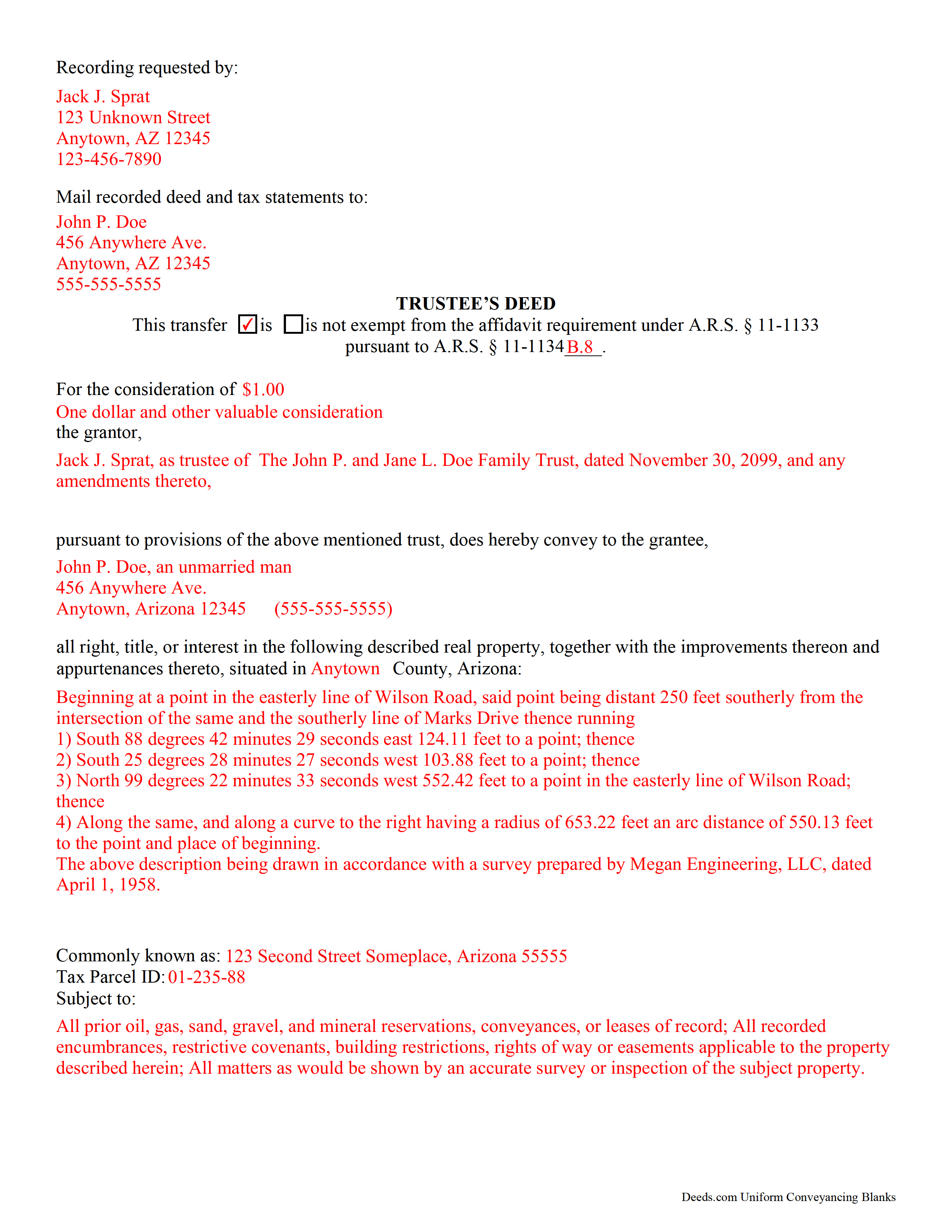
Coconino County Completed Example of the Trustee Deed Document
Example of a properly completed form for reference.
All 3 documents above included • One-time purchase • No recurring fees
Immediate Download • Secure Checkout
Additional Arizona and Coconino County documents included at no extra charge:
Where to Record Your Documents
County Recorder Office
Flagstaff, Arizona 86001
Hours: 8:00am to 5:00pm Monday - Friday
Phone: 928-679-7850 or 800-793-6181
Recording Tips for Coconino County:
- Bring your driver's license or state-issued photo ID
- Ensure all signatures are in blue or black ink
- Make copies of your documents before recording - keep originals safe
- Recorded documents become public record - avoid including SSNs
- Recording fees may differ from what's posted online - verify current rates
Cities and Jurisdictions in Coconino County
Properties in any of these areas use Coconino County forms:
- Bellemont
- Cameron
- Flagstaff
- Forest Lakes
- Fredonia
- Grand Canyon
- Gray Mountain
- Happy Jack
- Kaibeto
- Leupp
- Marble Canyon
- Mormon Lake
- Munds Park
- North Rim
- Page
- Parks
- Sedona
- Supai
- Tonalea
- Tuba City
- Williams
Hours, fees, requirements, and more for Coconino County
How do I get my forms?
Forms are available for immediate download after payment. The Coconino County forms will be in your account ready to download to your computer. An account is created for you during checkout if you don't have one. Forms are NOT emailed.
Are these forms guaranteed to be recordable in Coconino County?
Yes. Our form blanks are guaranteed to meet or exceed the applicable formatting requirements used for recording in Coconino County, including margin requirements, font requirements, and other layout standards. This guarantee applies to formatting, not to the legal sufficiency of information entered by the user or the suitability of a form for a particular transaction.
Can I reuse these forms?
Yes. You can reuse the forms for your personal use. For example, if you have multiple properties in Coconino County you only need to order once.
What do I need to use these forms?
The forms are PDFs that you fill out on your computer. The free Adobe Acrobat Reader is recommended, and most PDF apps also work. You do NOT enter your property information online - you download the blank forms and complete them privately on your own computer.
Are there any recurring fees?
No. This is a one-time purchase. Nothing to cancel, no memberships, no recurring fees.
How much does it cost to record in Coconino County?
Recording fees in Coconino County vary. Contact the recorder's office at 928-679-7850 or 800-793-6181 for current fees.
Questions answered? Let's get started!
The Arizona Trustee Deed is the instrument a trustee uses to convey real property out of a trust to a beneficiary, a third-party purchaser, or another trust. It is distinct from the Trustee's Deed Upon Sale used in non-judicial foreclosure under ARS 33-807 — the foreclosure form transfers property at a trustee's sale on default of a deed of trust, and the trustee involved is the neutral third party under the security instrument, not the trustee of an Arizona Trust Code trust. The two instruments share a name but not a function. This form is the true trust conveyance: the trustee of an inter vivos trust, testamentary trust, or successor trust created under Arizona's Trust Code at ARS 14-10101 et seq. acts as grantor to distribute or transfer the trust's real property in accordance with the trust's terms.
When the Arizona Trustee Deed Is Used
Trustee's deeds are used whenever a trust needs to convey real property it holds. Typical scenarios include a revocable living trust distributing a residence to a beneficiary on the settlor's death, a trustee conveying trust property to a sub-trust (a marital trust, a bypass trust, a survivor's trust) that was created under the original trust instrument, a trustee selling trust property to a third party as part of trust administration, a trustee transferring property to the settlor or grantor when a revocable trust is being unwound during life, a trustee conveying property to another trust following a decanting or trust reformation, and successor trustees conveying property to themselves in their individual capacity when a trust terminates in their favor. The form is the working instrument for all of these scenarios; the choice of warranty level and the specific recitals change based on context, but the underlying structure remains the trustee-as-grantor conveyance.
The Trustee's Authority
A trustee's authority to convey trust property comes from the trust instrument itself, supplemented by the default powers under the Arizona Trust Code. ARS 14-10815 grants trustees broad default powers, including the power to sell or lease trust property, subject to the specific terms of the trust. Most contemporary Arizona trusts expressly grant the trustee full authority over trust real estate in language that leaves little ambiguity; older trusts or those drafted outside Arizona may require careful review to confirm the scope of the trustee's powers. When title is being insured for the grantee — which is typical for arm's-length sales out of a trust and common for distributions to beneficiaries — the title insurer will review the trust instrument and may require a certification of trust under ARS 14-11013.
The Certification of Trust — ARS 14-11013
Arizona has adopted the Uniform Trust Code's certification-of-trust mechanism at ARS 14-11013, which allows a trustee to establish the trust's existence and the trustee's authority without disclosing the full terms of the trust to every counterparty. The certification is a document signed by the trustee under penalty of perjury that recites the trust's existence, the date of the instrument, the identity of the settlor, the identity of the currently acting trustee, the trustee's powers relevant to the transaction, the manner of taking title to property held by the trust, and (where required) whether the trust has been revoked or amended in a way affecting the representations. Title companies, buyers, and lenders dealing with trust-held real estate routinely request a certification of trust rather than a copy of the full trust instrument, and Arizona law protects parties who rely in good faith on a certification — they do not have to look behind it.
Using a certification of trust has become standard Arizona practice for trustee's deed transactions, both for the privacy protection it affords the trust's beneficiaries and for the efficiency of closings. The certification is typically recorded contemporaneously with the trustee's deed or held in the closing file by the title company; the trust instrument itself generally is not recorded.
How Title Is Taken in the Trustee's Name
Arizona follows the convention that trust-held real estate is titled in the trustee's name in his or her fiduciary capacity — "Jane Doe, as Trustee of the Doe Family Revocable Trust dated January 1, 2020" rather than "The Doe Family Revocable Trust." The trust itself is not a legal entity capable of holding title; the trustee is. This naming convention matters for the trustee's deed: the grantor identification in the conveyancing clause should match the way title is held on the current vested deed, and the trustee's signature block should reflect the fiduciary capacity. A trustee's deed that names the trust rather than the trustee, or that names the trustee individually rather than in fiduciary capacity, creates a chain-of-title gap that can require curative action later.
Distributions to Trust Beneficiaries
When a trustee's deed is distributing property from the trust to a trust beneficiary — typically on the settlor's death, under the trust's terms — the transfer is generally made for nominal consideration, because the beneficiary is not purchasing the property but receiving it as part of the trust distribution. The deed should reflect this by stating consideration as "good and valuable consideration" or a similar variant, rather than a specific purchase price. The transaction is exempt from the Affidavit of Property Value under ARS 11-1134(B)(8), which specifically addresses transfers from a trustee to a beneficiary without consideration, and the exemption must be claimed on the face of the deed with a citation to the specific subsection. Functionally, the distribution resembles an inter vivos gift deed — value moving from one party (the trust) to another (the beneficiary) without a purchase-price transaction — but the trustee-as-grantor structure is different from a natural person giving a gift, and the deed's drafting reflects that distinction.
Warranty Level
Trustee's deeds are usually executed as limited-warranty instruments. A trustee is a fiduciary, not a property owner in the ordinary sense, and trustees typically do not provide general warranties covering defects arising before the property came into the trust — they have no personal knowledge of the earlier chain and would be exposing themselves to liability for other people's title problems. The common choices are a special warranty deed (covering only defects arising during the trustee's period of trust administration) or, for pure family distributions, a quitclaim or bargain and sale deed. For arm's-length sales of trust property to third-party buyers, title insurance typically does the heavy lifting on title protection, and a special warranty deed from the trustee plus an owner's title policy gives the buyer the protection ordinarily provided by a general warranty alone. The trust instrument itself may direct the level of warranty required, and trustees should follow the instrument's direction.
Community Property and Marital Property Considerations
Arizona's community property law complicates trust administration in ways that matter for trustee's deeds. When a married settlor funds a trust with community property, the trust holds community property on behalf of both spouses' community interests; on the first spouse's death, a properly drafted trust distinguishes between the deceased spouse's half and the survivor's half and directs distributions accordingly. When a trustee's deed is conveying what was historically community property, the recitals may need to reflect how the property was titled before it came into the trust and how the distribution is being characterized for community property and income tax basis purposes (a full stepped-up basis at first death turns on community property characterization surviving the trust administration). These considerations can be sophisticated, and trust administration involving Arizona community property is one of the areas where professional guidance has the highest value relative to cost.
Successor Trustees and Trust Conveyances
When a settlor of a revocable trust dies or becomes incapacitated, the successor trustee named in the trust instrument takes over and typically executes any trustee's deeds needed to distribute or administer trust property. The chain of succession from the original trustee to the acting successor trustee should be clear — ideally documented by recorded acceptances of trusteeship, successor trustee affidavits, or a current certification of trust identifying the signing trustee as the currently acting trustee. Gaps in the chain of trustee succession are one of the more common title issues encountered in post-death trust administration; addressing them with appropriate recitals or recorded affidavits before executing the trustee's deed prevents the gap from passing through to the grantee's chain of title.
Execution and Acknowledgment
Under ARS 33-401, the trustee's deed must be in writing, subscribed by the trustee in fiduciary capacity, and acknowledged before a notary public or other officer authorized to take acknowledgments. Arizona does not require subscribing witnesses. The acknowledgment should reflect the trustee's representative capacity — the notarial certificate should identify the signer as acting "in his or her capacity as trustee" of the named trust rather than individually. When the trustee is an out-of-state resident, which is common for distributed families, the acknowledgment must satisfy Arizona's foreign-acknowledgment rules under ARS 33-501 to be recordable.
Affidavit of Property Value and Exemptions
Arizona generally requires an Affidavit of Property Value to accompany instruments transferring an interest in real property (ARS 11-1133), but trustee's deeds frequently fall within the exemptions at ARS 11-1134. Specifically, ARS 11-1134(B)(8) addresses transfers from a trustee to a beneficiary without consideration, and other subsections cover transfers to or from a revocable trust by the trustor and related fiduciary situations. The exemption must be claimed on the face of the deed with a statement that the transfer is exempt and a citation to the specific exemption subsection, placed below the legal description. When a trustee's deed is conveying trust property to a third party in an arm's-length sale for full consideration, the transaction is typically not exempt, and the Affidavit of Property Value must be filed.
Formatting, Recording, and Priority
ARS 11-480 sets the formatting requirements for every recordable instrument: legible type of at least ten points, white paper no larger than 8.5 by 14 inches, a caption identifying the document (for example, "Trustee's Deed"), a top margin of at least two inches on the first page reserved for the recorder's stamp, and minimum half-inch margins elsewhere. Record the deed in the county where the property is located. ARS 33-411.01 imposes a duty on the transferor to record within sixty days of the transfer. Arizona's race-notice rule at ARS 33-412 applies to trustee's deeds as to any other conveyance — an unrecorded deed is void as against a subsequent purchaser for value who records first without notice. Prompt recording is the only reliable protection for the grantee's interest.
What's Included in the Download Package
The Arizona Trustee Deed package includes the deed form drafted with the trustee-as-grantor structure, fiduciary capacity recitals, and flexible warranty language suitable for trust distributions and trust sales, detailed guidelines covering the Arizona-specific drafting and recording requirements and the interaction with the Arizona Trust Code's certification of trust mechanism under ARS 14-11013, and a completed example showing how the form should look for a typical trust conveyance. All files are available for instant download after purchase.
Important: Your property must be located in Coconino County to use these forms. Documents should be recorded at the county recording office listed above.
This Trustee Deed meets all recording requirements specific to Coconino County.
Our Promise
The documents you receive here are guaranteed to meet or exceed the applicable Coconino County recording format requirements. If there is a rejection caused by our formatting, we will correct the issue or refund your payment. This guarantee applies to document formatting only and does not extend to information entered by the user, the selection of the form, or the legal effect of the completed document.
Save Time and Money
Get your Coconino County Trustee Deed form done right the first time with Deeds.com Uniform Conveyancing Blanks. At Deeds.com, we understand that your time and money are valuable resources, and we don't want you to face a penalty fee or rejection imposed by a county recorder for submitting nonstandard documents. We constantly review and update our forms to meet rapidly changing state and county recording requirements for roughly 3,500 counties and local jurisdictions.
4.8 out of 5 - ( 4,829 Reviews )
Marilyn C. 5 out of 5 stars
Fillable documents, after a download, would be helpful. Very good to have all these forms online and accessible for an overall fee.
Thank you!
Teresa H. 5 out of 5 stars
cost effective and quick!
Thank you!
Margaret M. 4 out of 5 stars
Quick and easy, but the 2MB file limit ended up causing some big headaches. Had I known the limit could be easily increased, it would have saved me a lot of time and trouble.
We appreciate your business and value your feedback. Thank you. Have a wonderful day!
Lana B. 5 out of 5 stars
Website is easy to use. I ordered the form, filled it out and uploaded it for recording. My only critique is that you can't preview the form before ordering and paying for it. I ordered a Deed of Full Reconveyance form only to find out I needed the Substitution of Trustee and Deedn of Reconveyance form instead. So I wasted $22 on the wrong form.
Thank you for your feedback. Order and payment for the incorrect order has been canceled. Have a wonderful day.
Dana P. 5 out of 5 stars
Thank you for making a difficult time a little easier. The forms are easy to download and complete and the Guide is very helpful.
Thank you for your feedback. We really appreciate it. Have a great day!
Margaret P. 5 out of 5 stars
EXCELLENT WEBSITE AND SERVICE, HIGHLY RECOMMENDED.
Your feedback is greatly appreciated. Thank you for taking the time to share your experience!
Kathy O. 5 out of 5 stars
I was so happy to be able to print the Quit Claim Deed form and learn about other forms. Very pleased with this service! Took the stress out of preparing needed deeds for notirization for our Trust. Very grateful. Thank you. Kathy
We appreciate your business and value your feedback. Thank you. Have a wonderful day!
David W. 5 out of 5 stars
The forms were exactly the ones required by that New Jersey county, and were very easy to fill out. I would use this site again, and highly recommend it.
We appreciate your business and value your feedback. Thank you. Have a wonderful day!
Rachelle S. 5 out of 5 stars
Wow that was easy
Thank you!
Fred A. 5 out of 5 stars
Very nice forms offer, very thoughtful to include other related forms that may be necessary. The site was easy to use, and very fast. Thank You.
Thank you!
Norma G. 5 out of 5 stars
Very fast response!
We appreciate your business and value your feedback. Thank you. Have a wonderful day!
Raymond C. 5 out of 5 stars
Very convenient
We appreciate your business and value your feedback. Thank you. Have a wonderful day!
Shirley P. 5 out of 5 stars
Very easy to use, download and print. Thank you!
We appreciate your business and value your feedback. Thank you. Have a wonderful day!
Darren D. 5 out of 5 stars
Easy-peasy to find, download and use the forms!
We appreciate your business and value your feedback. Thank you. Have a wonderful day!
DONNA P. 5 out of 5 stars
Deeds.com was quick, efficient, and cost effective. Deeds.com works with individuals where I found other companies only offer services to title companies, settlement companies, etc. Thank you Deeds.com!
Thank you for your feedback. We really appreciate it. Have a great day!