Cochise County Mineral Quitclaim Deed Form
Last validated September 14, 2026 by our Forms Development TeamFormatted for recording in Cochise County, for property anywhere in the county: rural and unincorporated areas as well as Benson, Bisbee, Bowie, Cochise, Douglas, Dragoon, Elfrida, Fort Huachuca and 12 more.
- 3 documents included
- Immediate PDF download
- Formatting guarantee
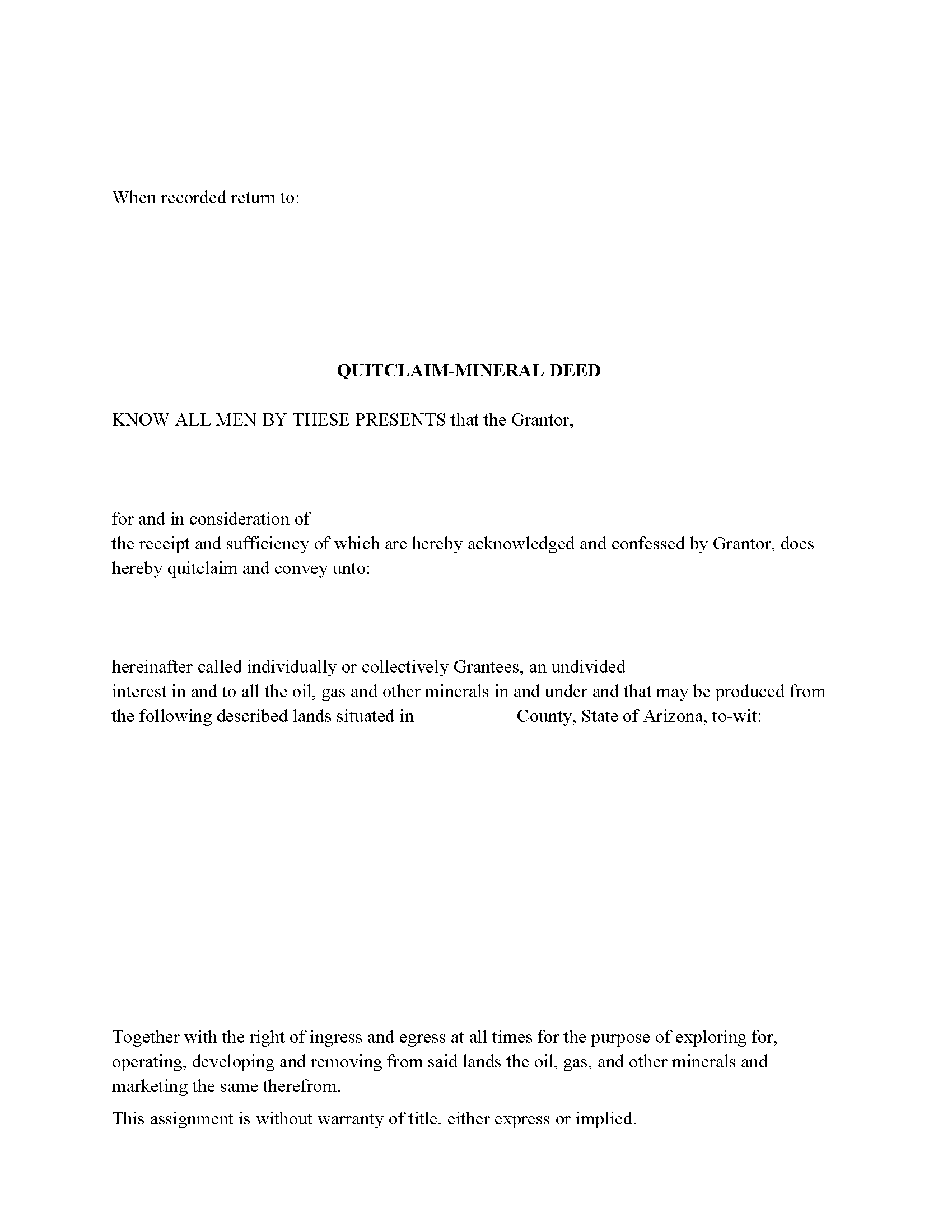
Cochise County Mineral Quitclaim Deed Form
Fill in the blank Mineral Quitclaim Deed form formatted to comply with all Arizona recording and content requirements.
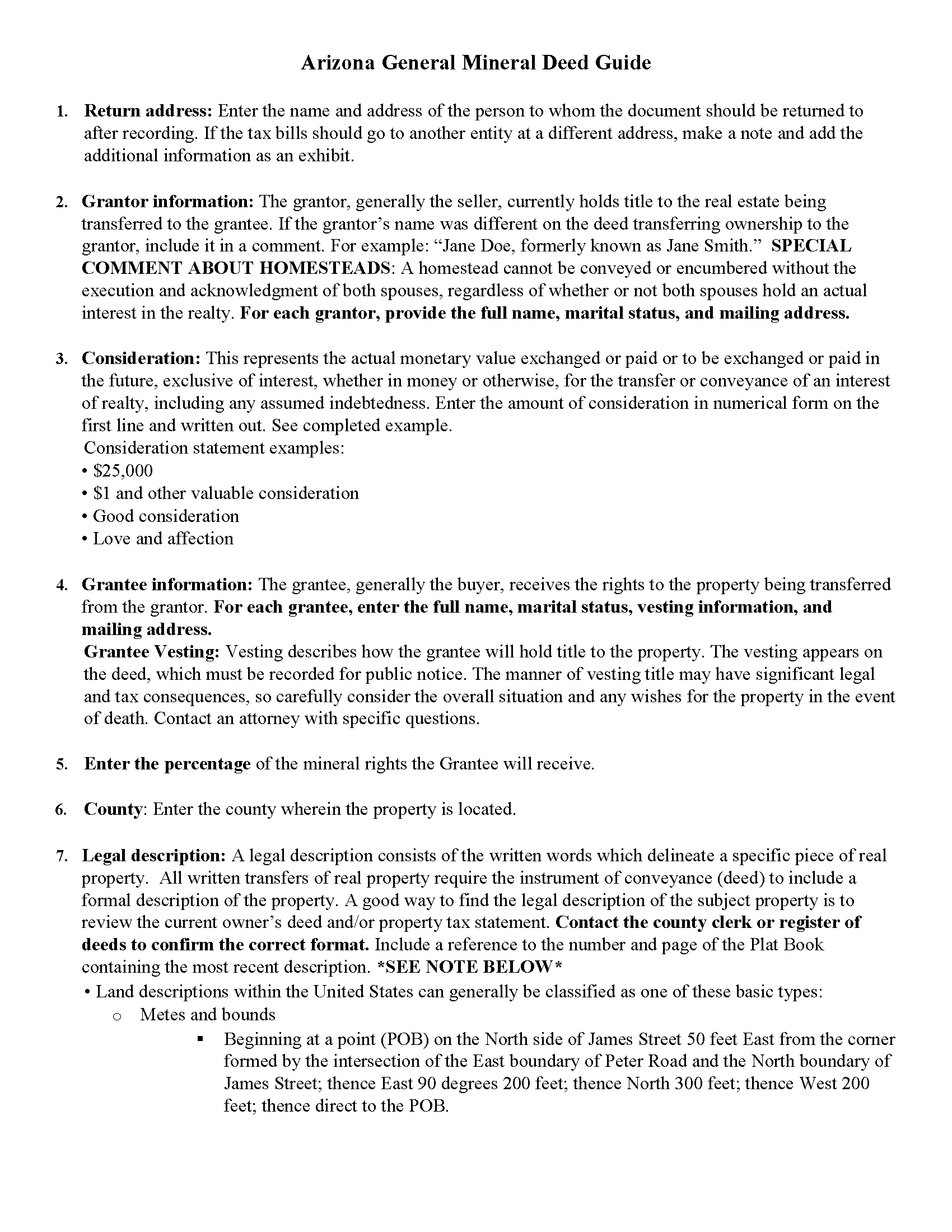
Cochise County Mineral Quitclaim Deed Guide
Line by line guide explaining every blank on the Mineral Quitclaim Deed form.
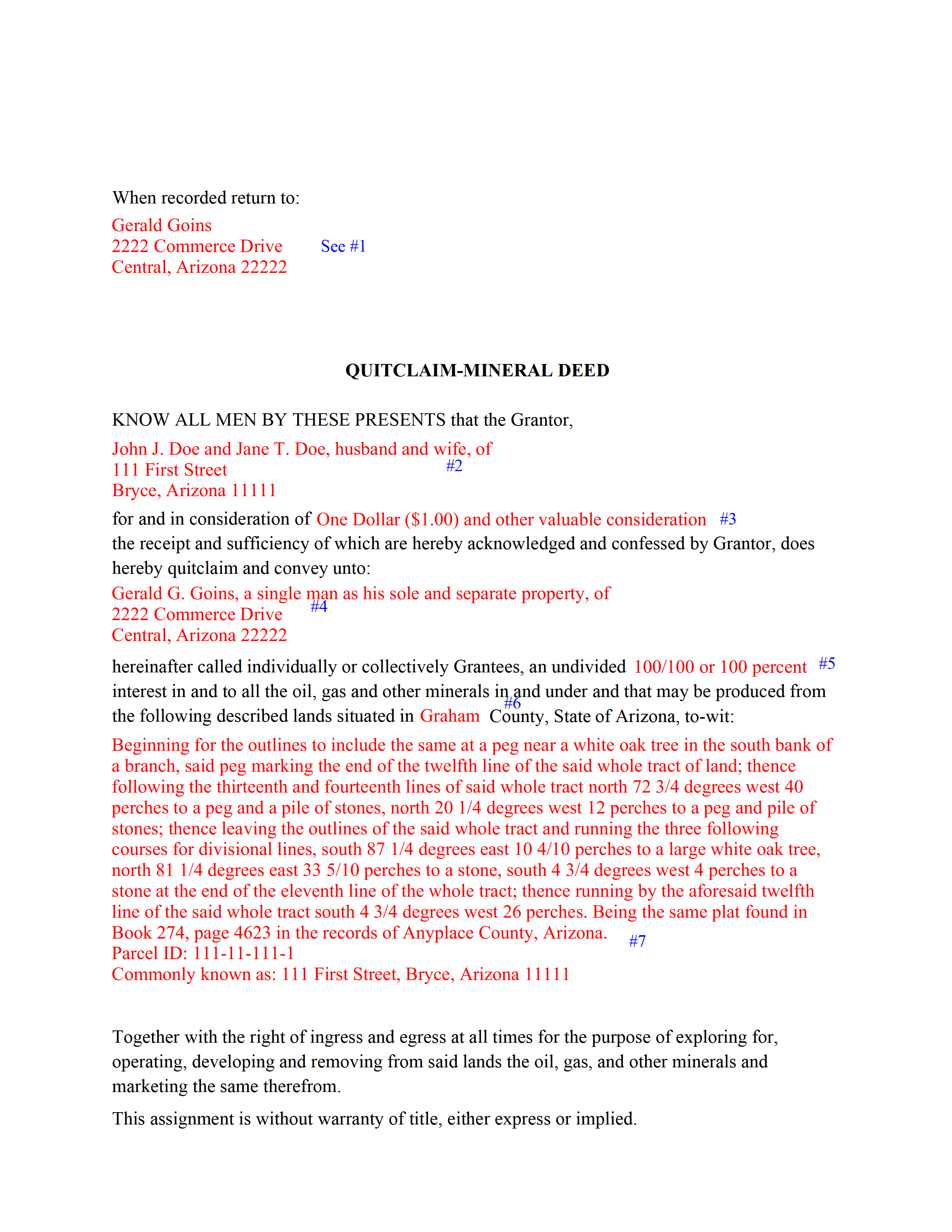
Cochise County Completed Example of the Mineral Quitclaim Deed Document
Example of a properly completed Arizona Mineral Quitclaim Deed document for reference.
All 3 documents above included • One-time purchase • No recurring fees
Immediate Download • Secure Checkout
Additional Arizona and Cochise County documents included at no extra charge:
Where to Record Your Documents
Recorder's Office
Bisbee, Arizona 85603
Hours: 8:00am - 5:00pm Monday - Friday
Phone: 520-432-8350
Recording Tips for Cochise County:
- Bring your driver's license or state-issued photo ID
- Ensure all signatures are in blue or black ink
- Verify all names are spelled correctly before recording
- White-out or correction fluid may cause rejection
- Ask about their eRecording option for future transactions
Cities and Jurisdictions in Cochise County
Properties in any of these areas use Cochise County forms:
- Benson
- Bisbee
- Bowie
- Cochise
- Douglas
- Dragoon
- Elfrida
- Fort Huachuca
- Hereford
- Huachuca City
- Mc Neal
- Naco
- Pearce
- Pirtleville
- Pomerene
- Saint David
- San Simon
- Sierra Vista
- Tombstone
- Willcox
Hours, fees, requirements, and more for Cochise County
How do I get my forms?
Forms are available for immediate download after payment. The Cochise County forms will be in your account ready to download to your computer. An account is created for you during checkout if you don't have one. Forms are NOT emailed.
Are these forms guaranteed to be recordable in Cochise County?
Yes. Our form blanks are guaranteed to meet or exceed the applicable formatting requirements used for recording in Cochise County, including margin requirements, font requirements, and other layout standards. This guarantee applies to formatting, not to the legal sufficiency of information entered by the user or the suitability of a form for a particular transaction.
Can I reuse these forms?
Yes. You can reuse the forms for your personal use. For example, if you have multiple properties in Cochise County you only need to order once.
What do I need to use these forms?
The forms are PDFs that you fill out on your computer. The free Adobe Acrobat Reader is recommended, and most PDF apps also work. You do NOT enter your property information online - you download the blank forms and complete them privately on your own computer.
Are there any recurring fees?
No. This is a one-time purchase. Nothing to cancel, no memberships, no recurring fees.
How much does it cost to record in Cochise County?
Recording fees in Cochise County vary. Contact the recorder's office at 520-432-8350 for current fees.
Questions answered? Let's get started!
The Arizona Mineral Quitclaim Deed transfers whatever interest the grantor holds in the mineral estate — oil, gas, and other minerals — without any warranty of title. It is the mineral-rights counterpart to an ordinary quitclaim deed: the grantor conveys only what the grantor has, makes no representations about the extent or quality of that interest, and does not defend the grantee against competing claims. That lack of warranty is the distinguishing feature and the reason the form exists separately from the general mineral deed under ARS 33-402. Arizona mineral title chains are long, fragmented, and frequently ambiguous after generations of partial severances, probate transfers, and tax sales, and the quitclaim is often the only viable vehicle for clearing fractional interests out of a chain when the grantor cannot credibly warrant a title the grantor does not fully understand.
When the Arizona Mineral Quitclaim Deed Is Used
Mineral quitclaims are used in situations where someone wants to release whatever mineral interest they might hold without representing what that interest actually is. Typical uses include settling estates where a decedent may have held fractional mineral interests that are poorly documented, resolving disputes between family members over inherited mineral rights, clearing clouds on title where an old recorded document suggests the grantor might have a residual interest even though the grantor believes they do not, consolidating mineral ownership when an operator or investor is building a block and wants every possible claimant to release, and transfers between related parties where the parties are comfortable operating without warranty protection. The form is also used after a severance of mineral and surface rights, when a party who held or may have held an interest wants to relinquish any claim so the other party's position is clear.
What the Quitclaim Conveys — and What It Does Not
The deed uses quitclaim language — typically "the grantor quitclaims to the grantee all of the grantor's right, title, and interest, if any, in the described mineral estate." Three features define what that language does. First, the grantor transfers only the interest the grantor actually holds at the moment of delivery. If the grantor holds nothing, nothing is conveyed; if the grantor holds a 1/16 interest, a 1/16 interest is conveyed; if the grantor holds what the grantor believes to be a 1/4 interest but actually holds a 1/8 interest, the grantee takes the 1/8 and has no claim against the grantor for the difference. Second, no implied covenants attach — the ARS 33-435 covenants that arise when a deed uses "grant" or "convey" do not apply to a quitclaim, because the quitclaim language expressly disclaims them. Third, quitclaim deeds in Arizona do not pass after-acquired title: if the grantor later acquires a better mineral interest in the same property, that later interest stays with the grantor. A grant deed carries after-acquired title automatically; a quitclaim deed does not.
When the deed does convey an interest, it conveys the mineral estate together with the practical rights that make it usable: royalties, overriding royalties, net profits interests, and the right to access the land for mining, drilling, exploring, operating, developing, storing, transporting, and marketing minerals. The grantor may convey all of the grantor's interest or a specific fractional portion. When fractions are involved, the deed should state the fractional interest being quitclaimed with precision.
Severed Mineral Estates and Surface Access
Arizona recognizes severance of mineral and surface estates as a fundamental property-law principle. Once severed, the mineral estate is a separate property interest, owned and transferable independently of the surface. The mineral estate is also the dominant estate: its owner has the implied right to use as much of the surface as is reasonably necessary to develop the minerals, subject to reasonable-use limits and any specific surface-damage obligations. These rules apply to interests conveyed by mineral quitclaim just as they apply to interests conveyed by general mineral deed — the lack of warranty does not shrink the substantive rights that come with whatever interest is conveyed. It shrinks only the grantor's promises about that interest.
State Trust Land and Federal Land
Private mineral deeds — including quitclaims — reach only privately owned minerals. Arizona's state trust land, administered by the Arizona State Land Department under ARS Title 37, covers roughly nine million acres, and mineral rights on state trust land are leased by the State Land Department under competitive procedures rather than held in private chains. Federal land in Arizona is administered under separate federal frameworks, including the General Mining Law of 1872 for hardrock minerals on public domain lands and federal leasing statutes for oil, gas, and certain leasable minerals. A quitclaim that purports to cover minerals on state trust or federal land has no effect on those public interests; it reaches only the private minerals, if any, that the grantor actually holds. Grantors and grantees should both be clear on which interests are actually in play before the deed is executed.
"Subject To" Existing Leases
When the mineral estate is already leased, a quitclaim conveyance passes the grantor's interest subject to the existing lease. The grantee steps into the grantor's position for royalty and rental payments going forward and is bound by the operational terms the lease imposes. Whether the deed expressly says so or not, the grantee cannot terminate or disregard an existing lease simply by acquiring the mineral owner's position through a quitclaim; lease terms survive the transfer of the underlying fee. The practical point is that a mineral quitclaim does not create a clean slate — it moves whatever the grantor held, in whatever condition, to the grantee.
Community Property and Spousal Joinder
Arizona is a community property state, and mineral interests acquired by either spouse during marriage are presumed to be community property unless a separate-property exception applies (ARS 25-211). Both spouses must sign when community property mineral interests are being quitclaimed; a quitclaim by one spouse alone is voidable by the other. When the interest is the separate property of one spouse — typically inherited mineral rights, or interests acquired before marriage — the separate owner can sign alone, but the marital status of the grantor belongs in the conveyancing clause so the record shows the basis for the solo signature. When the grantor is a business entity or a trust, the signature block should reflect representative capacity, and any necessary authorization should be documented or recorded.
Execution and Acknowledgment
Under ARS 33-401, the deed must be in writing, subscribed by the grantor, and acknowledged before a notary public or other officer authorized to take acknowledgments. Arizona does not require subscribing witnesses. Acknowledgments taken outside Arizona must comply with ARS 33-501, which recognizes notaries, judges and clerks of courts of record, and any other officer authorized to perform notarial acts in the state where the acknowledgment is taken. Mineral quitclaims are frequently signed out of state — non-resident heirs, distant family members releasing fractional interests — and the acknowledgment form has to comply with Arizona's foreign-acknowledgment rules to be recordable.
Affidavit of Property Value and Exemptions
Arizona requires an Affidavit of Property Value, signed by both grantor and grantee, to accompany most instruments transferring an interest in real property (ARS 11-1133), and mineral quitclaims fall within that requirement. In practice, most mineral quitclaims qualify for an exemption under ARS 11-1134 — quitclaims between family members, transfers to or from a revocable trust by the trustor, quitclaims for no consideration to clear title clouds, releases between entities under common control. When an exemption applies, a statement that the transfer is exempt, together with a citation to the specific exemption subsection, must appear on the face of the deed below the legal description. Quitclaims that omit the exemption recital are routinely rejected at the recorder's window, even when the transaction plainly qualifies. When the quitclaim is given for meaningful consideration — a release purchased from a dissident fractional holder to clear a block, for example — the affidavit may be required rather than exempt.
Formatting, Recording, and Priority
ARS 11-480 sets formatting requirements for every recordable instrument: legible type of at least ten points, white paper no larger than 8.5 by 14 inches, a caption identifying the document (for example, "Mineral Quitclaim Deed"), a top margin of at least two inches on the first page reserved for the recorder's stamp, and minimum half-inch margins elsewhere. Record the deed in each county where the underlying land is located; mineral estates often span parcels in more than one county, and recording only in one creates gaps in the title chain.
Arizona's race-notice rule at ARS 33-412 applies to mineral quitclaims as to any other conveyance: an unrecorded deed is void as against a subsequent purchaser for value who records first without notice. Given that quitclaims are often used specifically to clear clouds on title, the timing of recording matters — a quitclaim that is executed but not promptly recorded does not actually clear the cloud, because title examiners cannot see it until it is indexed.
What's Included in the Download Package
The Arizona Mineral Quitclaim Deed package includes the deed form drafted to release whatever interest the grantor holds in the mineral estate, detailed guidelines covering the Arizona-specific drafting and recording requirements and the interaction with severed estates and existing leases, and a completed example showing how the form should look for a typical release. All files are available for instant download after purchase.
Important: Your property must be located in Cochise County to use these forms. Documents should be recorded at the county recording office listed above.
This Mineral Quitclaim Deed meets all recording requirements specific to Cochise County.
Our Promise
The documents you receive here are guaranteed to meet or exceed the applicable Cochise County recording format requirements. If there is a rejection caused by our formatting, we will correct the issue or refund your payment. This guarantee applies to document formatting only and does not extend to information entered by the user, the selection of the form, or the legal effect of the completed document.
Save Time and Money
Get your Cochise County Mineral Quitclaim Deed form done right the first time with Deeds.com Uniform Conveyancing Blanks. At Deeds.com, we understand that your time and money are valuable resources, and we don't want you to face a penalty fee or rejection imposed by a county recorder for submitting nonstandard documents. We constantly review and update our forms to meet rapidly changing state and county recording requirements for roughly 3,500 counties and local jurisdictions.
4.8 out of 5 - ( 4,824 Reviews )
Harry B. 5 out of 5 stars
I received exactly what I was looking for on Deeds.com. Not only that, but this website provided instructions for form completion, and an example of a completed form. I'm certainly glad I chose this website.
Thank you for your feedback. We really appreciate it. Have a great day!
Michael R. 5 out of 5 stars
This process was so easy.
We appreciate your business and value your feedback. Thank you. Have a wonderful day!
Richard C. 5 out of 5 stars
Amazing from start to finish!
Thank you for your feedback. We really appreciate it. Have a great day!
Kenneth C. 5 out of 5 stars
Great forms, easy to use if you have at least a sixth grade education.
Thank you!
Imari E. 5 out of 5 stars
QUICK SERVICE
Thank you!
Marjorie D. 5 out of 5 stars
Makes recording fast and easy. Great service!
Knowing our customers are happy is our top priority. Thank you for the wonderful feedback!
Linda P. 5 out of 5 stars
Web site was easy to navigate and I was very satisfied with my search and forms downloaded
Thank you for choosing our service. We appreciate your review.
Robert C. 5 out of 5 stars
Great service! Easy to navigate and the instructions were perfectly understandable.
We appreciate your business and value your feedback. Thank you. Have a wonderful day!
Linda L. 5 out of 5 stars
Excellent service. Very quick response.
Thank you Linda, we appreciate your feedback.
Shelly S. 4 out of 5 stars
was fairly easy to work through the forms but needed better information on what goes on a few of the lines
Thank you for your feedback. We really appreciate it. Have a great day!
Doris P. 4 out of 5 stars
Easy to understand and fill out Beneficiary Deed, but when I tried to download finished form, it disappeared! Luckily I had printed it first and had to fill out again.
Thank you!
Kathleen M. 5 out of 5 stars
I bought the Beneficiary Deed package for Arizona. The instructions were clear and I had no problem filling out the needed forms. My deed was recorded this afternoon. Thanks so much for your excellent forms.
We appreciate your review and your business. Thank you.
Rhobe M. 5 out of 5 stars
Very user friendly site. I was able to get the information I needed fast.
Thank you!
James W. 5 out of 5 stars
We were able to find deceased parents' deed.
Thank you!
JOY W. 5 out of 5 stars
Really great resource to use in a time that can be very stressful. Downloading was very simple and the instructions provided were detailed and easy to follow. I was grateful to have found this.
Thank you for your review, Joy. We’re glad the process was straightforward and helpful when you needed it most.