California Disclaimer of Interest (Trustee or Personal Representative)
County Specific Legal Forms Validated as recently as September 17, 2026 by our Forms Development Team
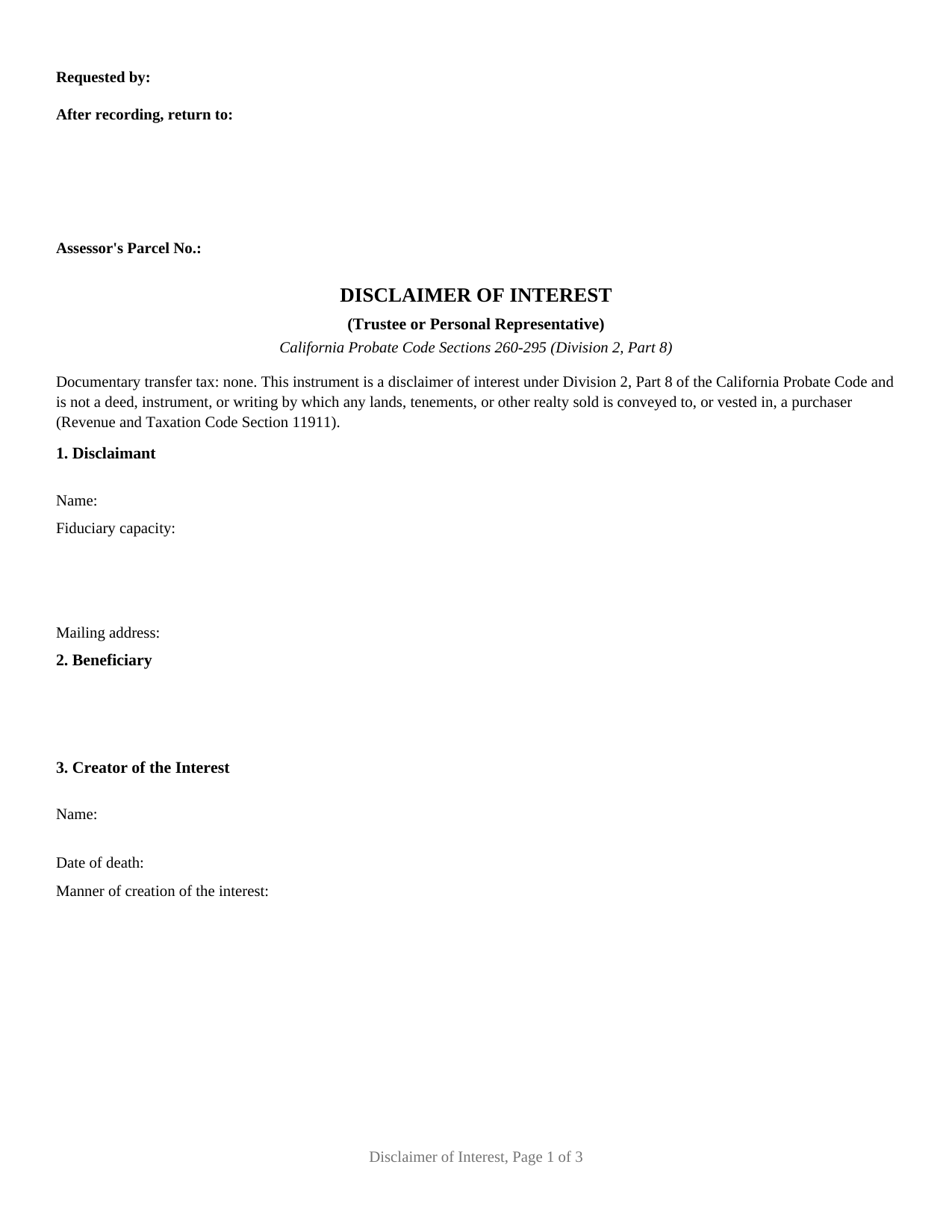
About the California Disclaimer of Interest (Trustee or Personal Representative)
How to Use This Form
- Select your county from the list
- Download the county-specific form
- Fill in the required information
- Have the document notarized if required
- Record with your county recorder's office
What Others Like You Are Saying
"Transaction went smoothly. The forms in the package were just what was needed."
"I used the Quitclaim form. The form was easy to complete without using the example or guide. $21 was…"
"Easy to follow; user friendly."
"Very straightforward, and fair-enough pricing."
"FANTASTIC. Sometimes we think know something, glad I found out I was wrong before it was too late."
4.8/5 from 4,819 reviews. Read all
A California disclaimer of interest is the writing by which a beneficiary refuses an inheritance or other interest instead of taking it. This version of the form carries a fiduciary signer: the trustee of a trust that is entitled to take an interest, or the personal representative of a deceased beneficiary, executing the refusal on the beneficiary's behalf under Probate Code Sections 264 and 275.
A refusal signed in a fiduciary office
California's disclaimer statute, Part 8 of Division 2 of the Probate Code, defines the disclaimant to include a person who executes a disclaimer on behalf of a beneficiary. When a will or beneficiary designation runs to a trust, the trustee signs the refusal for the trust, stating the office held on the form's fiduciary capacity line. When the beneficiary died before disclaiming, Probate Code Section 277 puts the power in the personal representative of the beneficiary's estate and, outside the Independent Administration of Estates Act, conditions the disclaimer on a court order finding that the decedent as a prudent person would have refused the interest. That petition and order come out of the probate proceeding itself; they are prepared separately and are not included in this package. The form's court order section identifies the resulting order by court, case number, and date, and a trustee signing without one enters None there.
Where the disclaimed interest goes
A disclaimer names no replacement taker. Under Probate Code Section 282, the disclaimed interest descends as if the disclaiming beneficiary had predeceased the creator of the interest, unless the creating instrument provides its own disposition on disclaimer, and the refusal relates back to the creator's death for all purposes. Once effective it is irrevocable and binds the beneficiary, everyone claiming through the beneficiary, and the beneficiary's creditors (Section 281), and Section 283 provides that the disclaimer is not a fraudulent transfer. The statute closes the door after acceptance: a beneficiary who has taken the interest or a benefit under it, transferred or encumbered it, or waived the right to disclaim in writing can no longer disclaim it (Section 285).
Nine months, measured from the statute
Probate Code Section 279 requires the disclaimer to be filed within a reasonable time after the person able to disclaim learns of the interest, and it makes nine months a conclusive presumption of reasonableness for the familiar classes: interests under a will, by intestate succession, by surviving a joint tenant, under life insurance, retirement accounts, and employee benefit plans, and under a transfer on death deed designation. Filing means delivery under Section 280(a) to the superior court where the estate is administered, to the fiduciary responsible for distributing the interest, or to the creator of the interest. On a later filing, the disclaimant carries the burden of establishing that it came within a reasonable time.
Recording when California real property is involved
Where the disclaimed interest touches real property or an obligation secured by real property, Section 280(b) lets an acknowledged disclaimer be recorded with the county recorder where the land lies, in like manner and with like effect as a grant of real property, so the chain of title shows the refusal. The form is laid out for that recording: the first page reserves the recorder's stamp space with the requester, return address, and parcel number entries, the title sits directly below, and the face states that no documentary transfer tax applies because nothing is sold for consideration. The property description section carries the county, the full legal description from the prior recorded deed, and the prior recording reference.
What this configuration recites
The instrument carries one signature block and one acknowledgment certificate, the California all-purpose certificate with the boxed notary notice of Civil Code Section 1189. Its operative section executes the disclaimer solely in the fiduciary capacity stated on the form and on behalf of the identified beneficiary, and the statutory extent election prints both alternatives the statute supplies, in whole and in part, with one box to mark. A beneficiary refusing an interest in the beneficiary's own personal right, and a conservator's or guardian's disclaimer for a conservatee or minor, follow different signing and court order patterns than this form recites.
The download includes the fillable disclaimer of interest form, a completed example showing a trustee's disclaimer of a devised one-half interest in Alameda County real property, and a guide that walks through each section with the governing Probate Code citations. The materials are informational and are not legal advice; an attorney can weigh how a disclaimer operates on a particular estate, trust, or title.
Important: County-Specific Forms
Our disclaimer of interest (trustee or personal representative) forms are specifically formatted for each of the 58 counties in California.
After selecting your county, you'll receive forms that meet all local recording requirements, ensuring your documents will be accepted without delays or rejection fees.