Illinois Quitclaim Deed (Individual Grantor by Attorney-in-Fact)
County Specific Legal Forms Validated as recently as October 15, 2026 by our Forms Development Team
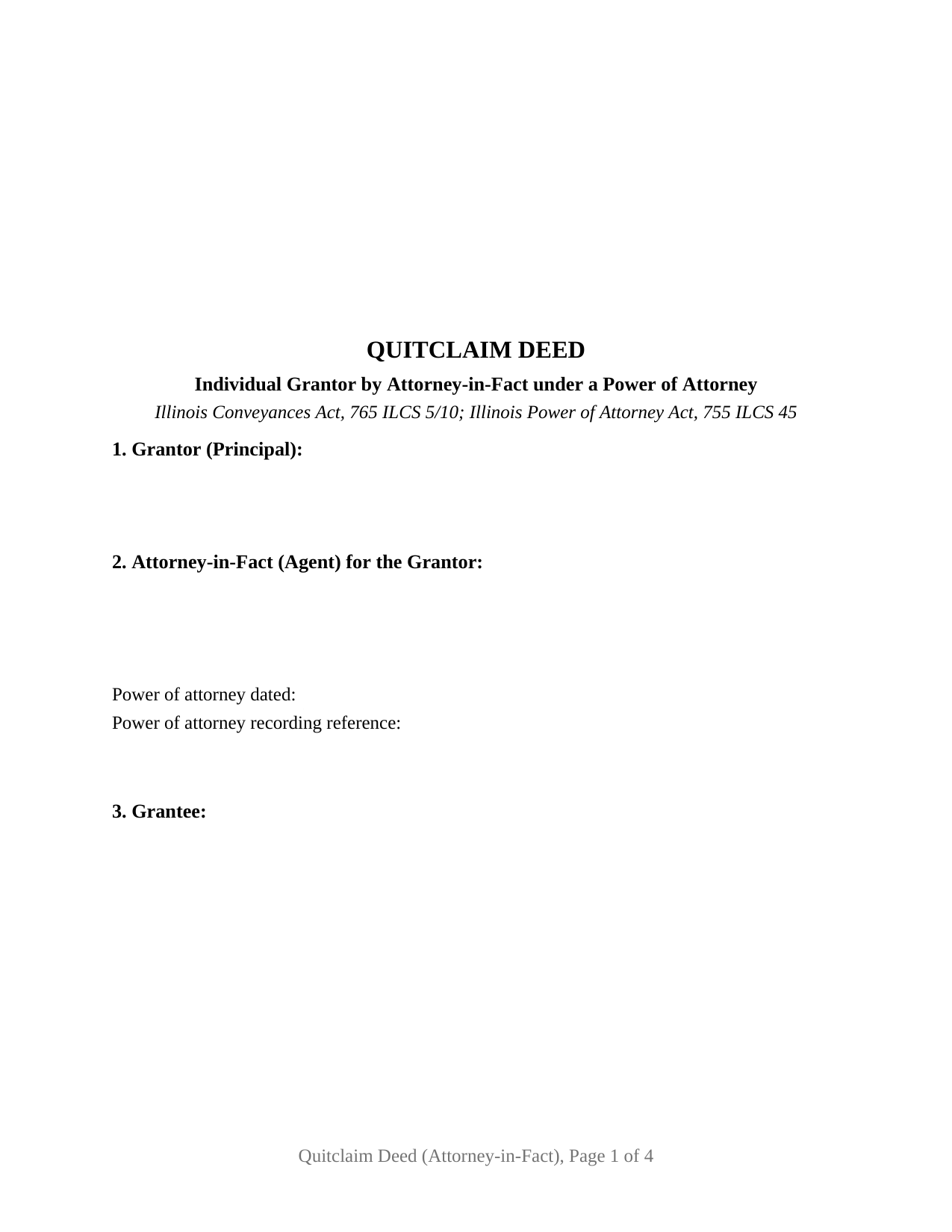
About the Illinois Quitclaim Deed (Individual Grantor by Attorney-in-Fact)
How to Use This Form
- Select your county from the list
- Download the county-specific form
- Fill in the required information
- Have the document notarized if required
- Record with your county recorder's office
What Others Like You Are Saying
"Great!"
"Deeds.com handled my needs quickly and very economically. I would recommend them to anyone needing t…"
"Prompt and helpful"
"Very easy...found what I was looking for"
"Perfect quitclaim form. Easy to fill in with the required information and all the required informati…"
4.8/5 from 4,828 reviews. Read all
Two names sit above the signature line on this Illinois quitclaim deed, and only one of them signs. The record owner stands alone as Grantor; the individual holding that owner's power of attorney executes the deed. Section 2 ties that signature to a dated power of attorney and its recording reference, so the authority sits in the county records too.
What the power of attorney has to authorize
The Conveyances Act settles the threshold question in its opening section: under 765 ILCS 5/1 a conveyance in writing may be signed by the party making it or by that party's authorized agent, so an attorney-in-fact's signature makes the deed the principal's conveyance. Scope comes from the Illinois Power of Attorney Act. Category (a) of the statutory short form covers real estate transactions, and 755 ILCS 45/3-4 defines it: an agent holding that category may buy, sell, exchange, rent, and lease real estate, may "convey, assign and accept title to real estate," and may "release rights of homestead with respect to real estate." Illinois prescribes no separate statutory deed form for an agent, so the quitclaim form of 765 ILCS 5/10 is the form, executed in a stated capacity.
The gift limit written into the short form
One boundary inside the Act lands squarely on deeds. The closing language of 755 ILCS 45/3-4 withholds from every statutory category, (a) through (o), the power to make gifts of the principal's property or to change a designated beneficiary, unless specific authority appears in paragraph 3 of the short form. The land records feel that limit: 755 ILCS 45/2-8(b) makes a title insurer's refusal to insure such a gift reasonable cause to refuse the power.
What the attorney-in-fact configuration carries
Section 1 names the individual record owner as Grantor; Section 2 names the person signing, the date the principal signed the power of attorney, and that instrument's recording reference. Section 11 then states that the Grantor conveys and quit claims by that agent under that power, that the signer acts as attorney-in-fact and not individually and takes on no personal obligation, and that no warranty of title accompanies the transfer, with the express homestead release clause of the Illinois statutory forms in the same sentence, reaching the principal's own homestead rights under 755 ILCS 45/3-4(a). Below that sit one signature line, one printed name line carrying name and capacity as 765 ILCS 5/35c contemplates, and one acknowledgment certificate under 765 ILCS 5/26, completed for the person who appears, the agent. Title patterns presenting this configuration include an owner living outside Illinois when the deed is delivered and an owner under a durable power whose agent conveys for value during incapacity. Two record owners sit outside this layout, as does a non-principal spouse's own homestead release, which 765 ILCS 5/27 leaves to that spouse.
Two instruments, one county record
765 ILCS 5/28 names powers of attorney among the instruments affecting title recorded where the real estate sits, so an agent's deed and its power usually reach the counter together, hence the document number entry in Section 2. Under 755 ILCS 45/2-5 the agency runs until the principal's death absent an earlier stated termination date.
What the deed moves, and what it leaves alone
A quit claim deed on the statutory form hands over the interest the Grantor holds when it is delivered and stops there: no covenant of title, and nothing acquired afterward unless Section 10 adds words for that. Recorded mortgages, liens, easements, and plat restrictions survive the transfer untouched.
Transfer tax with the agent's signature on it
35 ILCS 200/31-25 has the declaration signed by at least one seller and one buyer, or by their attorneys or agents, and that last phrase is what an attorney-in-fact signs under. A taxable transfer travels with Form PTAX-203 or its MyDec equivalent and stamps at 50 cents per $500 of value; 55 ILCS 5/3-5021 adds municipal proof where a home rule ordinance is certified. An exempt one records on a signed, dated notation naming its paragraph of 35 ILCS 200/31-45. The example takes the taxable route for a Macon County sale.
Three files arrive with the purchase: the fillable deed, an example filled in from the first entry down to the notary's commission date, and a guide on every numbered section, authority, homestead, notarization, and recording. Nothing here is legal advice. The description is general, and an Illinois attorney reviews a specific power of attorney, a specific title, and the transfer they are meant to accomplish.
Important: County-Specific Forms
Our quitclaim deed (individual grantor by attorney-in-fact) forms are specifically formatted for each of the 102 counties in Illinois.
After selecting your county, you'll receive forms that meet all local recording requirements, ensuring your documents will be accepted without delays or rejection fees.