Illinois Quitclaim Deed (Corrective)
County Specific Legal Forms Validated as recently as October 15, 2026 by our Forms Development Team
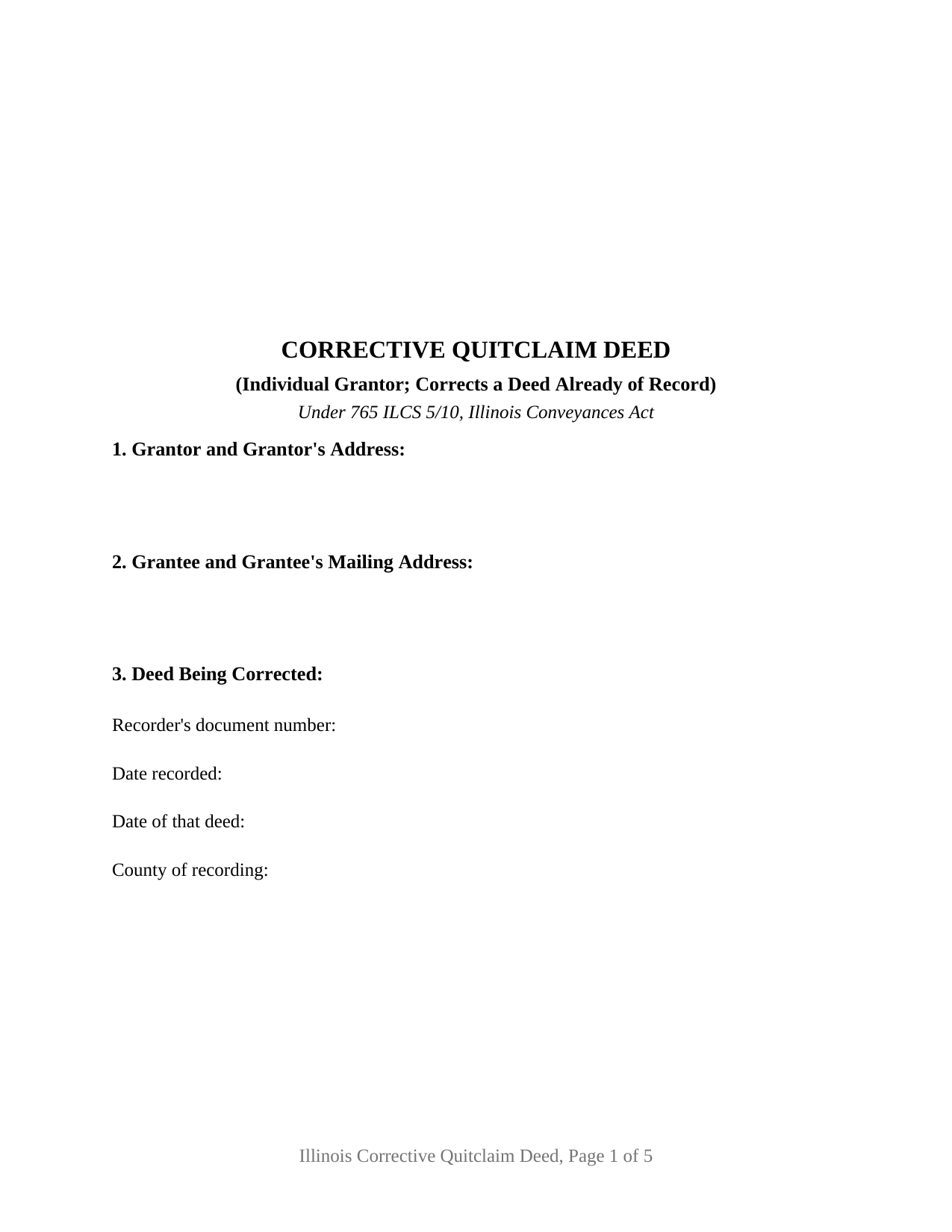
About the Illinois Quitclaim Deed (Corrective)
How to Use This Form
- Select your county from the list
- Download the county-specific form
- Fill in the required information
- Have the document notarized if required
- Record with your county recorder's office
What Others Like You Are Saying
"Great place to find much needed documents. A huge thanks!"
"Happy to give you a 5 star rating. We have never been a position to get changes on and record our ow…"
"Wonderful tool to have available on line!"
"Great service & quick response. Thank U."
"I haven't taken the forms to our county clerk for recording yet so not sure they contain all needed …"
4.8/5 from 4,831 reviews. Read all
An Illinois deed cannot be edited once the recorder has stamped it. The record keeps what was filed, transposed digits and all, and the repair is a second instrument that speaks about the first. This corrective quitclaim deed is arranged for that job: the individual who signed the deed of record signs again, names that deed by its document number, states the item it got wrong beside the item as corrected, and restates the conveyance in the statutory words of 765 ILCS 5/10.
Paragraph (d), and the condition it turns on
Illinois transfer tax law names this instrument directly. Under 35 ILCS 200/31-45(d), a deed that, without additional consideration, confirms, corrects, modifies, or supplements a previously recorded deed is exempt from Article 31 of the Property Tax Code, and the Department of Revenue instructions for Form PTAX-203 group that paragraph with the exemptions recorded on a notation of exempt status written on the face of the deed rather than on a filed declaration. What the paragraph turns on is the absence of new money, not the caption: a correction carrying fresh consideration is an ordinary taxable conveyance. Section 10 prints the statement that no additional consideration passes, a blank for the paragraph claimed, and a signature and date for the notation.
The document number that ties the two deeds together
55 ILCS 5/3-5020.5 has every recorded instrument carry the recorder's document number, or book and page, of any instrument it refers to and of any instrument related to it. On most deeds that entry is a courtesy to the next title searcher. On a correction deed it is the entire mechanism, because an instrument that does not name what it corrects floats loose in the grantor and grantee indexes. Section 3 gathers four identifiers of the deed being corrected: the document number, the date of recording, the date of the deed itself, and the county where it was filed. Section 7 then states the item twice, once as the recorded deed put it and once as corrected, so the reach of the change sits on the face of the new deed.
What the corrective configuration carries
The form recites one individual grantor, the person named as grantor in the deed being corrected, and one grantee block carrying the grantee that deed named. Below the operative section sit one signature line and one acknowledgment certificate following the substance of 765 ILCS 5/26, with the express homestead release language of the Illinois statutory forms inside the granting sentence, where 765 ILCS 5/27 requires it to be stated rather than implied. That section corrects the earlier deed in the respects stated in Section 7 and in no other respect, confirms it otherwise, and disclaims any covenant of title. Scrivener's errors presenting this configuration include a transposed lot or block number, a plat document number written incorrectly, a misspelled party name, a wrong permanent index number, an omitted homestead clause, and a defective acknowledgment on the recorded deed. A deed executed by two record owners takes both of their signatures and sits outside this one-signer layout, as does an entity grantor; and where the parcel is an occupied homestead and the grantor is married, 735 ILCS 5/12-904 conditions a valid release of that estate on a writing signed by the individual and that individual's spouse.
Where a signed correction stops
A corrective deed has force because the hand that made the original conveyance restates it voluntarily. Where the grantor has died, cannot be located, or denies that anything was wrong, the question leaves the recorder's counter for a courtroom, and Illinois sets a demanding bar: reformation calls for a mistake of fact, mutual and common to both parties, proved by clear and convincing evidence, the ground on which Skelly v. Ersch reformed a deed in 1922. Nor does the new deed erase the old one or borrow its date. Both instruments stay in the chain, and 765 ILCS 5/30 measures each against creditors and subsequent purchasers without notice from the time it was filed.
Three files come with the purchase: the corrective quitclaim deed as a fillable PDF, a completed example for a Rock Island County deed that described the wrong lot number, and a guide walking every numbered section together with the homestead, notarization, and recording questions a correction raises. None of this is legal advice. It sets out Illinois law in general terms, and one particular error in one chain of title is a question for an Illinois attorney or title company.
Important: County-Specific Forms
Our quitclaim deed (corrective) forms are specifically formatted for each of the 102 counties in Illinois.
After selecting your county, you'll receive forms that meet all local recording requirements, ensuring your documents will be accepted without delays or rejection fees.