Illinois Quitclaim Deed (Married Couple as Grantors)
County Specific Legal Forms Validated as recently as October 15, 2026 by our Forms Development Team
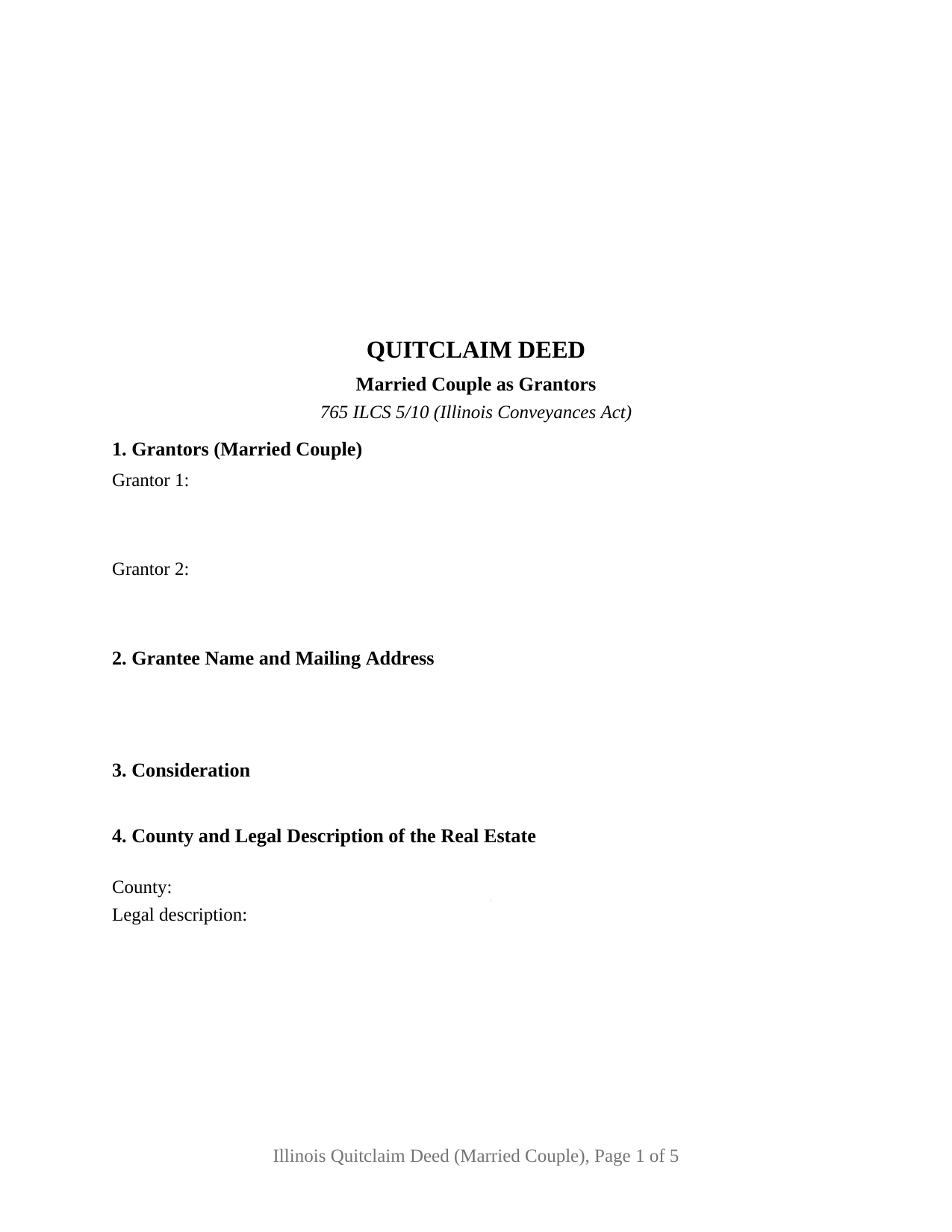
About the Illinois Quitclaim Deed (Married Couple as Grantors)
How to Use This Form
- Select your county from the list
- Download the county-specific form
- Fill in the required information
- Have the document notarized if required
- Record with your county recorder's office
What Others Like You Are Saying
"Easy to use and the sample really helped."
"Super simple to download all necessary forms. BIG thank you for this service."
"I was quite pleased with Deeds.com. I got the information I requested instantly."
"Love Deeds.com! I was a little confused as to how to go about Quitclaiming, but you made it very eas…"
"It was fast and easy to find."
4.8/5 from 4,828 reviews. Read all
Two spouses can pass their whole title in one Illinois quitclaim deed, and this form is arranged for exactly that transfer: a married couple, or the parties to a civil union, joining as co-grantors in a single instrument under 765 ILCS 5/10. The deed recites the grantors' relationship in its operative clause, applies the statutory convey and quit claim words to both interests at once, and carries the signature set that a couple's conveyance produces.
A deed that recites the marriage
The operative clause states that the grantors are married to each other or are parties to a civil union with each other, wording that tracks the gender-neutral spouse and civil-union amendments to the Conveyances Act effective January 1, 2026, and the equal-treatment rule of 750 ILCS 75/20. The recital states the couple's status; it does not establish that status, and the marriage or civil union record remains its proof. What the recital signals to anyone reading the chain of title is that the spousal signatures Illinois homestead law looks for are on the face of the deed: 765 ILCS 5/27 requires an express clause before any deed releases the homestead exemption, 735 ILCS 5/12-904 makes a release or conveyance of the exempt estate valid only in a writing signed by the individual and spouse, and 765 ILCS 1005/1c makes a deed of homestead property held in tenancy by the entirety effective only when both tenants sign. With the two spouses named as the two grantors, each requirement is answered inside the instrument itself, alongside the printed release clause.
What the married-couple configuration carries
The form recites two grantor blocks, each with a printed name and residence, one operative sentence conveying every interest both grantors hold, and an acknowledgment certificate for each signer, so the spouses may acknowledge on different dates or before different notaries. Illinois law does not call for one certificate per signer; the statutory certificate of 765 ILCS 5/26 covers signers who appear together, and the layout simply accommodates spouses who sign apart. Ownership patterns that present this configuration include spouses funding a shared revocable living trust with their home, a couple deeding a jointly held rental parcel to the limited liability company they organized, and spouses joining in a release that settles a boundary line with a neighbor. The form is not set up as a sole-owner instrument, and it does not recite co-owners outside a marriage or civil union.
Entirety title, into and out of the deed
Tenancy by the entirety runs through this configuration in both directions. Property the couple already holds by the entirety moves only on the signatures of both tenants, which are exactly the signatures this quit claim deed collects. On the receiving side, the additional-provisions section accepts the specific statement 765 ILCS 1005/1c requires when spouses convey homestead title to the trustees of their revocable trust with entirety treatment preserved; a generic deed to a trust does not carry that treatment on its own. The completed example shows the drafting in full: a Champaign County couple conveying their home to themselves as co-trustees of a family trust, with the statutory entirety statement in Section 8 and the transfer tax notation claiming paragraph (e) of 35 ILCS 200/31-45, the exemption for a transfer whose actual consideration is under $100.
The recording package around the signatures
The deed collects what Illinois recorders check at intake: the 55 ILCS 5/3-5022 preparer statement, the grantee name and mailing address the recorder looks for on the face of the instrument (55 ILCS 5/3-5026), the tax bill endorsement of 765 ILCS 5/35c, a return-to block, and the prior deed's document number (55 ILCS 5/3-5020.5). The layout follows statewide format standards, reserving the 3 by 5 inch blank the recorder stamps at the upper right of page one, so the printed husband and wife quitclaim deed presents as a standard-class document on a county's flat fee schedule. A taxable transfer travels with the PTAX-203 declaration, or its MyDec equivalent, and the required stamps; an exempt transfer records on the face-of-deed notation alone.
The purchase includes three items: the deed as a fillable PDF, an example completed start to finish for the Champaign County trust transfer described above, and a guide that explains each numbered entry along with the signing, homestead, and recording rules. Nothing here is legal advice; these materials describe Illinois law in general terms, and questions about a specific marriage, title, or estate plan belong with an Illinois attorney.
Important: County-Specific Forms
Our quitclaim deed (married couple as grantors) forms are specifically formatted for each of the 102 counties in Illinois.
After selecting your county, you'll receive forms that meet all local recording requirements, ensuring your documents will be accepted without delays or rejection fees.