Illinois Quitclaim Deed (Married Grantor with Non-Owner Spouse Joinder)
County Specific Legal Forms Validated as recently as September 29, 2026 by our Forms Development Team
About the Illinois Quitclaim Deed (Married Grantor with Non-Owner Spouse Joinder)
How to Use This Form
- Select your county from the list
- Download the county-specific form
- Fill in the required information
- Have the document notarized if required
- Record with your county recorder's office
What Others Like You Are Saying
"Your site was very easy to use and provided all the information needed."
"I found your website easy to use and very informative."
"I am extremely impressed with the quality of this service. They are a pleasure to work with and I kn…"
"Excellent way to do this kind of transaction."
"LOVE this site.. easy to use and very very quick to record"
4.8/5 from 4,828 reviews. Read all
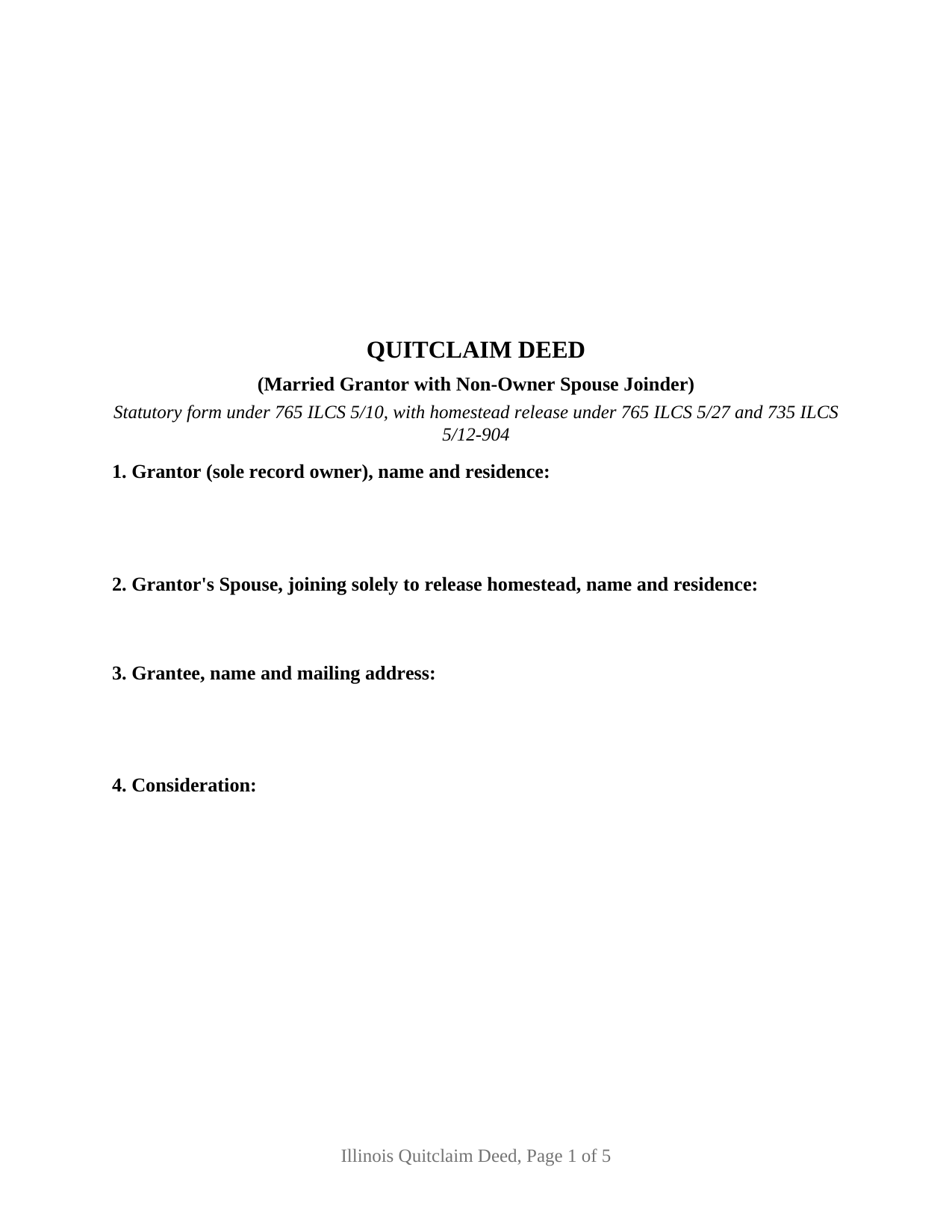
Illinois asks for a signature that catches sellers off guard: a spouse who owns no part of the property signs the deed anyway. This quitclaim deed is arranged around that signature. One married individual holds the record title and conveys it; the spouse who is not on title signs a separate labeled block for one purpose, releasing the homestead estate.
Why a spouse who owns nothing signs
Two statutes work together. 765 ILCS 5/27 provides that no deed is construed as releasing or waiving the right of homestead unless it contains a clause expressly doing so, and that a release by one spouse does not bind the other spouse unless the other joins in it. 735 ILCS 5/12-904 makes a release, waiver, or conveyance of the exempt homestead estate invalid unless it is in writing signed by the individual and that individual's spouse, if any, treating abandonment of possession, or possession given under the conveyance, as the alternatives. The estate protects $50,000 of an individual interest as of January 1, 2026. A deed of an occupied Illinois residence signed by the record owner alone leaves that question open in the chain of title, where a title examiner reads it.
One grantor, one joining spouse, two certificates
The deed names a single grantor in Section 1 and the joining spouse in Section 2, and the operative section keeps the two roles apart. The Grantor conveys and quit claims every interest the Grantor holds, with the express homestead release printed where the Conveyances Act calls for it. A separate sentence states that the spouse joins solely to release and waive homestead rights, conveys no interest, takes on no obligation of the Grantor, and makes no covenant of title, and the second signature block repeats that limitation in its own label. The labeling carries weight: deciding mortgage cases, Illinois appellate courts have given effect to this kind of qualified signature rather than treating the signer as a party to the obligation. Each signer has an acknowledgment certificate, so the two may appear before different notaries on different days, and the certificate form in 765 ILCS 5/26 itself contemplates a spouse acknowledging and being named with the spouse designation.
Titles that present this pattern include a residence one spouse bought before the marriage and still holds alone, a house that came to one spouse by gift or inheritance during the marriage, and a parcel one spouse has always held alone while the couple lives in it. The form is not set up for two record owners signing as grantors, for entirety property where both spouses are already tenants, or for a transfer to the owner's own spouse, which 735 ILCS 5/12-904 excepts from the joinder requirement.
What a quit claim deed moves and what it leaves behind
Under 765 ILCS 5/10, the words convey and quit claim pass, in fee, all existing legal and equitable rights the grantor holds, and nothing more: no covenant of title, no warranty against encumbrances, and no reach to title acquired later unless express words are added for it. Mortgages, judgments, easements, and plat restrictions of record ride through untouched, and moving the record title does nothing to the Grantor's loan liability.
The paperwork a recorder expects with it
Illinois makes certain content a condition of recording, and each item has its labeled place: who prepared the instrument, the grantee name and mailing address, where the recorded original is returned, the document number of the deed the Grantor took title by, and the address for the next tax bills. Page geometry answers the county fee statutes, with letter size sheets, half inch clean margins, and the blank corner the recorder stamps. Section 11 handles transfer tax in either direction, through the PTAX-203 declaration or MyDec, or a completed notation of the paragraph of 35 ILCS 200/31-45 relied on for an exempt transfer. Cook County adds a layer, since the recorder there mails notice to the owners of record whenever a quit claim deed is recorded.
Three files arrive with the purchase: the deed as a fillable PDF, a completed example filled in start to finish for a Winnebago County homestead transfer with the joinder signature in place, and a guide covering each section, the homestead statutes and the decisions reading them, notarization including remote notarization, and county recording steps. All of it is general information about Illinois law rather than legal advice, and an Illinois attorney or title company can speak to one particular homestead and chain of title.
Important: County-Specific Forms
Our quitclaim deed (married grantor with non-owner spouse joinder) forms are specifically formatted for each of the 102 counties in Illinois.
After selecting your county, you'll receive forms that meet all local recording requirements, ensuring your documents will be accepted without delays or rejection fees.