Illinois Quitclaim Deed (Interspousal)
County Specific Legal Forms Validated as recently as October 2, 2026 by our Forms Development Team
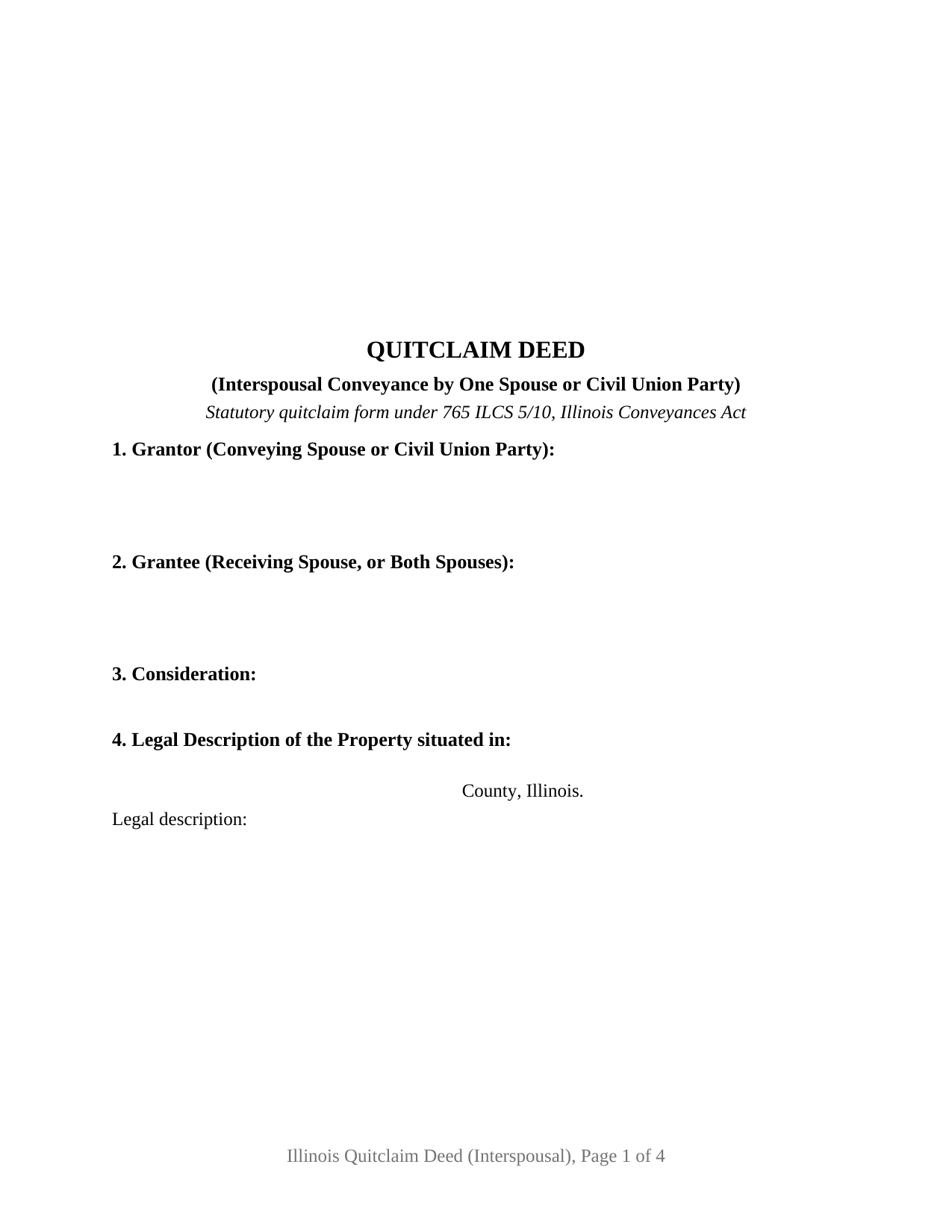
About the Illinois Quitclaim Deed (Interspousal)
How to Use This Form
- Select your county from the list
- Download the county-specific form
- Fill in the required information
- Have the document notarized if required
- Record with your county recorder's office
What Others Like You Are Saying
"I did my Lady Bird Deed in a way the instruction indicated to do. The example you provided make it e…"
"Very happy with my experience with using Deeds.com! Especially easy to use with the sample page of w…"
"I received what I requested. Then I didn't need it after all."
"Site was easy to navigate. I found the lien discharge form I was looking for immediately and the dow…"
"Forms & Guide easy to use. It would have been helpful if the counties with identical form packag…"
4.8/5 from 4,829 reviews. Read all
Illinois homestead law wants two signatures on a deed of an occupied residence, and then names one exception: a conveyance running from an individual grantor to that grantor's own spouse. This interspousal quitclaim deed is arranged for exactly that transfer. One spouse, or one party to a civil union, holds the record title and signs as the only Grantor, and the other spouse is named as Grantee, either alone or beside the conveying spouse.
The exception the homestead statute names
Section 12-904 of the Code of Civil Procedure guards the homestead estate jointly: neither a waiver of it nor a conveyance of it holds up unless the owner and the owner's spouse have both signed. That same section then carves out the movement this form performs, providing that a conveyance from an individual grantor to that grantor's spouse is effectual to pass the expressed title whether or not the spouse joins. The clause itself still prints on the deed, because 765 ILCS 5/27 gives homestead language no effect unless an instrument states it expressly. What the exception takes away is the second signature line, never the clause.
Who signs, and what the deed recites
The form opens with one Grantor block and one Grantee block, applies the statutory words conveys and quit claims to the whole of the Grantor's interest, and finishes with a single signature line under one acknowledgment certificate whose text follows the substance of 765 ILCS 5/26, homestead clause included. Section 11 carries the relationship recital, stating that the Grantor and the Grantee are married to each other or are parties to a civil union with each other; 750 ILCS 75/20 puts civil union parties on the same statutory footing. Patterns that present this configuration include a residence acquired by one spouse before the wedding and afterward shared with the other, and a parcel moved to the spouse whose name goes on a new loan. The form is not set up for two record owners signing together, and it does not reach a homestead the couple already holds by the entirety, where 765 ILCS 1005/1c makes a deed effective only on both tenants' signatures.
Adding a spouse to the title
A spouse to spouse deed is also how an Illinois residence leaves sole ownership for a shared form, and two provisions of the Joint Tenancy Act let that happen in one recording. 765 ILCS 1005/1b permits the estate to be created even where the grantor is or may become one of the tenants, so no straw party holds title in the middle. 765 ILCS 1005/1c supplies the entirety estate for homestead property, open to spouses and civil union parties where the instrument identifies them as such and declares that the conveyance is made not as joint tenants or tenants in common but as tenants by the entirety. Section 9 is where that declaration goes; left empty on a deed to two people, the rule in 765 ILCS 1005/1 leaves them holding as tenants in common. The completed example fills it in for a Peoria County transfer and completes the notation under paragraph (e) of 35 ILCS 200/31-45, the entry for a deed whose actual consideration is under $100.
What a quit claim deed between spouses leaves in place
No covenant of title rides on this instrument, so every mortgage, judgment, lien, easement, and plat restriction already of record survives the transfer, and a Grantor who signed the note stays liable on the debt. Federal law softens one worry that follows a spousal transfer: 12 U.S.C. 1701j-3(d)(6) bars a lender from calling a residential loan secured by fewer than five dwelling units because the borrower's spouse became an owner. Classification is separate again, since 750 ILCS 5/503(b)(1) presumes property acquired during a marriage to be marital property for distribution purposes and reaches non marital property moved into co-ownership between the spouses, whatever form of title the deed used.
Three files arrive with the download: the interspousal quitclaim deed as a fillable PDF, the Peoria County example completed from the first blank through the notary's commission date, and a guide covering each numbered section along with the homestead, signing, and county recording rules. These materials describe Illinois law in general terms and are not legal advice; an Illinois attorney or title company can speak to a particular chain of title.
Important: County-Specific Forms
Our quitclaim deed (interspousal) forms are specifically formatted for each of the 102 counties in Illinois.
After selecting your county, you'll receive forms that meet all local recording requirements, ensuring your documents will be accepted without delays or rejection fees.