Illinois Transfer on Death Instrument (Tenant in Common Interest)
County Specific Legal Forms Validated as recently as October 24, 2026 by our Forms Development Team
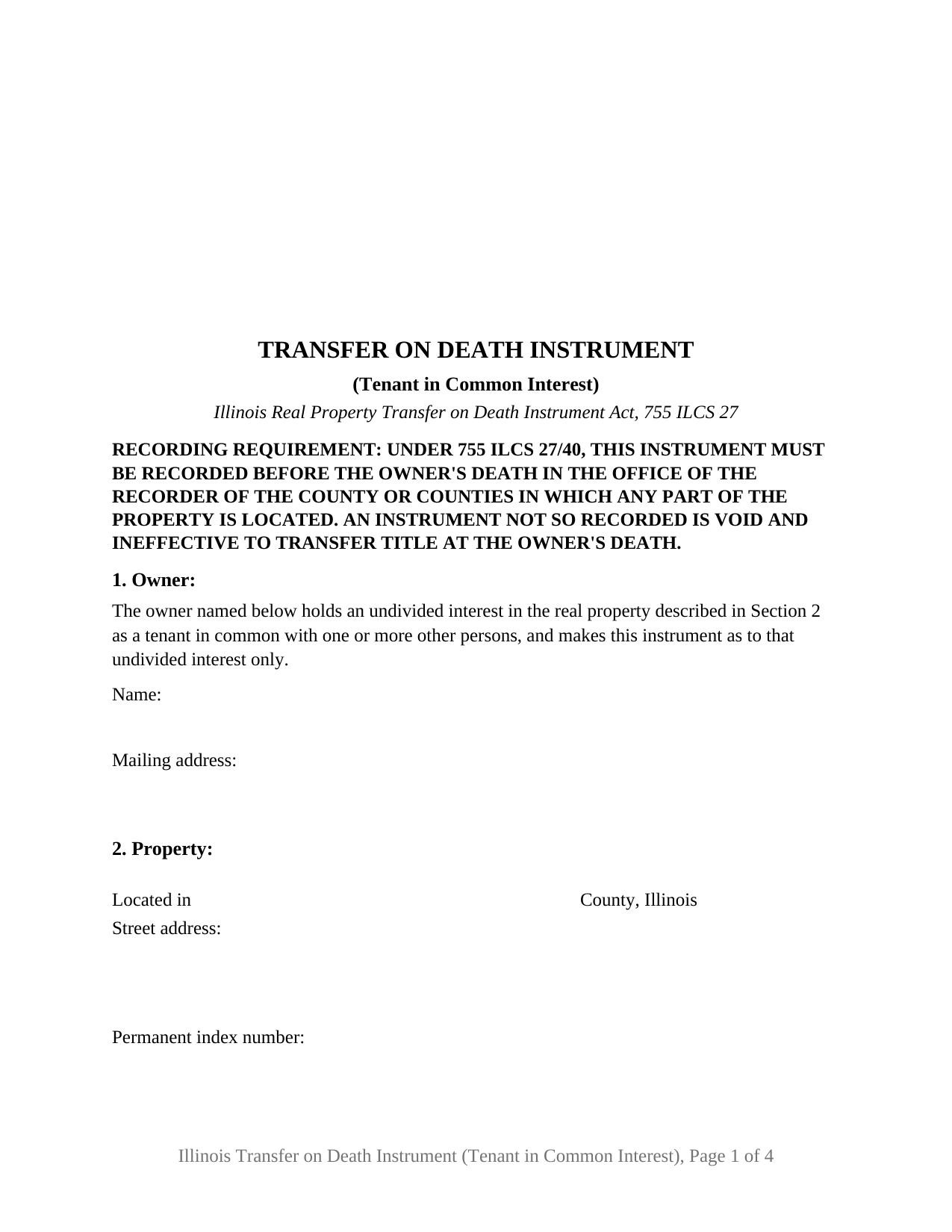
About the Illinois Transfer on Death Instrument (Tenant in Common Interest)
How to Use This Form
- Select your county from the list
- Download the county-specific form
- Fill in the required information
- Have the document notarized if required
- Record with your county recorder's office
What Others Like You Are Saying
"Thanks, it was a big help!!!"
"Using an I pad and cannot type on form that was downloaded. I do not have a computer Charles"
"Well written form, and the guidance document and example supplied were very helpful."
"The product was just what I needed. Not being the sharpest computer user I stumbled a little but aft…"
"Great place to find much needed documents. A huge thanks!"
4.8/5 from 4,831 reviews. Read all
One tenant in common can name who takes that owner's undivided interest in Illinois real property at death, on a recorded instrument the other co-owner never signs. The form is built for exactly that owner: a tenant in common designating a beneficiary for his or her own undivided share under the Real Property Transfer on Death Instrument Act, 755 ILCS 27. Illinois calls it a TODI; elsewhere the same device is a transfer on death deed or beneficiary deed.
A share that is the owner's alone to give
Under 765 ILCS 1005/1 a deed to two or more persons that does not expressly declare survivorship creates a tenancy in common, and each tenant in common holds a separate undivided interest that passes at that owner's own death while the other co-owners keep what they held. The Act draws the same line: Section 5 defines a joint owner as a co-owner with a right of survivorship and excludes a tenant in common, so the joint owner rules of Section 70, which postpone a designation to the last death, do not reach this instrument. The owner's undivided interest is property owned by the owner at death under Section 65(a); the designated beneficiary takes it then and holds it in common with whoever holds the rest.
The co-owner is not a party
The form recites that the owner holds an undivided interest as a tenant in common with one or more other persons and makes the instrument as to that interest only, and its operative paragraph states that the instrument does not affect the interest of any other owner, as Section 60(a)(1) provides. The other tenant in common has no signature block and gives nothing, and Section 3 identifies the deed under which the owner took the interest.
Two witnesses, a notary, and the recorder, before death
Illinois signs this instrument with the formality of a will. Under Section 45 the owner signs before two or more credible witnesses, whose written attestation states that the owner executed the instrument in their presence, that the execution was free and voluntary, and that the owner appeared to them of sound mind and memory; the owner's and the witnesses' signatures are then acknowledged in front of a notary public. The form prints the attestation in the statute's substance, two witness blocks, and one acknowledgment certificate naming the owner and both witnesses; a beneficiary who witnesses engages Section 45(c). Section 40 then requires recording before the owner's death with the recorder of each county in which any part of the property lies, or the instrument is void, a condition printed on the form's first page.
What this configuration recites
The form recites exactly one owner, a natural person signing personally, holding an undivided interest as a tenant in common. It recites no marital status, fractional share, or co-owner name, so any size of undivided interest completes the same blanks. Section 4 receives one or more designated beneficiaries of any class the Act permits; two or more named without a stated form of ownership take equal undivided shares with no survivorship under Section 65(a)(2). Unmarried partners who bought a home as tenants in common, each directing his or her own half, and a widow holding an undivided third with her late husband's children after an estate distribution present the pattern this instrument recites. Co-owners holding as joint tenants or by the entirety, two owners on one instrument, a trustee, and an agent under a power of attorney present configurations this form is not set up as. A later instrument of revocation and the Section 75 notice of death affidavit are prepared separately and are not included in this package.
Exempt from transfer tax, prepared by the owner
The instrument carries the preparer statement, return address, tax bill address, permanent index number, and signed exemption statement under paragraph (e) of 35 ILCS 200/31-45 that Illinois recorders look for. Under Section 95 of the Act the instrument is prepared only by a licensed attorney; the same section preserves an owner's own preparation and states that the instrument is not void without it.
The package includes the fillable transfer on death instrument, a completed example filled in for a Kane County fact pattern in which one of two tenants in common names his daughter, and the guide that walks through every section, the signing formalities, and recording. The guide and this description explain the form and the governing Illinois statutes in general terms and are not legal advice.
Important: County-Specific Forms
Our transfer on death instrument (tenant in common interest) forms are specifically formatted for each of the 102 counties in Illinois.
After selecting your county, you'll receive forms that meet all local recording requirements, ensuring your documents will be accepted without delays or rejection fees.