Illinois Transfer on Death Instrument (Trust Beneficiary)
County Specific Legal Forms Validated as recently as October 23, 2026 by our Forms Development Team
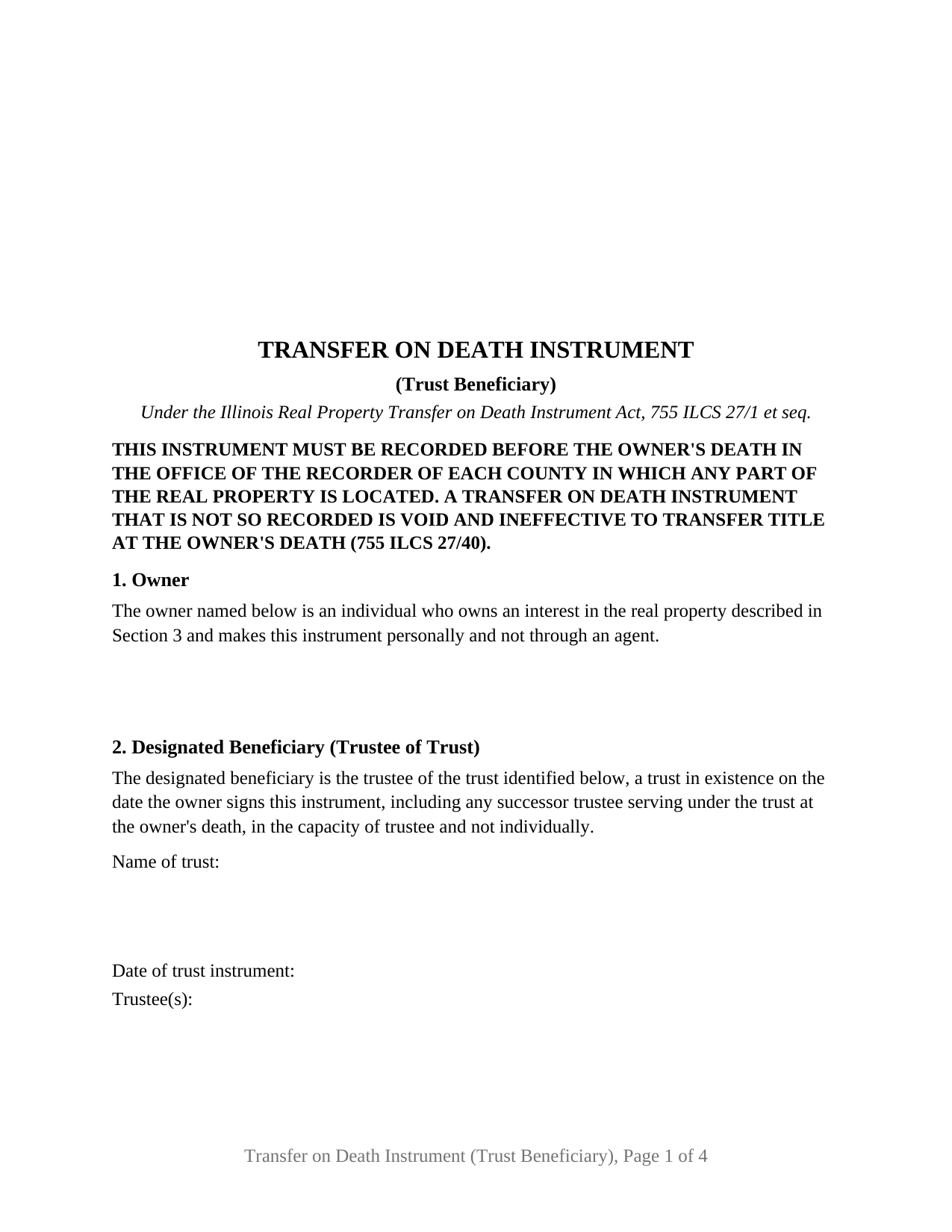
About the Illinois Transfer on Death Instrument (Trust Beneficiary)
How to Use This Form
- Select your county from the list
- Download the county-specific form
- Fill in the required information
- Have the document notarized if required
- Record with your county recorder's office
What Others Like You Are Saying
"Usually I have trouble registering things online, even though people tell me it's easy. This time, i…"
"I love this tool and it is easy to work with. The interface is straight forward and notifications ar…"
"Wonderful service."
"Excellent! Great communication through the process and quick response."
"I had worked for a couple of months sending things back and forth to the county and still had no suc…"
4.8/5 from 4,830 reviews. Read all
An Illinois transfer on death instrument, the TODI, can name a trust instead of a person. This form prepares the trust beneficiary configuration under the Real Property Transfer on Death Instrument Act, 755 ILCS 27: one owner of Illinois real property designates the trustee of an existing, identified trust as the designated beneficiary, so that at the owner's death the property passes to the trust without probate. The owner keeps full title for life, and the instrument stays revocable until death.
A deed that waits for death and then follows the trust
Section 21 of the Act, added by Public Act 102-68 effective January 1, 2022, permits a transfer by transfer on death instrument to a trustee of a trust that is in existence when the owner executes the instrument and that is identified in it, even if the trust is subject to amendment, modification, revocation, or termination. Unless the instrument provides otherwise, the real property transferred is governed by the terms of the trust instrument, including later amendments. The form carries no provision otherwise, so those statutory rules apply as written, and if the trust is revoked or terminated before the owner's death, the Act sends the transfer to the owner's estate.
The pattern Illinois practice most often presents is the revocable living trust: the house stays titled in the owner's own name during life, and the trust receives it at death through a recorded instrument rather than a probate proceeding. The form identifies the trust by name, date, and trustee, and its fixed recital reaches any successor trustee serving at the owner's death, in the capacity of trustee and not individually.
Two witnesses, one notary, and a recording deadline
Illinois sets stricter signing formalities for a transfer on death instrument than for an ordinary deed. Section 45 requires the owner's signature, attestation in writing by two credible witnesses, and acknowledgment of the owner's and the witnesses' signatures in front of a notary public, and an instrument without two witnesses is void. The form prints the three-part attestation the statute describes, two witness signature blocks, and a single acknowledgment certificate in the short form of the Illinois Notary Public Act naming the owner and both witnesses. Section 45(c) addresses a witness who is a beneficiary or a beneficiary's spouse, and the guide explains why the trustee and the trustee's spouse sit outside the witness pool.
Recording is a condition of validity, not a formality. Section 40 requires the instrument to be recorded before the owner's death in the office of the recorder of each county in which any part of the property lies, and an instrument that is not so recorded is void and ineffective to transfer title. The form prints that condition in capital letters at the top of its first page. Revocation follows the same path: only a later recorded instrument, executed and witnessed the same way and acknowledged after the original, revokes it; a will or an unrecorded paper does not.
What this configuration recites
The form recites exactly one owner, an individual who owns an interest in the property and signs personally; under Section 35 an agent under a power of attorney has no authority to make one. It recites one designated beneficiary, the trustee of the trust identified in Section 2, and no alternate beneficiaries or share provisions, because the trust takes the whole of the owner's interest and the trust instrument then governs. The owner's marital status is not recited; a married owner and an unmarried owner complete the same blank, and the guide describes the surviving spouse's renunciation right under Section 66, the homestead continuation of 735 ILCS 5/12-902, and the joint owner rules of Section 70. Two owners on one instrument, individual or entity beneficiaries, and a trust created inside the instrument or under a will present different patterns from the one this form recites.
The instrument also carries the preparer statement of 55 ILCS 5/3-5022, the return address, the tax-bill endorsement of 765 ILCS 5/35c, and a transfer tax exemption statement under 35 ILCS 200/31-45, formatted to the statewide standards of 55 ILCS 5/3-5018.2.
The package includes the fillable form, a completed example filled in for a Sangamon County fact pattern in which the owner names her own revocable living trust, and the guide that walks through every section, the signing formalities, and the recording process. This description and the guide describe the form and the governing statutes in general terms; they are not legal advice.
Important: County-Specific Forms
Our transfer on death instrument (trust beneficiary) forms are specifically formatted for each of the 102 counties in Illinois.
After selecting your county, you'll receive forms that meet all local recording requirements, ensuring your documents will be accepted without delays or rejection fees.