Illinois Transfer on Death Instrument (Married Owner with Spousal Waiver of Renunciation)
County Specific Legal Forms Validated as recently as October 23, 2026 by our Forms Development Team
About the Illinois Transfer on Death Instrument (Married Owner with Spousal Waiver of Renunciation)
How to Use This Form
- Select your county from the list
- Download the county-specific form
- Fill in the required information
- Have the document notarized if required
- Record with your county recorder's office
What Others Like You Are Saying
"Thank you so much for giving us a service so important to many. I will pass on this pertinent proces…"
"Quick assistance with same day recording. The tech identified barriers to successful Recordation suc…"
"Great site !! Very easy to navigate and explanations are clear and simple to understand. Thank You!"
"I can't think of any suggestions for improvement. The documents I needed were readily available. Tha…"
"I was quite impressed by the quality of your documents and the ease of the download."
4.8/5 from 4,830 reviews. Read all
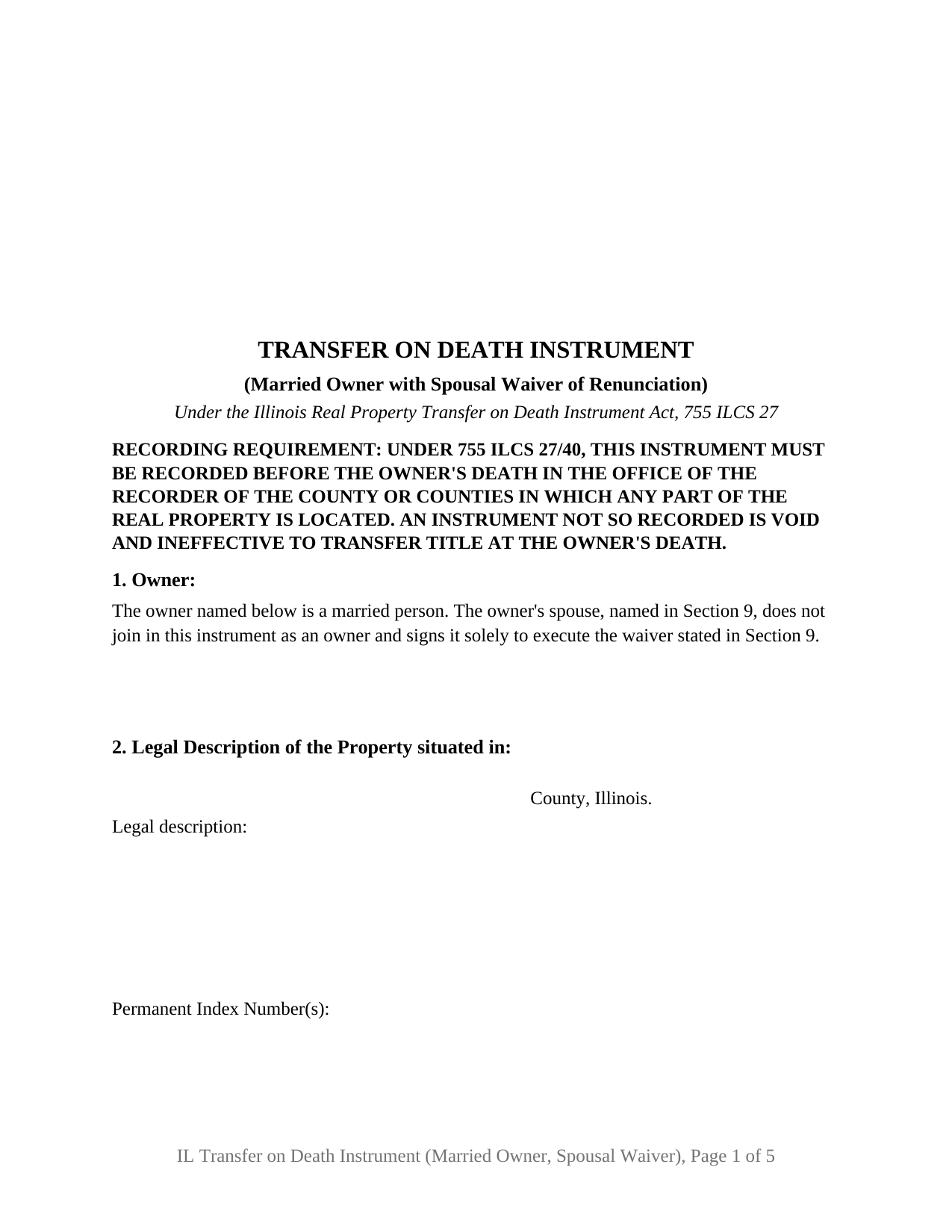
This Illinois transfer on death instrument is prepared for one married owner and carries, on the instrument itself, the spouse's waiver of the statutory right to renounce. The owner names who receives the owner's interest in Illinois real property at death, outside probate; the waiver under Section 66 of the Real Property Transfer on Death Instrument Act, 755 ILCS 27, closes a door the Act otherwise leaves open to a surviving spouse.
The door a surviving spouse can open
Since January 1, 2022, Section 66 has let an owner's surviving spouse renounce a transfer on death instrument and take a one-third interest in the transferred property if the owner leaves a descendant, or a one-half interest if the owner leaves none, by filing a written renunciation with the county recorder within 7 months after the owner's death. A transfer on death deed, as the instrument is often called, that names children from an earlier marriage or anyone other than the spouse is exposed to that filing.
The same section supplies the answer: the surviving spouse may waive the right to renounce by executing a waiver as part of the transfer on death instrument. This form places that waiver in its own numbered section, with the spouse's name, the fixed waiver sentence citing Section 66, a spouse signature line, and a separate acknowledgment certificate, so the waiver is recorded with the instrument before the owner's death.
One owner, one spouse who signs only the waiver
The form recites exactly one owner, a married person, and states that the owner's spouse does not join as an owner and signs solely for the waiver. That is the pattern of an owner who holds the property in his or her own name, acquired before the marriage, inherited, or held with someone other than the spouse. Spouses who hold title together as joint tenants or tenants by the entirety present a two-owner pattern this form is not set up as; Section 70 governs instruments executed by joint owners.
During the owner's life nothing changes: under Section 60 the instrument does not affect the owner's right to sell, mortgage, or transfer the property and creates no interest in the beneficiary. At death the beneficiary takes subject to the liens and other matters then affecting the property, without covenant or warranty of title.
Two witnesses, two certificates
Under Section 45 the owner signs in the presence of two credible witnesses, the witnesses attest in writing that the owner signed in their presence as a free and voluntary act while of sound mind and memory, and the signatures of the owner and the witnesses are acknowledged before a notary public. The form prints the attestation in the statute's substance, two witness blocks, and one acknowledgment certificate for the owner and both witnesses. The spouse's waiver signature has its own certificate, and the spouse is never one of the two witnesses, so the interested-witness rule in Section 45(c) is not engaged by the spouse's signature.
Recording before death is the condition on everything else. Section 40 requires the instrument to be recorded, before the owner dies, in every county where any part of the property lies, and makes an unrecorded instrument void. The form reserves the recorder's 3 by 5 inch space on the first page, carries the preparer statement and return address the Counties Code requires, and prints the paragraph (e) transfer tax exemption notation Illinois recorders look for on an instrument given without consideration.
What the waiver reaches
The waiver reaches the Section 66 right to renounce and nothing more. It is not a homestead release, and it has no work to do where the instrument transfers the property to a trustee of a trust for the sole benefit of the surviving spouse, a transfer Section 66 already exempts from renunciation. The guide covers each point with its citation, along with Section 95, under which the instrument is prepared only by a licensed attorney while an owner's own preparation is preserved, the lapse and revocation rules, and the Section 75 notice of death affidavit, which is prepared separately and is not included in this package.
The package includes the fillable transfer on death instrument, a completed example filled in for a realistic Sangamon County fact pattern, and the guide that walks through every numbered section and the recording process. This description and the guide describe the form and the governing Illinois statutes in general terms; they are not legal advice.
Important: County-Specific Forms
Our transfer on death instrument (married owner with spousal waiver of renunciation) forms are specifically formatted for each of the 102 counties in Illinois.
After selecting your county, you'll receive forms that meet all local recording requirements, ensuring your documents will be accepted without delays or rejection fees.