Illinois Transfer on Death Instrument (Unmarried Sole Owner)
County Specific Legal Forms Validated as recently as October 23, 2026 by our Forms Development Team
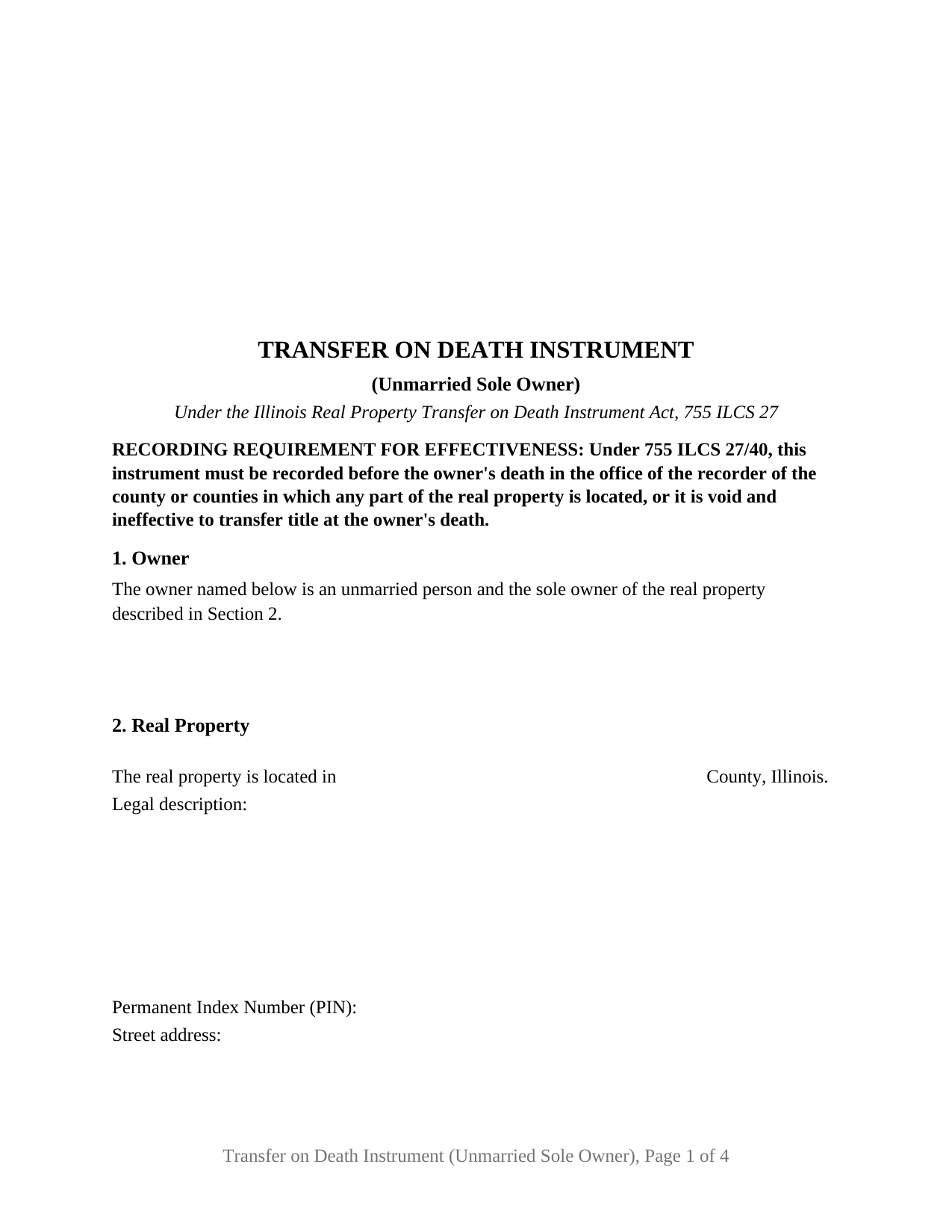
About the Illinois Transfer on Death Instrument (Unmarried Sole Owner)
How to Use This Form
- Select your county from the list
- Download the county-specific form
- Fill in the required information
- Have the document notarized if required
- Record with your county recorder's office
What Others Like You Are Saying
"Thank you! Including the Guide and completed example was especially helpful."
"Great Service, very helpful and knowledgeable."
"You're a creditable company that performs well and provides what I requested."
"This service was extremely helpful. I truly appreciated the way I was communicated with every step o…"
"Deeds.com is a very Good company. They helped me when I needed the"
4.8/5 from 4,831 reviews. Read all
An Illinois property owner who holds title alone and is not married can name who receives the property at death by recording a transfer on death instrument, the Illinois form of a transfer on death deed or beneficiary deed. This form prepares that instrument under the Real Property Transfer on Death Instrument Act, 755 ILCS 27, for one unmarried sole owner: one signature, two witnesses, one notary certificate, and no probate for the property it describes.
One owner, one signature, nothing transferred until death
The instrument recites that the owner named in it is an unmarried person and the sole owner of the real property, and the owner signs alone. During the owner's life it transfers nothing. Under Section 60 of the Act it does not affect the owner's right to sell, transfer, or encumber the property and creates no interest in the beneficiary. At the owner's death the named beneficiary takes whatever interest the owner then holds, subject to any mortgage or other matter affecting title, without probate. It stays revocable for the owner's life: Section 55 permits revocation by a later transfer on death instrument or a recorded instrument of revocation, each recorded separately and not included in this package, and not by a will.
Two witnesses and a notary, an Illinois requirement
Most states that recognize a transfer on death deed ask only for a notarized signature. Illinois asks for more. Under 755 ILCS 27/45 the owner signs in the presence of two credible witnesses; the witnesses sign a written attestation that the owner executed the instrument in their presence, that the execution was the owner's own free and voluntary act, and that the witnesses believed the owner to be of sound mind and memory; and the signatures of the owner and both witnesses are acknowledged before a notary public. An instrument without two credible witnesses is void. The form prints the attestation in the statute's own substance, carries a signature block for each witness, and carries a single acknowledgment certificate naming the owner and both witnesses. A beneficiary, or a beneficiary's spouse, who serves as a witness brings Section 45(c) into play, which voids that beneficiary's interest unless two other qualifying witnesses attest, subject to a limited exception the guide describes.
Recording before death is the condition that decides everything
Section 40 of the Act lists what a valid instrument contains and ends with the condition that matters most: the instrument must be recorded before the owner's death in the office of the recorder of the county where the property is located. An instrument signed, witnessed, and notarized but unrecorded at the owner's death is void. The form prints that requirement at the top of its first page and follows the statewide standard for a recorded document: letter size pages, a three inch by five inch recorder's space at the upper right of the first page, one half inch margins, and black type, with the flat per-document fee Illinois recorders charge. It also prints the transfer tax exemption notation under 35 ILCS 200/31-45, paragraph (e), the paragraph for a transfer without consideration, which the Department of Revenue accepts on the face of the document in place of a PTAX-203 declaration.
The unmarried sole owner configuration
The form recites exactly one owner, unmarried and holding sole title, and prints that status as fixed text with only the owner's name and mailing address left to the blank. The beneficiary section accepts one or more beneficiaries by name, whether an individual, a trustee of a trust, or an entity; where two or more are named, the Act's default of equal undivided shares with no right of survivorship applies unless the instrument provides otherwise. A widowed or divorced owner who holds the home alone, and a single adult who bought a condominium in his or her own name, present the pattern this instrument recites. A married owner, a party to a civil union, co-owners holding as joint tenants or as tenants by the entirety, and a trustee holding title follow different paths under the Act and are not what this form is set up as.
The package includes the fillable transfer on death instrument, a completed example filled in for a realistic Sangamon County fact pattern, and the guide that walks through every section, the witness and notary formalities, and recording with the county recorder. This description and the guide describe the form and the governing Illinois statutes in general terms; they are not legal advice.
Important: County-Specific Forms
Our transfer on death instrument (unmarried sole owner) forms are specifically formatted for each of the 102 counties in Illinois.
After selecting your county, you'll receive forms that meet all local recording requirements, ensuring your documents will be accepted without delays or rejection fees.