Illinois Transfer on Death Instrument (Married Owners as Tenants by the Entirety)
County Specific Legal Forms Validated as recently as October 23, 2026 by our Forms Development Team
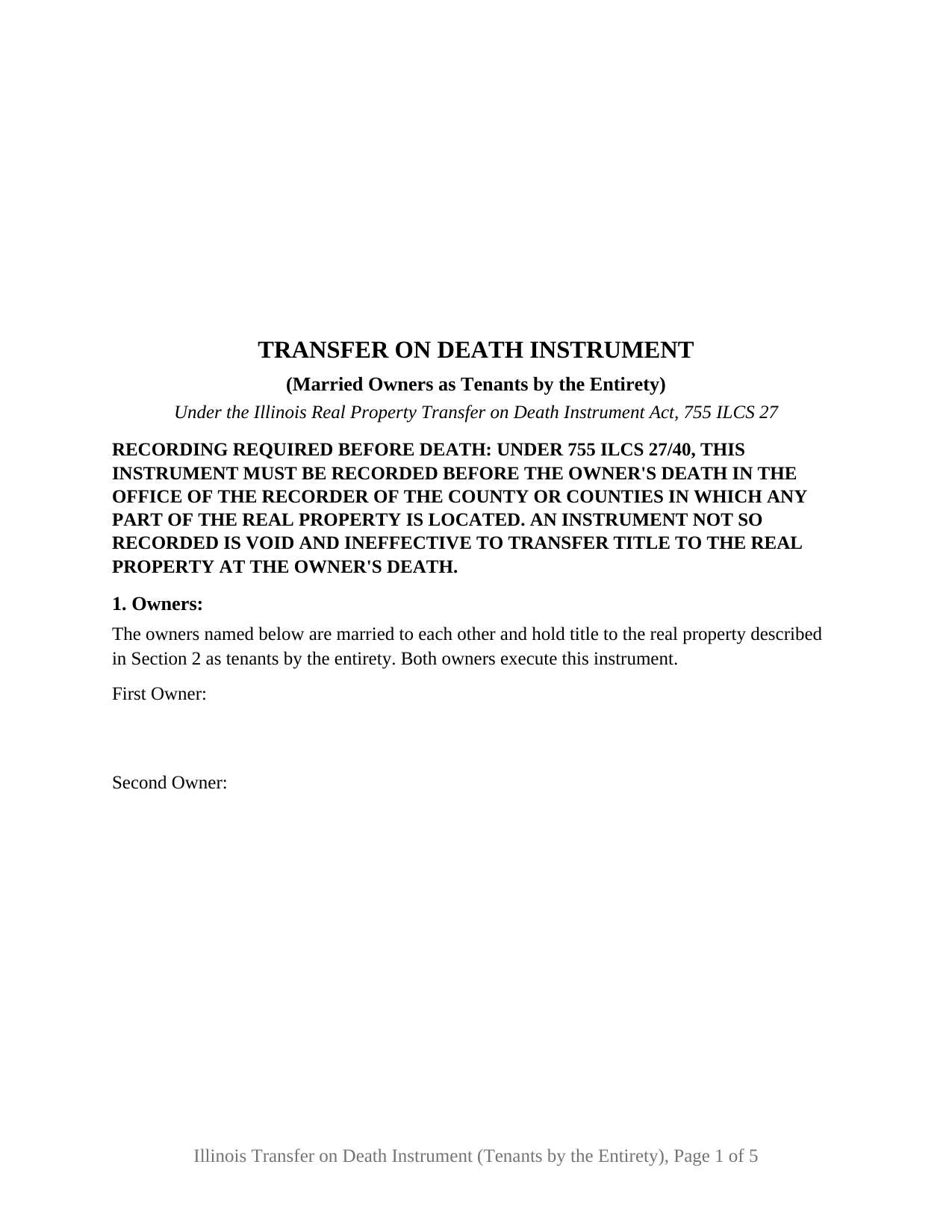
About the Illinois Transfer on Death Instrument (Married Owners as Tenants by the Entirety)
How to Use This Form
- Select your county from the list
- Download the county-specific form
- Fill in the required information
- Have the document notarized if required
- Record with your county recorder's office
What Others Like You Are Saying
"Thank you so much for giving us a service so important to many. I will pass on this pertinent proces…"
"The staff of DEEDS.COM is in a class of excellence all by themselves! From my own personal experienc…"
"great service and quick filing."
"Thorough. Thanks!"
"so far appears to meet my needs!"
4.8/5 from 4,830 reviews. Read all
Spouses who hold their Illinois homestead as tenants by the entirety can name, on one recorded instrument that both of them sign, who takes the home after the second of them dies. This form prepares that transfer on death instrument, the Illinois TODI that other states call a transfer on death deed or beneficiary deed, under the Real Property Transfer on Death Instrument Act, 755 ILCS 27, for exactly two owners who are married to each other and hold title by the entirety under 765 ILCS 1005/1c.
Both spouses on one instrument
Tenancy by the entirety is the Illinois estate for a married couple's homestead, and the Joint Tenancy Act gives it two features that shape this form: the survivor retains the entire estate when the first spouse dies, and no deed, mortgage, or lease of the homestead is effective unless both tenants sign. Section 1 recites that the owners are married to each other and hold as tenants by the entirety, and both execute the instrument in signature blocks of their own. The recital states the estate the owners assert; the vesting deed is the source of that estate.
The first death changes nothing the instrument does
The Act counts a tenant by the entirety as a joint owner, Section 70(d) provides that the instrument does not sever the tenancy, and Section 65(a) applies the at-death rules to property owned by the owner at death. When the first spouse dies, the whole estate stays with the survivor under 765 ILCS 1005/1c and nothing passes under the instrument; when the surviving spouse dies, the designated beneficiary takes whatever interest that owner then holds, outside probate and subject to any mortgage then on the property. The form prints the single sentence Section 40(a)(2) requires, that the transfer is to occur at the owner's death; the guide traces the second-death result through the sections that produce it.
Revocation takes both while both are living
Because all of the joint owners execute this instrument, Section 70(b) governs its revocation: only all of the then living joint owners may revoke it, and the last surviving joint owner may revoke it notwithstanding any agreement to the contrary. While both spouses live, one of them cannot undo the designation alone; after the first death, the survivor can replace or revoke it by a later instrument meeting Sections 45 and 55, prepared separately and not included in this package. A will does not revoke it.
Witnesses, a notary, and three certificates
Section 45 requires each owner's signature to be attested in writing by two credible witnesses and the owners' and witnesses' signatures to be acknowledged before a notary public; without two credible witnesses the instrument is void. The form prints the attestation above two witness blocks and carries three acknowledgment certificates, one for each spouse and one for the witnesses, a layout the form uses rather than a rule of Illinois law. Section 40 makes recording before the owner's death a condition of validity; the form states that condition in capitals on its first page, reserves the recorder's 3 inch by 5 inch space, and prints the 35 ILCS 200/31-45 paragraph (e) exemption notation for a nonconsideration transfer.
What this configuration recites
The form recites two owners, married to each other, holding the described property as tenants by the entirety, both signing, with nothing about either owner's status left to a blank or a selector. Section 3 receives one or more beneficiaries of any class the Act permits, an individual, a trustee, or an entity; two or more named without a stated form of ownership take equal undivided shares with no right of survivorship under Section 65(a)(2). A couple who bought their house together and took title by a deed naming them as tenants by the entirety, naming their adult children, and a childless couple naming a sibling, present the pattern this instrument recites. Spouses holding as joint tenants or tenants in common, a married owner holding title alone, an unmarried owner, a trustee, and three or more owners present configurations this form is not set up as; it carries no Section 66 spousal waiver because both spouses execute it as owners.
The package includes the fillable transfer on death instrument, a completed example filled in for a Champaign County fact pattern, and the guide that walks through every numbered section, the signing formalities, and recording. This description and the guide describe the form and the Illinois statutes in general terms; they are not legal advice.
Important: County-Specific Forms
Our transfer on death instrument (married owners as tenants by the entirety) forms are specifically formatted for each of the 102 counties in Illinois.
After selecting your county, you'll receive forms that meet all local recording requirements, ensuring your documents will be accepted without delays or rejection fees.