Iowa Quitclaim Deed (Corrective)
County Specific Legal Forms Validated as recently as October 9, 2026 by our Forms Development Team
About the Iowa Quitclaim Deed (Corrective)
How to Use This Form
- Select your county from the list
- Download the county-specific form
- Fill in the required information
- Have the document notarized if required
- Record with your county recorder's office
What Others Like You Are Saying
"I would've done this years ago if I'd known how easy it was! The plus is it's not expensive either. …"
"Easy to set up and fast service."
"quick response"
"Very impressive. The only change I would suggest is a smaller font on the title."
"It was easy to download. And your guide was informative as was the completed form for an example. Bu…"
4.8/5 from 4,829 reviews. Read all
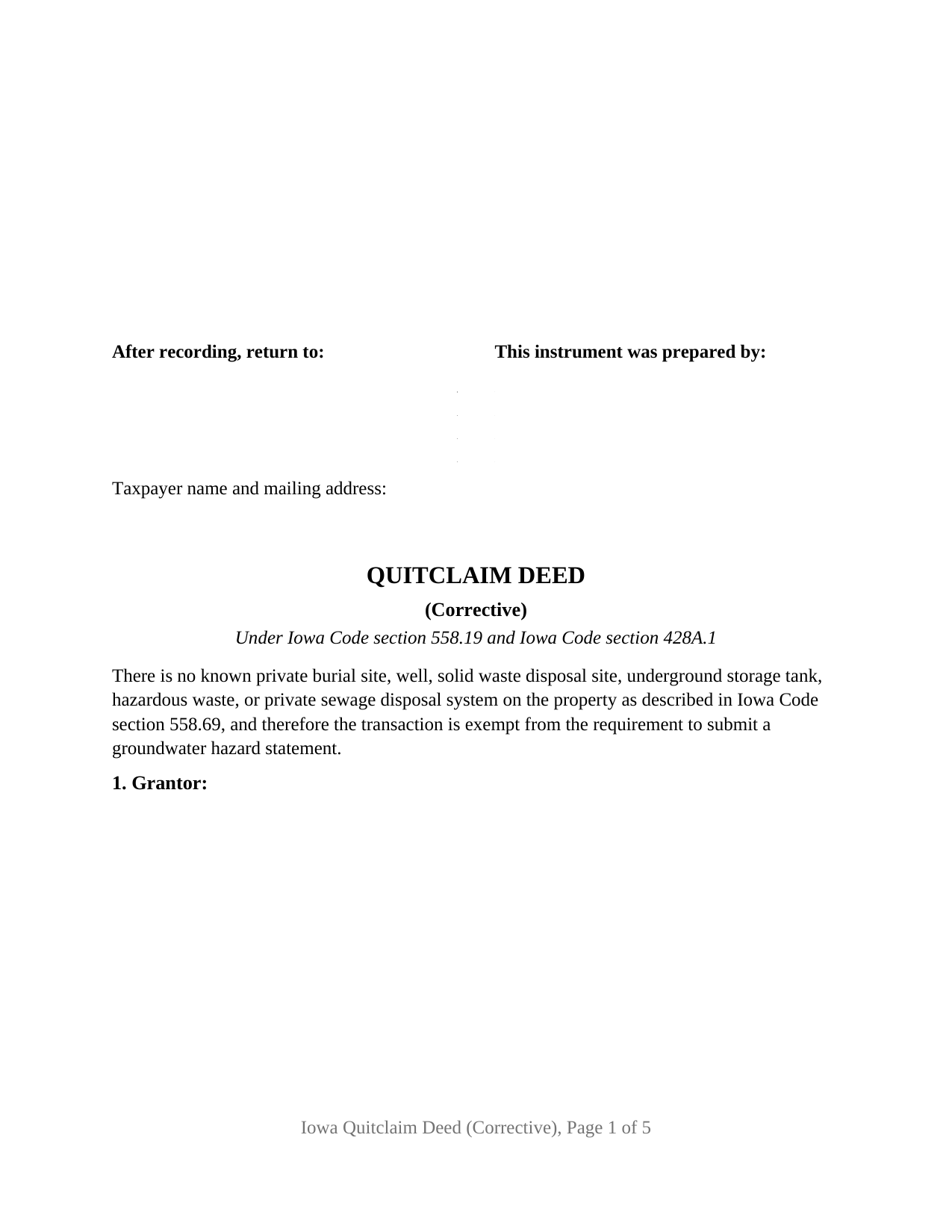
Iowa's transfer tax chapter lets a deed announce its own purpose. Iowa Code section 428A.1 imposes the tax on instruments conveying Iowa realty, then provides that where the instrument is executed and tendered for recording as an instrument corrective of title, and so states, there is no tax. This corrective quitclaim deed carries that statement in its operative section, beside the recording data of the deed it repairs.
Where an Iowa correction begins
Iowa Code section 558.67 catches the moment. A conveyance that clears the recorder passes to the county auditor for the transfer books, and that section has the auditor notify the grantee of any error in description discovered in an instrument filed for transfer, and permit the error to be corrected by the parties before the transfer is completed. The correcting act belongs to the parties. Nothing leaves the record: the deed already filed stays where it is, this one records as its own conveyance under its own grantor and grantee entries, and a later search of the chain turns up both.
A quitclaim shaped to the record it corrects
The operative words come from Iowa Code section 558.19, whose quitclaim form releases all of the grantor's interest and warrants nothing about it. A quit claim deed, or correction deed as it is also searched, leaves every mortgage, easement, covenant, assessment, and unpaid tax where it stood. What sets this variant apart surrounds those words. Section 4 identifies the recorded deed by title, date, recording date, document reference number, and the parties as that deed named them, the same particulars Iowa Code section 558.49 has the recorder carry in the index records. Section 6 sets the statement as it appears in the prior deed beside the corrected statement, and Section 7 states that this deed conveys no interest beyond the interest that deed conveyed.
One grantor, one spouse, and no new consideration
The form recites exactly one individual grantor, the grantor named in the deed being corrected, and one grantee entry that takes a single grantee or co-grantees with a co-ownership designation. A second labeled block belongs to the spouse of a married grantor: Iowa Code section 561.13 conditions a homestead conveyance by a married owner on the spouse's execution of the same or a like instrument, and subsection 2 keeps a spouse who specifically relinquishes homestead rights out of the granting clause. Each signer has an acknowledgment certificate of its own in the individual capacity short form of Iowa Code section 9B.16. A misspelled subdivision name in a platted description, and a grantee's name spelled one way in the granting clause and another below the signature, are the records this configuration answers. It is not set up for two grantors, an entity grantor, a fiduciary signer, or an instrument that adds consideration or reaches past the prior deed.
No tax, and no declaration of value either
Iowa Code section 428A.2, subsection 10, excepts deeds which, without additional consideration, confirm, correct, modify, or supplement a deed previously recorded, and Section 8 of this deed is the signed statement Iowa Code section 428A.4 accepts in place of payment. The numbering carries past the tax: a declaration of value is called for outside subsections 2 through 5, 7 through 13, and 16 through 21, and subsection 10 sits inside that band, so the deed records with neither. Iowa Department of Natural Resources materials close the chain: with no declaration of value submitted, no groundwater hazard statement is called for.
A first page built to the Iowa standard
Iowa Code section 331.606B reserves three inches at the top of page one and places below it: the preparer with a telephone number, the taxpayer name and complete mailing address, the return address, the title, the grantor, the grantee, and the legal description. This form carries each of them on page one, the legal description box opening on page two under the page reference section 331.606B(3) has the first page note. The body text sits at 12 point, and every signature has a printed name line beneath it. The guide takes up the recording fees, the auditor's transfer fee, the format failures that draw a ten dollar charge and those that draw a rejection, and submission through Iowa Land Records.
The purchase delivers three files: the fillable blank deed, a completed example prepared as a Muscatine County correction of a platted legal description, and a plain language guide to the sections, signing, and recording. The materials are informational and are not legal advice.
Important: County-Specific Forms
Our quitclaim deed (corrective) forms are specifically formatted for each of the 99 counties in Iowa.
After selecting your county, you'll receive forms that meet all local recording requirements, ensuring your documents will be accepted without delays or rejection fees.