Iowa Quitclaim Deed (Two Grantors)
County Specific Legal Forms Validated as recently as October 9, 2026 by our Forms Development Team
About the Iowa Quitclaim Deed (Two Grantors)
How to Use This Form
- Select your county from the list
- Download the county-specific form
- Fill in the required information
- Have the document notarized if required
- Record with your county recorder's office
What Others Like You Are Saying
"thank you - your service is awesome - i sent documents to the county - after 2 plus weeks they retur…"
"Everything worked Fine. I wish there was an John Doe type of an example for the Tax form."
"Awesome forms, filled them out on my computer, printed them out complete, notarized, recorded, wonde…"
"A+"
"After trying to get help locally I found your website. Very easy"
4.8/5 from 4,828 reviews. Read all
When two people who hold Iowa real estate together convey it, Iowa's signature arithmetic can run to four. Each grantor signs, and under Iowa homestead law the spouse of a grantor who is married to someone other than the other grantor signs too. This Iowa quitclaim deed is built for exactly that count: two individual grantors, one grantee entry, two labeled spousal relinquishment blocks, and four acknowledgment certificates, in a single recorded instrument.
Two grantors, one quitclaim
Iowa Code section 558.19 prints the quitclaim in the first person singular: for the consideration of a stated sum, I hereby quitclaim to the grantee all my interest in the described tract. This deed carries that act in the plural. For the consideration stated, the undersigned grantors quitclaim to the grantee all of the grantors' interest in the described real estate, so two co-owners pass the whole of what they hold in one filing rather than two. A quit claim deed, as it is also searched, promises nothing about the quality of that interest; mortgages, liens, easements, and unpaid taxes stay with the land.
Four signature lines for two owners
Iowa Code section 561.13 withholds validity from a married owner's conveyance of the homestead until the owner's spouse executes the same or a like instrument, and the Iowa Supreme Court applied that result against both spouses in Martin v. Martin, 720 N.W.2d 732 (Iowa 2006). On a deed by two grantors the rule can arrive twice, once for each marriage. Section 10 of the deed answers it with a block labeled SPOUSE OF GRANTOR 1 and another labeled SPOUSE OF GRANTOR 2, each executing solely to relinquish dower, homestead, and distributive share rights and carrying no interest of the signer's own away. Iowa Code section 561.13(2) keeps that signer out of the granting clause, and the line under each block is labeled Signature of Spouse. Where the two grantors are married to each other, their own two signatures do the statutory work and the spousal blocks stay blank; where a grantor is unmarried, that grantor's block stays blank as well. Each of the four signers has an acknowledgment certificate in the individual capacity short form of Iowa Code section 9B.16, so a sister in Cedar Rapids and a brother in another state may acknowledge on different days before different officers.
Records in this shape appear when a brother and sister who inherited a house sell it to one buyer, when two tenants in common end a co-ownership at a single closing, and when two joint tenants pass a parcel to the next owner together. The form is not set up for a single grantor, for three or more grantors, for an entity grantor, or for a signer acting as trustee, executor, or attorney in fact.
A first page that carries both names
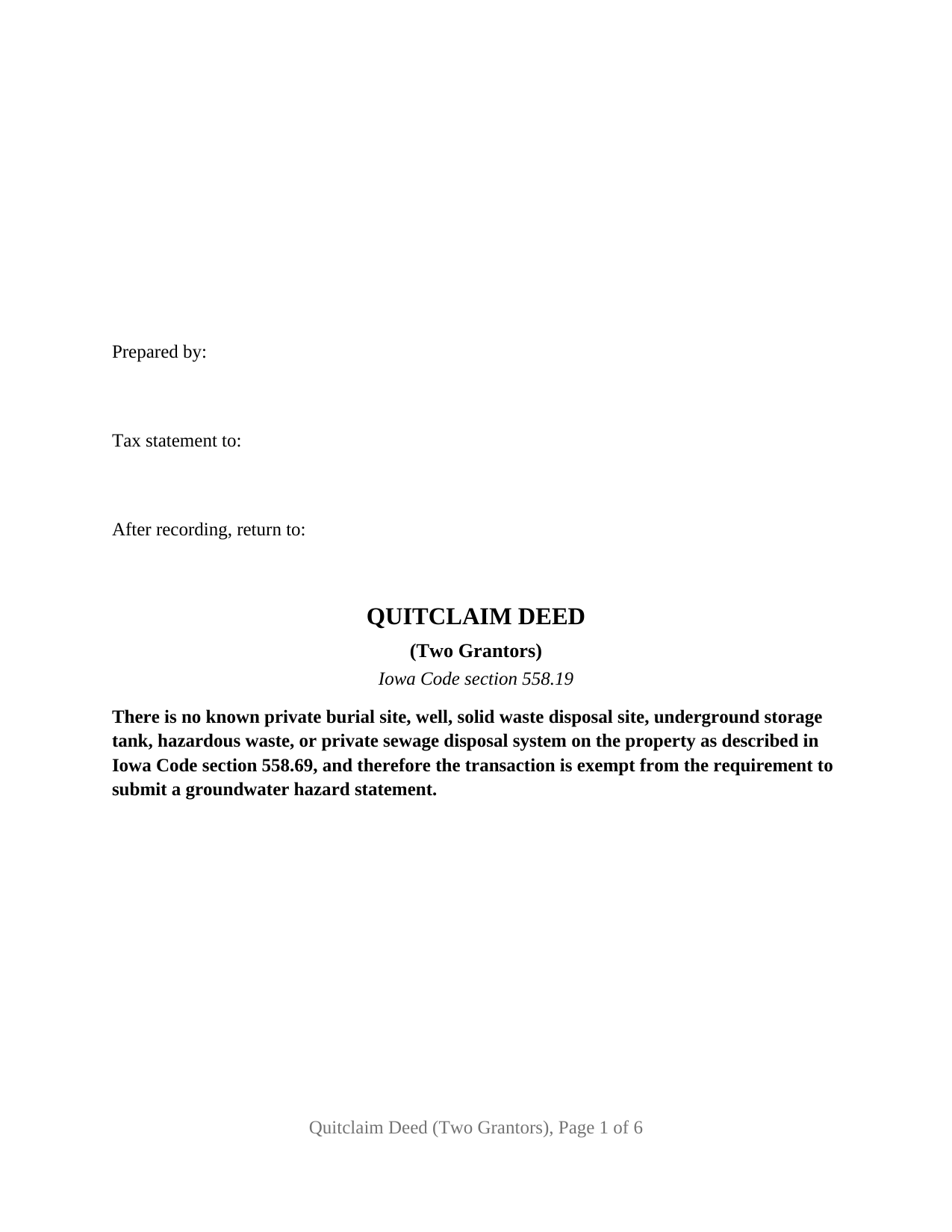
Iowa Code section 331.606B(2) lists what the first page of a recorded instrument carries below the three inch recorder margin, and the list runs past the preparer, the taxpayer address, and the return address to the title, all grantors' names, all grantees' names, and the legal description. This deed lays its first page out to that list: the three administrative blocks, the title, the statutory groundwater sentence of Iowa Code section 558.69(8A), both grantors with their mailing addresses, and the grantee all sit on page one. The legal description takes the treatment section 331.606B(3) supplies when the page cannot hold every item: a notation on the first page of the page where it is found, here Section 3 on page 2.
Tax on a sale by two
Iowa Code section 428A.1 computes the transfer tax on the whole consideration, eighty cents for each five hundred dollars above the first five hundred, however many grantors share it; the example's price of $84,000.00 carries $133.60, paid to the county recorder with the declaration of value. Where an exception in Iowa Code section 428A.2 applies, Section 7 holds the ground claimed as the signed statement Iowa Code section 428A.4 accepts in place of payment, and the four signatures sign it. The guide carries the computation, the recording and auditor's fees, and electronic submission through Iowa Land Records.
The download delivers three files: the fillable two-grantor Iowa quitclaim deed, a completed example prepared as a Linn County sale by a brother and sister with both of their spouses joining, and a plain language guide to the sections, the signing, the tax, and the recording. The materials are informational and are not legal advice.
Important: County-Specific Forms
Our quitclaim deed (two grantors) forms are specifically formatted for each of the 99 counties in Iowa.
After selecting your county, you'll receive forms that meet all local recording requirements, ensuring your documents will be accepted without delays or rejection fees.