Iowa Quitclaim Deed (Interspousal)
County Specific Legal Forms Validated as recently as October 9, 2026 by our Forms Development Team
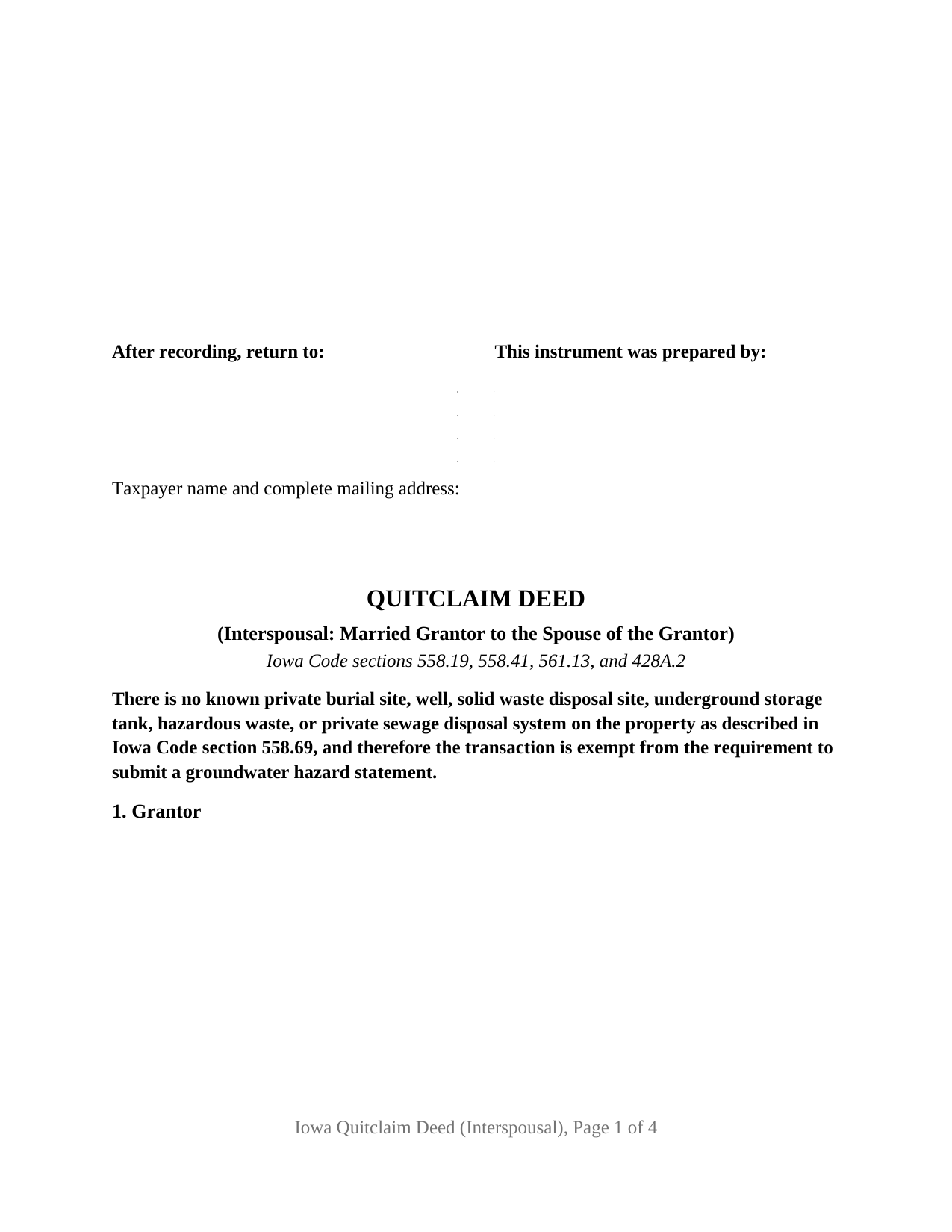
About the Iowa Quitclaim Deed (Interspousal)
How to Use This Form
- Select your county from the list
- Download the county-specific form
- Fill in the required information
- Have the document notarized if required
- Record with your county recorder's office
What Others Like You Are Saying
"Fast and convenient service."
"Great site. quick turnaround and communication. I needed an exception that they told me I needed and…"
"As a real estate professional, I've had the opportunity to use various legal form providers over the…"
"Deeds.com has done a wonderful job! They are quick to get back to me either with the Deed or reason …"
"Your company was great, you all walked me through every step of the process. With the pandemic and t…"
4.8/5 from 4,829 reviews. Read all
On an Iowa quitclaim deed between spouses, the person whose signature Iowa homestead law waits for is the grantee. This form is set up for exactly that conveyance: one married grantor quitclaims to one grantee, the grantee is the grantor's spouse, and the deed gathers both signatures on its own face. It is also searched as an interspousal deed or quit claim deed between spouses.
Why the grantee signs the deed
Iowa Code section 561.13(1) provides that a conveyance of a homestead by a married owner is not valid unless and until the spouse of the owner executes the same or a like instrument. The statute lists four exceptions, and a transfer between spouses is not among them. This form answers it from inside the instrument: the grantee, being the spouse of the owner, signs a labeled block of the grantee's own, and the operative section recites that the two are married on the date of the deed. Martin v. Martin, 720 N.W.2d 732 (Iowa 2006), is why that block is labeled rather than assumed: there the Iowa Supreme Court treated a homestead deed missing the spousal execution as invalid as to both spouses.
What the deed moves and what it leaves alone
The operative words track the quitclaim form of Iowa Code section 558.19: for the stated consideration, the grantor quitclaims to the grantee all of the interest of the grantor in the described real estate. Nothing is promised about its quality. A mortgage stays on the land while the borrower stays on the note, and easements, restrictions, and unpaid taxes follow the parcel. The grantor also relinquishes dower, homestead, and distributive share rights in the property, and the deed states that the grantee's signature carries no interest of the grantee away. Records in this shape appear when one spouse takes the record title alone ahead of a refinance, and when a spouse who owned the residence before the marriage places it in the other spouse's name. One grantor and one grantee are recited, with no co-ownership designation, because the deed vests the grantor's interest in a single grantee.
A gift between spouses that records without a declaration of value
Iowa Code section 428A.2, subsection 11, excepts deeds between husband and wife without actual consideration from the real estate transfer tax, and section 428A.4(1) lets an excepted deed record on a signed statement of the exception in place of payment. Section 8 of this deed is that statement, and the signatures at the end sign it. The exception reaches past the tax: section 428A.4(2) calls for a declaration of value only outside the exceptions numbered 2 through 5, 7 through 13, and 16 through 21, so subsection 11 releases the deed from that form too. Iowa Department of Natural Resources form 542-0960 closes the chain: where no declaration of value is submitted, no groundwater hazard statement is required either. The statutory no-condition sentence still prints on page one for a deed that does travel with a declaration of value. The included example is the exempt transaction; a deed between spouses for a price takes the other road, with tax at eighty cents for each five hundred dollars above the first five hundred.
Page one as an Iowa recorder reads it
Iowa Code section 331.606B holds the top three inches of page one for the recorder and names the information an instrument of conveyance carries below that band: the preparer with a telephone number, the taxpayer name and complete mailing address, the return address, the title, the grantor's and the grantee's names, and the legal description, with a page reference noted on the first page where an item continues elsewhere. This deed prints the first six on page one and opens page two with the legal description entry, under a page reference beneath the real estate heading. The body prints at 12 point against a 10 point statutory minimum, a printed name line sits under each signature, a rejection ground for documents dated on or after July 1, 2009, and both acknowledgment certificates open with the Iowa Code section 9B.16 short form sentence. The guide takes up the recording fees, the auditor's transfer fee, and electronic submission through Iowa Land Records.
The purchase delivers three pieces: the fillable interspousal quitclaim deed, a completed example prepared as a Dallas County conveyance from a husband to his wife, and a plain language guide to the sections, the signing, and the recording. The materials are informational and are not legal advice.
Important: County-Specific Forms
Our quitclaim deed (interspousal) forms are specifically formatted for each of the 99 counties in Iowa.
After selecting your county, you'll receive forms that meet all local recording requirements, ensuring your documents will be accepted without delays or rejection fees.