Iowa Quitclaim Deed (Trustee Grantee)
County Specific Legal Forms Validated as recently as October 9, 2026 by our Forms Development Team
About the Iowa Quitclaim Deed (Trustee Grantee)
How to Use This Form
- Select your county from the list
- Download the county-specific form
- Fill in the required information
- Have the document notarized if required
- Record with your county recorder's office
What Others Like You Are Saying
"Top notch real estate forms. Easy to use, printed out nice, and the guide and example are priceless.…"
"Thank you for your helpful information."
"Very satisfied with the PDF documents that I purchased. Will be able to transfer property without hi…"
"It is helpful that an example of filled out form is included."
"Very prompt and good resource. Unfortunately, I am unable to find a form for the Quitclaim Deed for …"
4.8/5 from 4,828 reviews. Read all
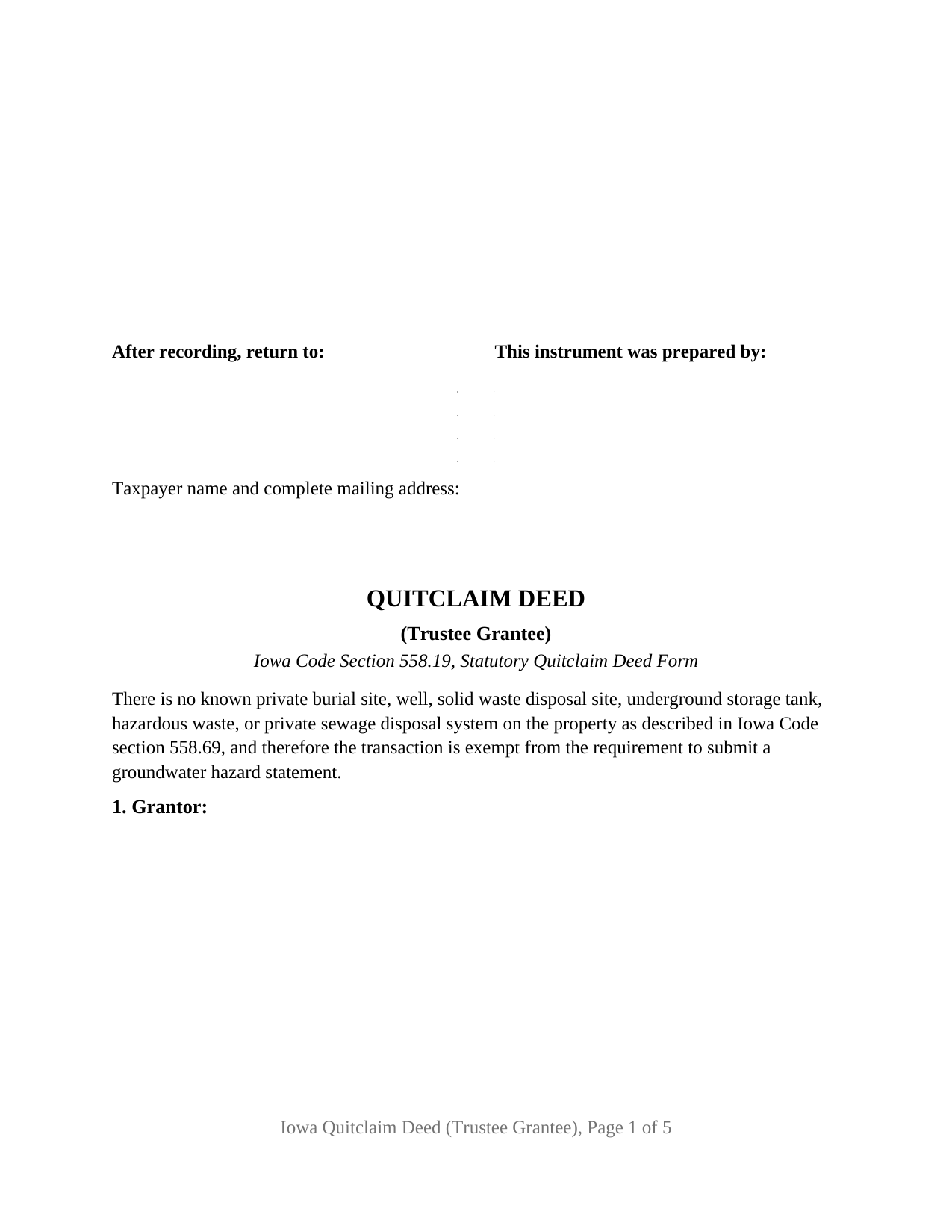
The grantee on this Iowa quitclaim deed takes the property in a capacity rather than in the grantee's own right. The form is built for that transfer: one individual grantor quitclaims to a trustee, the grantee entry names the person who holds the legal title as trustee, and a section of its own identifies the trust by name and by the date of the trust instrument.
A quitclaim that comes to rest in a trust
The operative words follow the statutory quitclaim form of Iowa Code section 558.19: for the stated consideration, the grantor quitclaims all of the grantor's interest in the described tract. Nothing is warranted about that interest: a mortgage stays on the land, and easements, covenants, assessments, and unpaid taxes ride into the trust with the parcel.
The destination separates this deed from an ordinary quitclaim. Title is taken and held by the named trustee, and by the successor trustees, on the terms of the trust instrument, so no co-ownership designation follows the grantee name: succession is written in the trust rather than in the deed. Iowa Code section 557.10 requires an instrument creating a trust in relation to real estate to be executed like a deed of conveyance; this deed is not that instrument; it conveys to the trustee of a trust already in existence.
What the deed names, and what the trustee produces later
Two blanks carry the trust: its full name as the trust instrument states it, and the date of that instrument. The grantee entry states the trustee capacity beside the trustee's name. That entry recites a capacity; a recital does not by itself establish the trust or the trustee's powers, and Iowa Code section 633A.4604 supplies the certification of trust a bank, buyer, or title examiner may later require, prepared separately and not included in this package.
One grantor, and the signature a married grantor's spouse adds
The form recites exactly one individual grantor, married or unmarried, with one signature block, and gives a married grantor's spouse a labeled block of that spouse's own. Iowa Code section 561.13 makes a married owner's homestead conveyance valid only when the owner's spouse executes the same or a like instrument, and section 561.13(2) lets a spouse who specifically relinquishes homestead rights stay out of the granting clause. The printed relinquishment states that limit and no other waiver, which matters here because Iowa Code section 633.238(2) confines the reach of a general waiver given in a conveyance to the trustee of the grantor's revocable trust. Each block carries its own Iowa Code section 9B.16 acknowledgment certificate, so the two signers may appear separately.
Records in this shape appear when an owner moves a long-held residence into a revocable trust created years earlier, when a parcel left out at the original funding is deeded in afterward, and when an owner deeds ground to an adult child serving as trustee for a younger relative. The form is not set up for two grantors, an entity grantor, or a grantor signing as trustee, executor, or attorney in fact.
The transfer tax question a trust deed raises
Iowa charges eighty cents for each five hundred dollars of consideration above the first five hundred, and Iowa Code section 428A.2 lists the exceptions. Subsection 21 covers deeds in which the consideration is five hundred dollars or less, the ground the example claims for a funding transfer where nothing passes; Section 10 of the deed is the signed exception statement Iowa Code section 428A.4 accepts in place of payment. That subsection also sits inside the group section 428A.4(2) releases from the declaration of value, so the example records without one. The statute is not symmetrical about trusts: subsection 22, deeds distributing trust assets to beneficiaries without consideration, falls outside that release, so a deed out of a trust still carries the form.
Formatted for the recorder
The top three inches of the first page are reserved for recording, and the first-page entries of Iowa Code section 331.606B print beneath it: the return, preparer, and taxpayer blocks, the title, the grantor, and the trustee grantee, with a section 331.606B(3) page reference to the legal description on page two. The statutory no-condition groundwater sentence of Iowa Code section 558.69 sits under the title.
The purchase delivers the fillable blank deed, a completed example prepared as a Black Hawk County conveyance into a revocable trust, and a plain language guide to the sections, signing, and recording. The materials are informational and are not legal advice.
Important: County-Specific Forms
Our quitclaim deed (trustee grantee) forms are specifically formatted for each of the 99 counties in Iowa.
After selecting your county, you'll receive forms that meet all local recording requirements, ensuring your documents will be accepted without delays or rejection fees.