Iowa Quitclaim Deed (Married Grantor with Non-Owner Spouse Joinder)
County Specific Legal Forms Validated as recently as October 9, 2026 by our Forms Development Team
About the Iowa Quitclaim Deed (Married Grantor with Non-Owner Spouse Joinder)
How to Use This Form
- Select your county from the list
- Download the county-specific form
- Fill in the required information
- Have the document notarized if required
- Record with your county recorder's office
What Others Like You Are Saying
"what do you do with it once filled out. doesn't tell you"
"I was quite pleased with Deeds.com. I got the information I requested instantly."
"Deeds.com made the recording of my timeshare Quit Claim Deed painless and extremely fast. I'm talkin…"
"The forms where easy to get to and I hope that they will be as easy to fill out."
"First time user. Great service. If I need other forms, I'll definitely be using Deeds."
4.8/5 from 4,828 reviews. Read all
The second signature on this Iowa quitclaim deed comes from a person who owns no part of the property. A married grantor who holds the record title alone makes the conveyance, and the grantor's spouse signs beside it for one purpose: to let go of the homestead and statutory share rights Iowa gives a spouse in the other spouse's real estate.
Why a spouse with no title signs anyway
Iowa Code section 561.13(1) makes a homestead conveyance by a married owner invalid unless and until the owner's spouse executes the same or a like instrument, and Martin v. Martin, 720 N.W.2d 732 (Iowa 2006), applied that consequence against both spouses where the signature was missing. A second provision reaches past the homestead. Under Iowa Code section 633.238(1)(a), a surviving spouse's elective share is measured against real property possessed at any time during the marriage to which the surviving spouse made no express written relinquishment of right, so a release given now keeps that property out of the elective share base later.
One grantor conveying, one spouse relinquishing
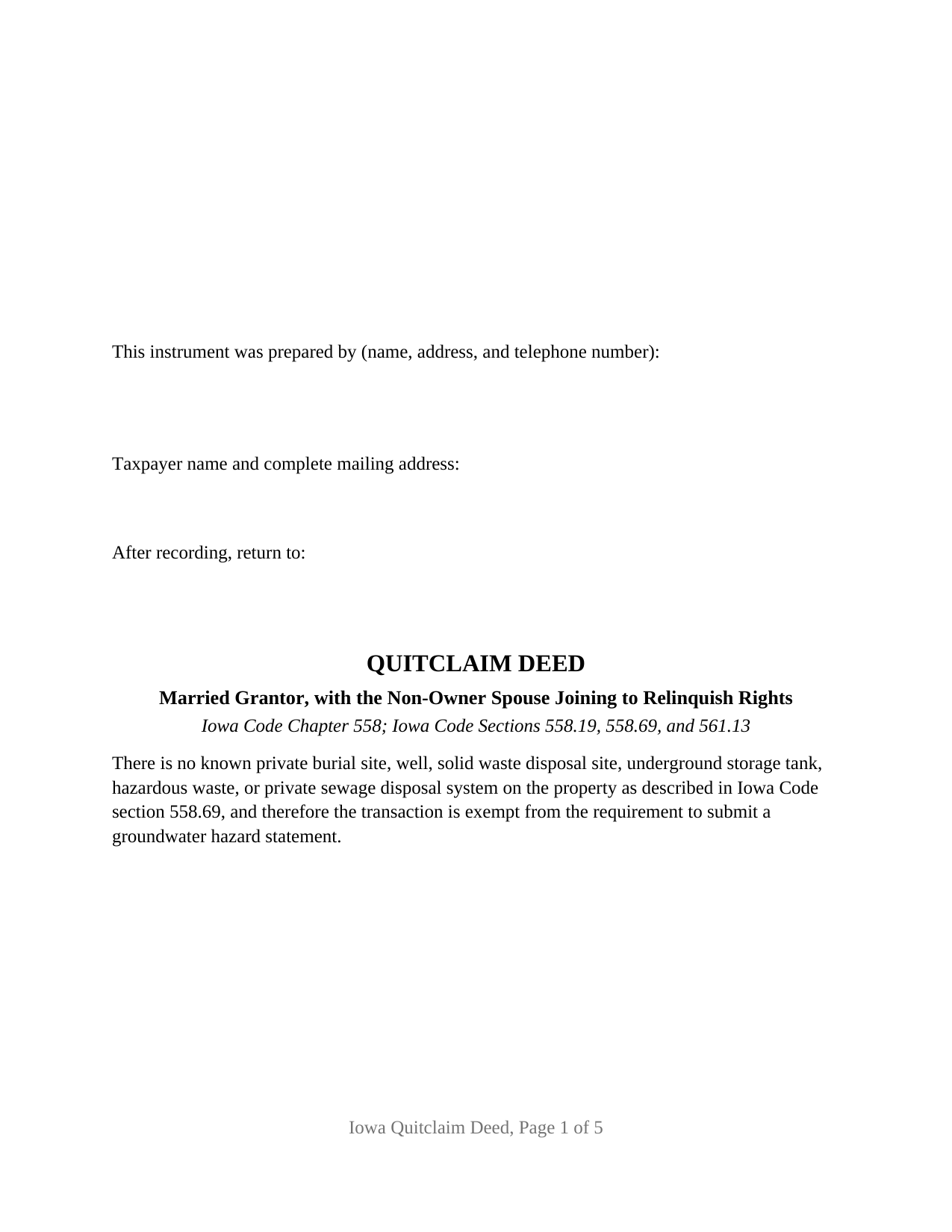
The form recites exactly one grantor, described as married and as the sole record owner, and gives the spouse a section of the spouse's own. The operative section then does both jobs in printed prose. The grantor quitclaims all of the grantor's interest in the described real estate, following the statutory quitclaim words of Iowa Code section 558.19, and the spouse relinquishes all rights of dower, homestead, and distributive share as an express written relinquishment of right, without joining in the granting clause and without passing any title. Iowa Code section 561.13(2) keeps that division clean: a spouse who holds only homestead rights and the surviving spouse's statutory share, and who specifically relinquishes homestead rights in the instrument, is not required to join in the granting clause. Two signature blocks follow, the second labeled for the relinquishment alone so the record shows the character of that signature, and each signer has an acknowledgment certificate of its own in the short form of Iowa Code section 9B.16.
Deeds in this shape begin with how the grantor came to hold title alone: a house bought before the marriage, a parcel taken by devise from a parent's estate, or ground deeded by the owner's own parents to the owner alone. The form is not set up for spouses who both appear in the vesting deed, for an unmarried owner, or for a grantor signing as trustee, executor, attorney in fact, or officer of an entity.
What the deed moves and what stays with the land
A quitclaim, also searched as a quit claim deed, passes the interest the grantor actually holds and says nothing about its quality. Mortgages, judgment liens, easements, restrictive covenants, assessments, and unpaid taxes stay exactly where they were. The spousal release has its own limit: it reaches the rights it names in the property it describes, and Iowa Code section 633.238(2) confines the effect of a general waiver given in a conveyance to the trustee of the grantor's revocable trust unless the spouse states a specific written intent to reach the trust property.
Page one, the groundwater sentence, and the tax
Iowa Code section 331.606B holds the top three inches of the first page for the recorder and places the items it names under that band: the preparer, the taxpayer name and complete mailing address, the return address, the title, and the grantor, spouse, and grantee entries, with the page reference to the legal description on page 2 that subsection 3 provides for. The taxpayer address and a printed name beneath each original signature are outright rejection grounds for documents dated on or after July 1, 2009. The statutory no-condition sentence of Iowa Code section 558.69(8A) sits under the title, and the transfer tax section holds an exemption ground under Iowa Code section 428A.2 where one applies. The included example takes the taxable path: $61,500.00 of consideration produces $97.60 of tax at eighty cents per five hundred dollars above the first five hundred, paid with the declaration of value. The guide carries the computation, the refusal rules, the auditor's fee, and electronic submission.
The purchase delivers three files: the fillable blank deed, a completed example prepared as a Scott County conveyance from a married sole owner to his sister with his wife joining to relinquish, and a plain language guide to the sections, the signing, and the recording. The materials are informational and are not legal advice.
Important: County-Specific Forms
Our quitclaim deed (married grantor with non-owner spouse joinder) forms are specifically formatted for each of the 99 counties in Iowa.
After selecting your county, you'll receive forms that meet all local recording requirements, ensuring your documents will be accepted without delays or rejection fees.