Iowa Quitclaim Deed (Individual Grantor)
County Specific Legal Forms Validated as recently as October 9, 2026 by our Forms Development Team
About the Iowa Quitclaim Deed (Individual Grantor)
How to Use This Form
- Select your county from the list
- Download the county-specific form
- Fill in the required information
- Have the document notarized if required
- Record with your county recorder's office
What Others Like You Are Saying
"Great site. Very easy to use."
"I LOVE THIS SITE KEEP UP THE GREAT WORK YOUR DOING THNKS KEVIN"
"I finally got it. Thanks, William Vickery"
"I did this on a desktop using a scanned .pdf file. Simple, straight-forward, excellent instructions,…"
"So easy to use!"
4.8/5 from 4,821 reviews. Read all
The last signature block on this Iowa quitclaim deed is written to operate only if someone signs it. The form recites one individual grantor, a natural person conveying in that person's own right, and prints a spousal relinquishment section that takes effect only when the spouse of a married grantor signs beneath it. An unmarried grantor leaves the block empty; a married grantor's spouse signs it. The grantor's marital status is entered as a fact, never fixed by the form.
A relinquishment that waits for a signature
Iowa Code section 561.13(1) is the reason: where the owner is married, a conveyance of the homestead is not valid unless and until the owner's spouse executes the same instrument or a like one, and the Iowa Supreme Court in Martin v. Martin, 720 N.W.2d 732 (Iowa 2006), applied that rule against both spouses where the signature was absent. Section 10 answers the statute conditionally: a spouse of the Grantor signing below executes the deed solely to relinquish all rights of dower, homestead, and distributive share in the described real estate, and the relinquishment operates only if a spouse of the Grantor signs below. Section 561.13(2) makes that shape work, since a spouse who specifically relinquishes homestead rights in the instrument is not required to join in the granting clause. The spouse signs a block headed SPOUSE OF GRANTOR and conveys nothing.
What one grantor quitclaims
Section 8 follows the quitclaim form that Iowa Code section 558.19 prints: for the consideration stated in the deed, the Grantor quitclaims to the Grantee all of the Grantor's interest in the described real estate, together with all appurtenances, without covenant or warranty of title. The grantee receives the position the grantor held, and the quit claim deed says nothing about its quality; liens, easements, and unpaid taxes remain on the land.
One individual, one grantee entry, two certificates
Section 1 names the grantor with a mailing address and the status the record calls for; the example reads a married person. Section 2 takes one grantee, or co-grantees with the co-ownership words they select under Iowa Code section 557.15. Each signature is followed by its own certificate in the individual-capacity short form of Iowa Code section 9B.16. Records in this shape appear when a former spouse conveys to the other under a dissolution decree, when one of several heirs releases an undivided inherited share to the heir who keeps the property, and when an owner sells a lot for a price. The form is not set up for two grantors, for an entity grantor, or for a signer acting as trustee, executor, conservator, or attorney in fact.
The line on page one that points to page two
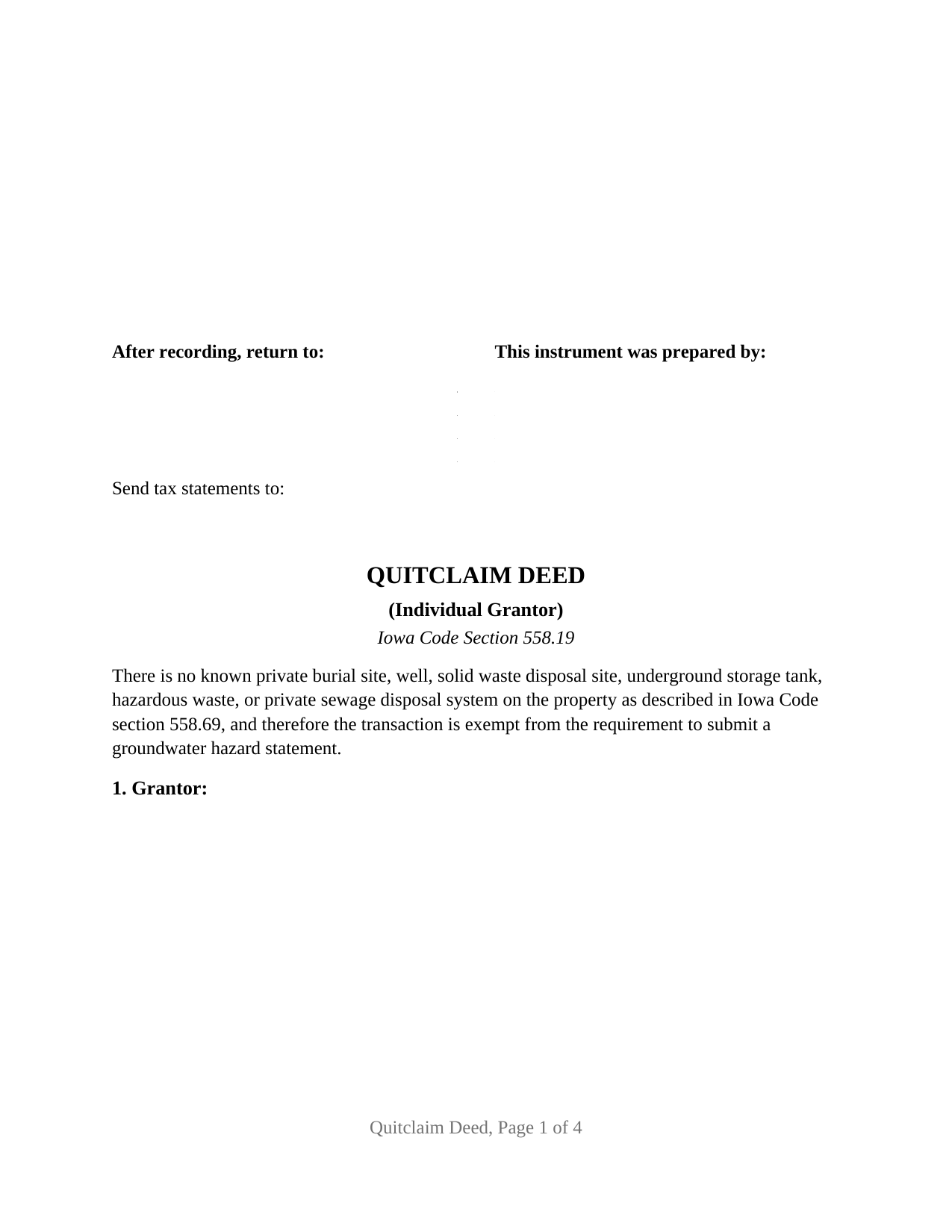
Iowa Code section 331.606B(2) lists what an instrument carries on its first page below the three-inch recorder's margin, from the preparer and the taxpayer's complete mailing address through the parties' names and the legal description and parcel identification number, and section 331.606B(3) adds the rule for a first page that cannot hold everything: the page reference where the information is located is noted on the first page. On this deed the administrative blocks, the title, the groundwater sentence of Iowa Code section 558.69(8A), the grantor, the grantee, the county, and the parcel number print on recorded page one, and its final line reads Legal description: continued at page 2, where the six-line description box opens. For a document dated on or after July 1, 2009, section 331.606B(7)(b) makes a missing taxpayer address a ground for refusal rather than a ten dollar fee.
Tax, exception, and the forms that travel with the deed
Iowa Code section 428A.1 taxes a conveyance at eighty cents for each five hundred dollars of consideration above the first five hundred, and section 428A.4 has the recorder refuse a taxable deed until it is paid or a signed statement of an exception under Iowa Code section 428A.2 accompanies it. Section 7 is that statement. The example conveys for one dollar and claims subsection 21, consideration of five hundred dollars or less, a ground section 428A.1(2) also releases from the declaration of value, so it records with neither tax nor declaration.
The purchase delivers the fillable blank deed, a completed example prepared as a Polk County conveyance by a married grantor with his wife relinquishing, and a plain language guide to the sections, the signing, the tax, and the recording. The materials are informational and are not legal advice.
Important: County-Specific Forms
Our quitclaim deed (individual grantor) forms are specifically formatted for each of the 99 counties in Iowa.
After selecting your county, you'll receive forms that meet all local recording requirements, ensuring your documents will be accepted without delays or rejection fees.