Iowa Quitclaim Deed (Corporation Grantor)
County Specific Legal Forms Validated as recently as October 9, 2026 by our Forms Development Team
About the Iowa Quitclaim Deed (Corporation Grantor)
How to Use This Form
- Select your county from the list
- Download the county-specific form
- Fill in the required information
- Have the document notarized if required
- Record with your county recorder's office
What Others Like You Are Saying
"Thank you for offering this service. We were getting several different answers on how to solve our p…"
"It was as I suspected. Very useful."
"Was a little frustrated first using your site, but due to my mental state, I expected that! Got what…"
"Very simple process to purchase and download. Made it easy to understand the different forms and the…"
"I am really impressed by this website. Not only is it affordable, but they give a detailed descripti…"
4.8/5 from 4,830 reviews. Read all
Iowa measures a corporation's deed against a question no individual's deed raises: whether the transfer would leave the corporation without a significant continuing business activity. Iowa Code section 490.1202 makes shareholder approval turn on that answer, and this quitclaim deed gives it a numbered section of its own, beside the board action behind the conveyance.
The approval question a corporate deed records
Section 490.1202 reaches a sale, lease, exchange, or other disposition of assets outside those described in Iowa Code section 490.1201, and calls for shareholder approval where the disposition would leave the corporation without a significant continuing business activity. A conclusive test in the corporation's favor rests on a retained business activity worth at least a quarter of total assets and a quarter of pretax income or of revenues.
Section 3 holds both entries, the board action and the shareholder approval where one is called for, and the conveyance section recites that the deed rests on them. The resolution itself stays in the minute book; a certified copy or a secretary's certificate is prepared separately and is not part of this package.
One corporation, one officer, one certificate
The form recites exactly one grantor, a corporation, with the state or other jurisdiction of incorporation on a line of its own. One signature line follows, for the officer signing on the corporation's behalf, with a printed name line and a title line beneath it, and then one certificate in the representative capacity short form of Iowa Code section 9B.16, whose blank names the signer, the authority, and the corporation. No spousal relinquishment block is printed, because Iowa Code section 561.13 conditions a homestead conveyance on the execution of the owner's spouse and a corporation has neither spouse nor homestead. The form is not set up for two corporations, an individual grantor, a limited liability company, or a fiduciary signer.
Records in this shape appear when a corporation releases its interest in a vacated alley beside its plant, when a company closing down passes its last parcel to a buyer, and when one clears a record interest left behind by a restructuring.
What a quitclaim out of a corporation passes
The operative words track Iowa Code section 558.19, where the statutory verb is quitclaim and the statutory scope is all the interest of the grantor. Quality of title is not addressed, which is the character of a quit claim deed, or corporate quitclaim deed as it is also searched: mortgages, easements, covenants, assessments, and unpaid taxes ride along. One promise does travel with the deed, and it belongs to the signer: Iowa Code section 558.72 reads into an entity's transfer instrument a warranty by the person executing it, of the corporation's existence and the signer's authority, unless the instrument clearly and conspicuously provides otherwise, and this deed's no-warranty sentence speaks to title alone.
A tax section that names corporations twice
Iowa charges eighty cents for each five hundred dollars of consideration above the first five hundred, and Iowa Code section 428A.4 lets an excepted instrument record on a signed statement of the exception instead of payment. Section 8 is that statement, and two grounds in Iowa Code section 428A.2 speak to corporations directly. Subsection 14 covers instruments resulting from a corporate merger, consolidation, or reorganization, on the condition that the deed states that fact on its face. Subsection 15 covers deeds between a family corporation and its stockholders in an incorporation or a corporate dissolution. The example travels the taxable road, where $210,000.00 of consideration yields $335.20 of tax.
What the recorder reads first
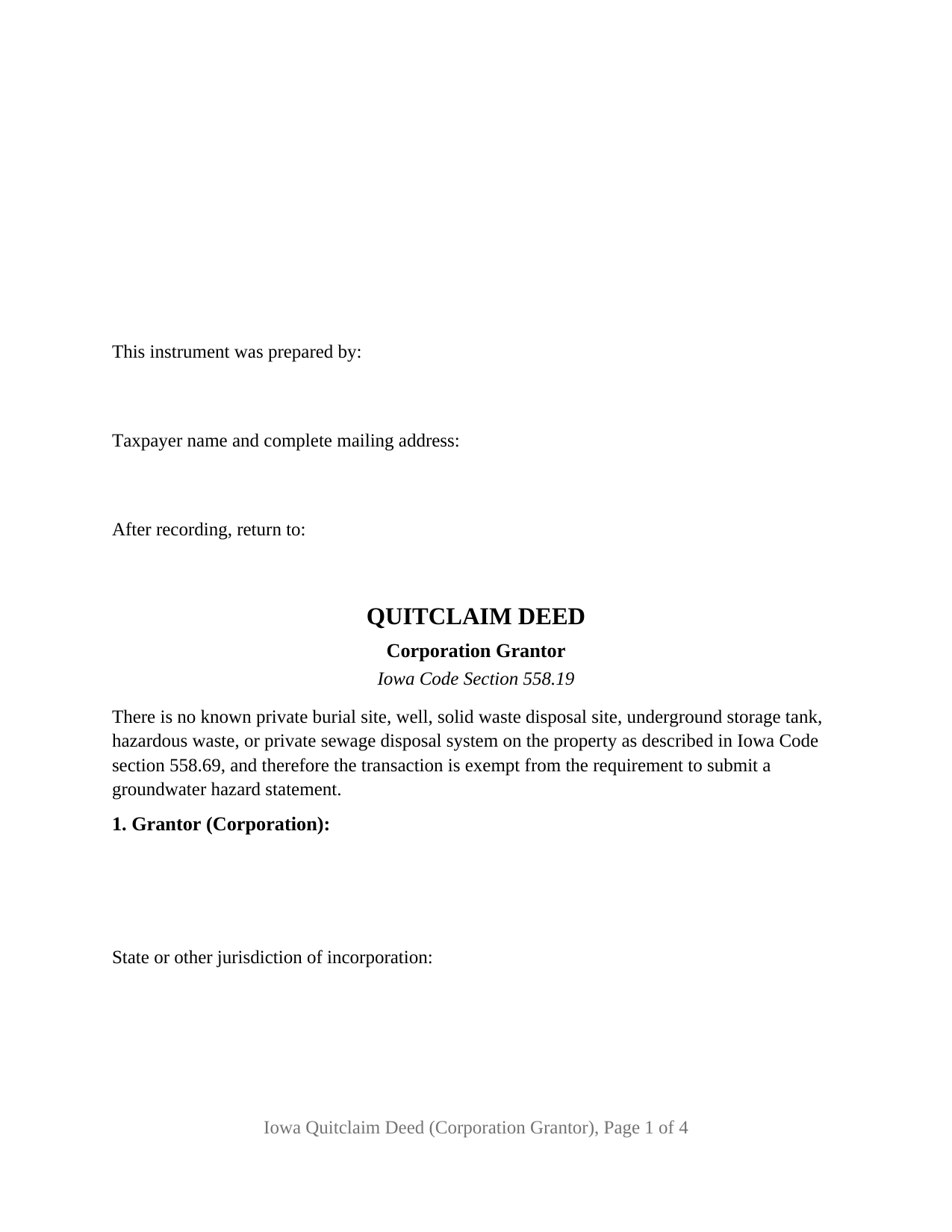
Iowa Code section 331.606B keeps the top three inches of the opening page clear for the recording stamp and puts the preparer, with a telephone number, the taxpayer with a full mailing address, and the return address in labeled blocks below that band. The grantor and the grantee share that page, and a one-line reference beneath them points to the legal description in Section 5, the page reference Iowa Code section 331.606B(3) calls for. Under the title sits the no condition sentence of Iowa Code section 558.69, and under the officer's signature a printed name, a rejection ground for documents dated on or after July 1, 2009.
The purchase delivers three files: the fillable blank deed, a completed example prepared as a Dubuque County sale by an Iowa corporation, and a plain language guide to the sections, signing, tax, and recording. The materials are informational and are not legal advice.
Important: County-Specific Forms
Our quitclaim deed (corporation grantor) forms are specifically formatted for each of the 99 counties in Iowa.
After selecting your county, you'll receive forms that meet all local recording requirements, ensuring your documents will be accepted without delays or rejection fees.