Iowa Quitclaim Deed (Married Couple as Grantors)
County Specific Legal Forms Validated as recently as October 9, 2026 by our Forms Development Team
About the Iowa Quitclaim Deed (Married Couple as Grantors)
How to Use This Form
- Select your county from the list
- Download the county-specific form
- Fill in the required information
- Have the document notarized if required
- Record with your county recorder's office
What Others Like You Are Saying
"Fantastic service -- very clear"
"I got what I needed and did exactly what I needed. All legal and no hassle. Thanks Deeds.com, you ma…"
"Thanks again for such expedient and excellent service!"
"Fabulous service team. VERY responsive with any issue I encountered. Preparing forms out of state to…"
"Thank you I hope I've done it all right!!"
4.8/5 from 4,828 reviews. Read all
A married couple conveying Iowa real estate answers the state's spousal execution rule with the two signatures this deed already collects. The form is an Iowa quitclaim deed for exactly two grantors who are married to each other, joining in a single instrument that releases every interest either spouse holds in the described property, with no warranty of title.
Two signatures that do the spousal release work themselves
Iowa Code section 561.13 makes a married owner's conveyance of a homestead valid only when the owner's spouse executes the same or a like instrument, and the Iowa Supreme Court has treated a homestead deed missing that execution as invalid as to both spouses. On this form the rule is met from inside the deed: each spouse conveys whatever interest that spouse holds, and each spouse's execution of the same instrument supplies the statutory joinder as to the other. The operative section recites that the grantors are married to each other and carries each spouse's relinquishment of all rights of dower, homestead, and distributive share, so the form prints no separate spousal relinquishment blocks at all; the two grantor signatures, each with an acknowledgment certificate of its own, complete the execution picture.
What a quitclaim from a couple actually passes
The operative words follow the Iowa Code section 558.19 statutory form: the grantors quitclaim to the grantee all of their interest in the described real estate. The instrument, often typed into a search box as a quit claim deed or quitclaim form, releases the position the couple actually occupies and promises nothing about its quality; mortgages, liens, and easements stay with the land. The pattern appears in Iowa records when parents deed the family home to an adult child as a gift, when spouses release their side of a boundary strip or shared driveway to the adjoining owner, and when a couple clears a lingering record interest so a title question can close cleanly.
A tax section that doubles as the statutory exemption statement
Iowa collects a real estate transfer tax of eighty cents for each five hundred dollars of value beyond the first five hundred, and Iowa Code section 428A.4 lets an excepted instrument record with a signed statement of the exemption in place of payment. Section 7 of this deed is that statement: the ground from Iowa Code section 428A.2 is entered in the blank, and the grantors' signatures at the end of the deed sign it. The included example claims the exemption for a deed from parents to their child without actual consideration, one of the grounds the statute lists; a couple's sale for value leaves the section blank, and the tax accompanies the recording.
A first page the recorder can act on
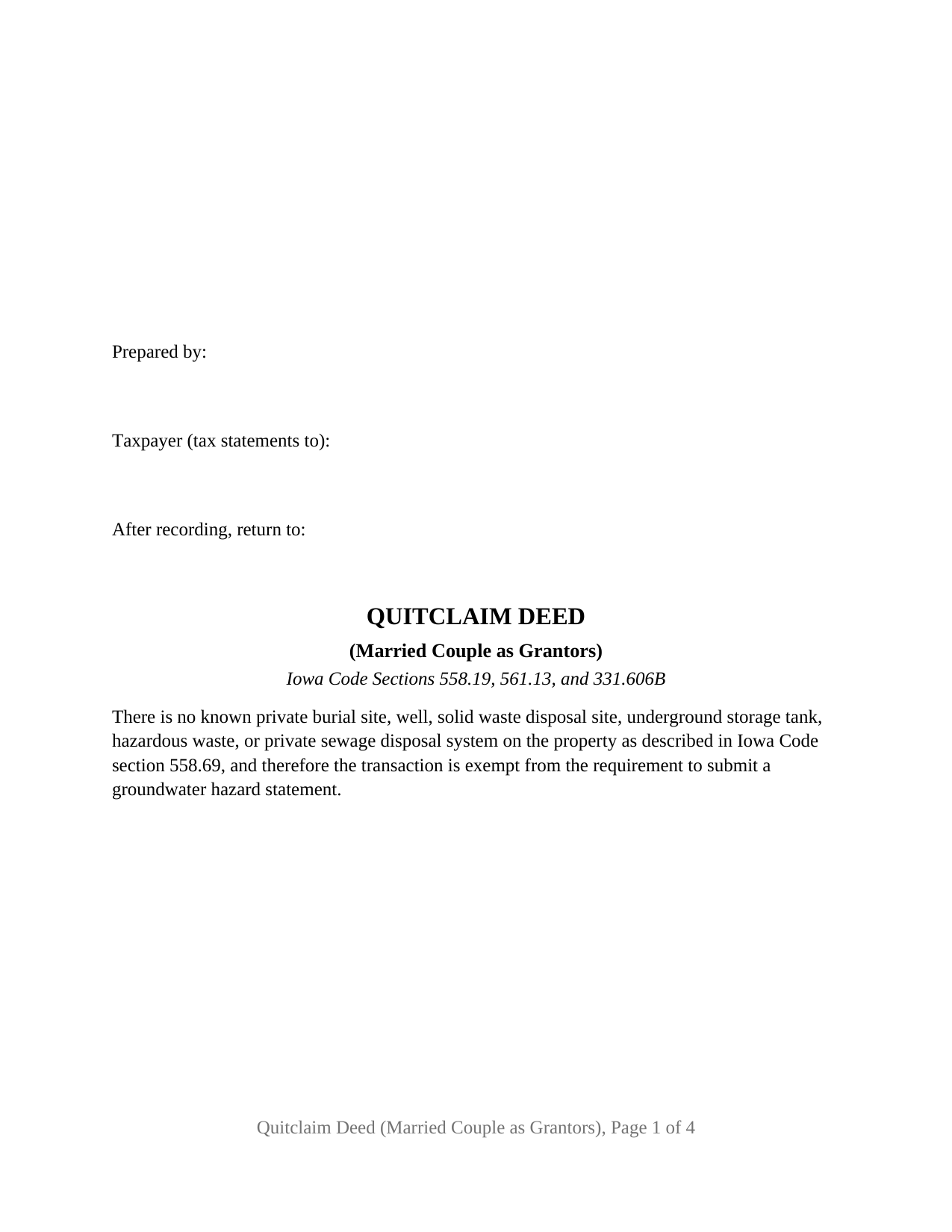
The top three inches of page one stay blank for recording information, and the entries Iowa Code section 331.606B places on a conveyance's first page print under that reserved band: the preparer's name, address, and telephone number, the taxpayer to whom the property tax statements go, the address for return of the recorded deed, the title, both grantors, and the grantee. The legal description takes more room than the first page leaves, so the first page notes the page on which it appears, the page reference that section 331.606B(3) calls for in that situation. The exact no condition groundwater sentence of Iowa Code section 558.69 follows the title, and printed name lines under both signatures meet the name under signature standard. The accompanying guide covers the declaration of value, the groundwater hazard mechanics, the recorder's refusal grounds, the county auditor's transfer fee, and electronic recording through the statewide county land record system.
The purchase delivers three pieces: the fillable blank deed, a completed example prepared as a Johnson County gift from a married couple to their daughter, and a plain language guide to the deed's completion, signing, and recording with the county recorder. The materials are informational and are not legal advice.
Important: County-Specific Forms
Our quitclaim deed (married couple as grantors) forms are specifically formatted for each of the 99 counties in Iowa.
After selecting your county, you'll receive forms that meet all local recording requirements, ensuring your documents will be accepted without delays or rejection fees.