Mississippi Quitclaim Deed (Corrective)
County Specific Legal Forms Validated as recently as October 4, 2026 by our Forms Development Team
About the Mississippi Quitclaim Deed (Corrective)
How to Use This Form
- Select your county from the list
- Download the county-specific form
- Fill in the required information
- Have the document notarized if required
- Record with your county recorder's office
What Others Like You Are Saying
"So far this has been a great experience. Very easy to use the deeds.com website and download the for…"
"Easier than I thought. No problem Nice service"
"Very user friendly. Forms professional and acceptable to state applicable to. Appreciate the sample …"
"Very easy and fast transaction. Thank you for complete set of forms needed for property transfer."
"Frankly, if our tax dollars were being used to run government "services" correctly, we wouldn't need…"
4.8/5 from 4,831 reviews. Read all
Mississippi put its statutory fix for a mistaken deed behind a bar card. This fillable corrective quitclaim deed takes the route the land records leave open to everyone else: one grantor names the earlier recorded deed on the face of a new instrument, sets the mistaken particular beside the corrected one, and conveys the parcel again under the description that is right.
The correction the code reserves for one signer
Miss. Code Ann. Section 89-5-8(2) lets notice of a typographical or other minor error in a document affecting title be given by recording an affidavit of scrivener's error, which the chancery clerk indexes under the names of the original parties. Then the statute names who may sign it. Only a Mississippi-licensed attorney who prepared a document in the chain of title may prepare that affidavit, it carries the attorney's bar number and good standing, and Section 89-5-8(2)(b) makes an affidavit executed by anyone else void, whenever recorded. That affidavit is its own instrument, prepared and recorded separately, and it is not part of this package.
A correction that works by conveying
What is left, and what this deed does, is convey. No warranty words appear in the operative section, and that omission fixes the instrument's character: Section 89-1-37 treats a conveyance made without warranty as a quitclaim and release of the title and possession its maker holds, while Section 89-1-39 carries across every estate that maker may lawfully convey and closes off a later claim under a title acquired afterward. The conveyance runs on the corrected description, so the record gains an instrument signed by the person whose interest is at stake, and the earlier deed stays indexed where it is. A capitalized section names the five covenants Section 89-1-33 gathers into the word warrant, states that none travels with this deed, and leaves a deed of trust, judgment lien, easement, or mineral reservation exactly where it sits.
What a chancellor would ask instead
The alternative is a lawsuit, priced steeply. To reform a deed, the movant proves beyond a reasonable doubt that an error contradicts the true intention of the parties, per Wright v. O'Daniel, 58 So. 3d 694 (Miss. Ct. App. 2011), on grounds of mutual mistake or of one party's mistake joined to fraud by the other, per Brown v. Chapman, 809 So. 2d 772 (Miss. Ct. App. 2002). A criminal standard of proof, in chancery.
One grantor, one earlier deed, one certificate
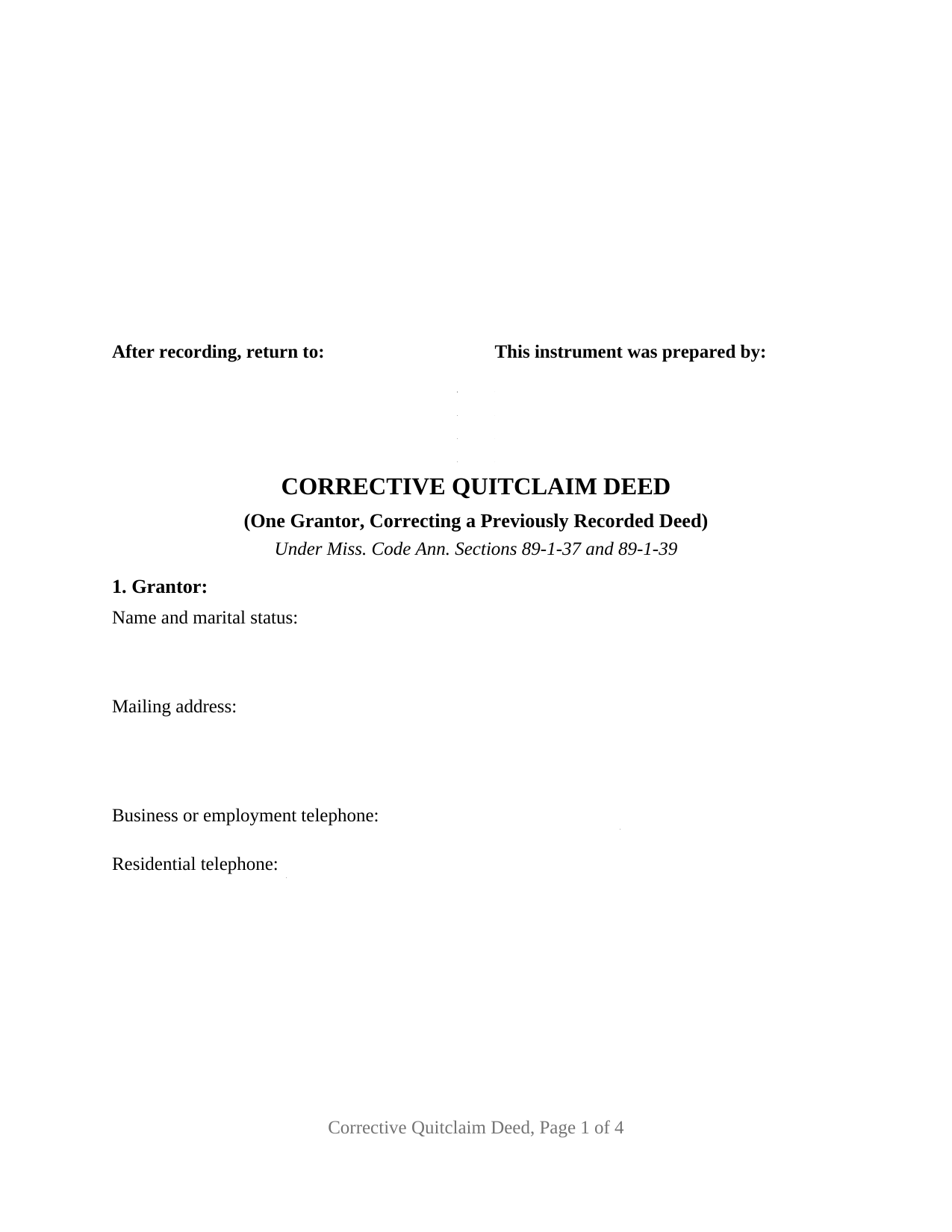
Section 1 takes a single grantor. Section 4 identifies the deed being corrected by its title, parties, date, recording date, and instrument or book and page reference; Section 5 holds the particular twice, as the earlier deed reads and as this one reads; Section 6 carries the description in corrected form. The receiving side stays open, taking one grantee or several, and the guide walks each ownership form Mississippi allows a grantee, beginning with the tenancy in common Section 89-1-7 supplies by default. One signature block and one acknowledgment certificate, in the short-form wording of Section 89-3-7(2), close the instrument. A lot number pointing at the neighbor's parcel, a grantor named unlike the vesting deed, and a missing plat reference all present the record this deed addresses. It is not laid out for two owners signing together, for a company acting through an officer, for an agent under a power of attorney, or for a married owner conveying homestead, where Section 89-1-29 asks for the spouse's signature too. Searches for a correction deed, a deed of correction, or a quit claim deed in two words arrive here.
At the chancery clerk's counter
Three inches at the top of page one belong to the clerk, with the items Section 89-5-24(2) assigns to that page underneath, both parties and the Section 89-5-33(3) indexing entry among them, the corrected description beginning on the page after. Both party sections gather the Section 27-3-51 address and telephone numbers a clerk may insist on. Section 25-7-9 charges twenty-five dollars for five pages or fewer; this deed runs four. A document departing from the Section 89-5-24 standards costs ten dollars more and nothing else, subsection (5) providing that nonconformance touches neither validity nor enforceability. No statewide transfer tax attaches.
Three files download together: the blank deed as a fillable PDF, a completed Oktibbeha County example, and a plain-language guide to the numbered sections, signing, and recording. These materials describe Mississippi law generally and are not legal advice.
Important: County-Specific Forms
Our quitclaim deed (corrective) forms are specifically formatted for each of the 82 counties in Mississippi.
After selecting your county, you'll receive forms that meet all local recording requirements, ensuring your documents will be accepted without delays or rejection fees.