Mississippi Quitclaim Deed (Individual Grantor)
County Specific Legal Forms Validated as recently as October 4, 2026 by our Forms Development Team
About the Mississippi Quitclaim Deed (Individual Grantor)
How to Use This Form
- Select your county from the list
- Download the county-specific form
- Fill in the required information
- Have the document notarized if required
- Record with your county recorder's office
What Others Like You Are Saying
"Amazing time saver, fantastic resource if you have an idea of what you are looking for and you can r…"
"Easy to use & got my one question answered in less than 5 minutes! Excellence."
"Outstanding forms and service. Liked that the main deed forms were PDF so I could fill them out on m…"
"Exceptionally easy site to navigate. Forms and related documents downloaded quickly and were helpful…"
"Easy to use, thank you."
4.8/5 from 4,825 reviews. Read all
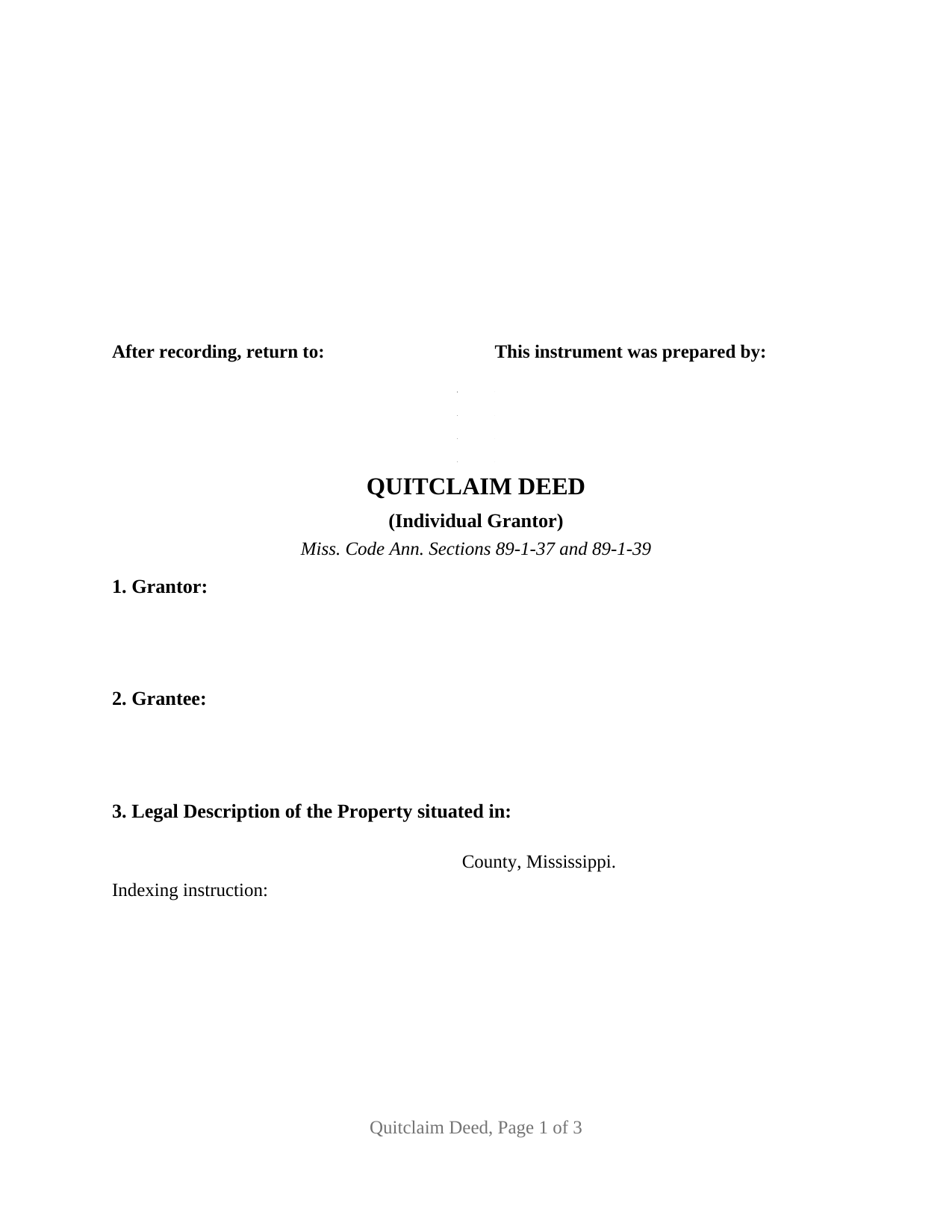
A Mississippi quitclaim deed made by one individual grantor carries a single signature line and a single acknowledgment certificate, and it moves whatever right, title, and interest that one grantor holds to the grantee. This fillable quitclaim deed form prepares that conveyance under Miss. Code Ann. Sections 89-1-37 and 89-1-39, for a natural person signing in that person's own right, formatted for recording with the chancery clerk of any Mississippi county.
A conveyance defined by the words it leaves out
Mississippi sorts its deeds by operative words rather than captions. The statutory conveyance form in Section 89-1-61 runs on the words convey and warrant, and Section 89-1-33 loads the word warrant with five title covenants. A conveyance that carries no warranty words takes a different statutory path: under Section 89-1-37, a conveyance without warranty operates to transfer the title and possession of the grantor as a quitclaim and release. This deed takes that path. Its operative section remises, releases, and forever quitclaims and conveys the grantor's interest, states that the conveyance is without warranty, and cites the governing sections on its face, so the instrument's character is plain in the record. The same document answers searches for a quit claim deed, the two-word spelling many customers use.
A release that still reaches forward
Section 89-1-39 gives the Mississippi quitclaim a forward reach. The instrument passes all the estate and interest the grantor can lawfully convey, and it estops the grantor and the grantor's heirs from asserting a later-acquired title adverse to the one conveyed. The grantee still receives no covenant that any particular interest exists; existing deeds of trust, liens, easements, and reservations of record are unaffected. What the deed conveys is the grantor's position in the title as the record holds it.
One grantor, one signature, one certificate
The form recites exactly one grantor of record, a natural person conveying in that person's own right. Its signature section carries one signature line with the printed name beneath it, followed by one notarial acknowledgment certificate in the individual short form of Section 89-3-7(2), the sentence This record was acknowledged before me on. The grantee section accepts one or more grantees, and the guide describes each ownership form Mississippi recognizes on the receiving side, from the estate in common Section 89-1-7 supplies when a deed to two or more people says nothing more, through the survivorship estates that section allows only when they manifestly appear from the instrument. A transfer between family members, a co-owner releasing an undivided interest to the other co-owner, and the release of a record interest of uncertain scope present the one-grantor pattern this deed recites. The form is not set up as a conveyance by two record owners signing together, by an entity acting through an officer, by a trustee or an agent under a power of attorney, or as a homestead conveyance by a married owner living with a spouse; Section 89-1-29 requires the spouse's signature on that last conveyance, a two-signature pattern outside this form's single signature block.
A first page the chancery clerk can index
Mississippi recording intake is specific, and the form is drafted to it. Section 89-5-24(2) places the preparer block, the return address, the instrument title, every party's name, mailing address, and telephone number, and the legal description or indexing instruction on the first page below the three inches reserved for the chancery clerk, and this deed lays out each of them there: the grantor and grantee entries with their telephone rows and the Section 89-5-33(3) indexing instruction all sit on page one, with the legal description opening page two under the statute's own continuation rule. Section 27-3-51 makes each party's mailing address and telephone numbers a recording prerequisite the clerk may enforce by refusal, which is why the party sections collect that data on the deed itself. Type runs at twelve point over the ten-point minimum of Section 89-5-24(1)(b), and the base recording fee under Section 25-7-9 is twenty-five dollars for the first five pages; this deed prints in three. Mississippi imposes no statewide transfer tax on an ordinary deed, and no separate transfer declaration accompanies it.
What arrives with the form
The download contains the blank quitclaim deed as a fillable PDF, a completed example showing the entire document filled in for a realistic Madison County fact pattern, and a plain-language guide that walks through every numbered section, the signing formalities, and the recording process. The materials describe Mississippi law in general terms and are not legal advice.
Important: County-Specific Forms
Our quitclaim deed (individual grantor) forms are specifically formatted for each of the 82 counties in Mississippi.
After selecting your county, you'll receive forms that meet all local recording requirements, ensuring your documents will be accepted without delays or rejection fees.