Mississippi Quitclaim Deed (Interspousal)
County Specific Legal Forms Validated as recently as October 1, 2026 by our Forms Development Team
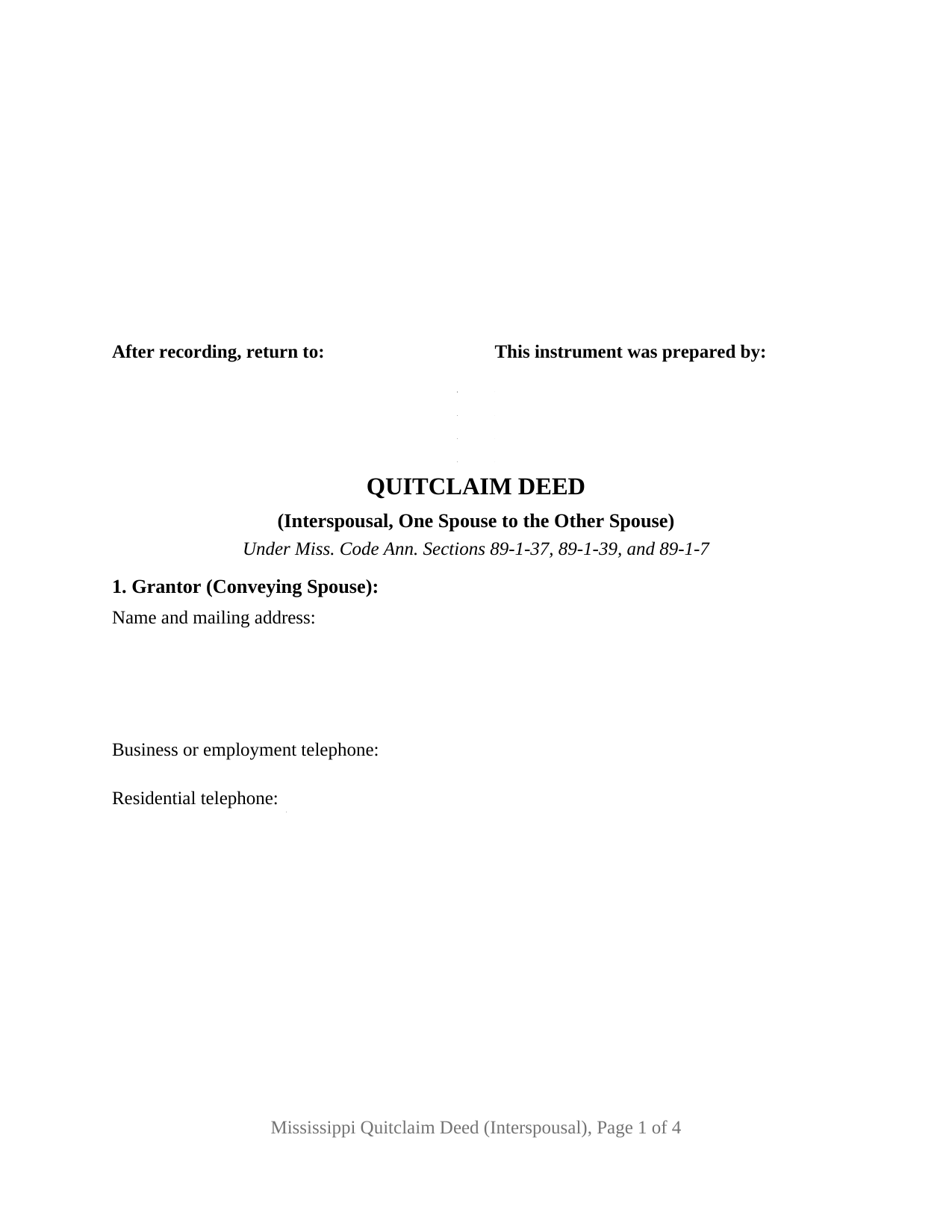
About the Mississippi Quitclaim Deed (Interspousal)
How to Use This Form
- Select your county from the list
- Download the county-specific form
- Fill in the required information
- Have the document notarized if required
- Record with your county recorder's office
What Others Like You Are Saying
"I believe that you should wait until a pending file is completed before asking for feedback. Thank y…"
"The forms were easy to fill in and file. I've never filed anything like this before and the forms ma…"
"You Guys are Fantastic and the service you all provide. Is PRICELESS!"
"It was easy and quick. Such a pleasure to use since we live out of town. So convenient. Definitely w…"
"You made a very confusing process very easy. Your response was timely. I will definitely use you aga…"
4.8/5 from 4,828 reviews. Read all
A deed to the marital home in Mississippi usually carries two signatures. An interspousal deed carries one, because the spouse whose signature the homestead statute exists to protect is the spouse receiving the property. The fillable form on this page prepares that instrument: a married Mississippi owner quitclaims to the other spouse, and what changes hands includes the grantor's homestead right and any survivorship the grantor holds with the grantee.
Why one signature answers the homestead rule
Miss. Code Ann. Section 89-1-29 voids a conveyance of a homestead that the owner's spouse has not signed, where the owner is married and living with that spouse, and the state Supreme Court has called the cases construing it legion. That severity is aimed outward, at conveyances leaving the marriage. Reading its own older decisions in Ward v. Ward, 517 So. 2d 571 (Miss. 1987), the court treated them as standing for the proposition that a spouse may convey to another spouse his or her interest in the homestead property, and the Land Title Association of Mississippi describes that result as an interspousal exception to joinder. Section 9 of the form puts the homestead release in its operative language, in the manner of the interspousal quitclaim that appears in the Ward record.
Ending a survivorship estate between spouses
For couples already holding with survivorship, Mississippi wrote the answer into the statute. The third paragraph of Section 89-1-7 provides that an estate in joint tenancy or entirety with right of survivorship between spouses may be terminated by deed of one spouse to the other without necessity of joinder of the grantee spouse and without regard to whether the property constitutes any part of the homestead of the spouses. This deed performs that termination in its own words, so a couple who took title as tenants by the entirety and now want the whole fee in one name leave a record an examiner reads on one instrument.
What passes, and what rides along untouched
The conveyance carries no warranty words. Section 89-1-37 gives a deed of that kind the character of a quitclaim and release of the grantor's title and possession, while Section 89-1-39 passes every estate the grantor can lawfully convey and estops the grantor and the grantor's heirs from asserting an adverse title picked up afterward. None of it disturbs the encumbrances: a deed of trust signed by the conveying spouse stays on the land, and judgment liens, easements, and mineral reservations of record survive the transfer unchanged. The deed says in capitals that the grantor makes none of the five covenants Section 89-1-33 folds into the word warrant.
One conveying spouse, one receiving spouse, one certificate
The form recites exactly one grantor and one grantee, married to each other, with the marriage stated in its own numbered section. The single signature block is followed by one notarial certificate in the wording of the short forms at Section 89-3-7(2). Spouses consolidating an entirety estate into one name, a spouse who owned the parcel before the marriage passing it across, and a husband or wife releasing whatever interest the record might show in the other's separate property all present the one-way spousal record this deed recites. The form is not set up for a grantee who is anyone other than the grantor's spouse, for two owners signing as grantors together, or for a spouse who signs only to answer the homestead statute while conveying nothing. A search for an interspousal transfer deed, or for a quit claim deed between husband and wife in the two-word spelling, reaches this same instrument.
A first page the recording statute writes
Mississippi tells a deed what its first page holds. Section 89-5-24(2) keeps the top three inches clear for the chancery clerk and puts below that band the preparer, the return address, the title, every party's name, mailing address, and telephone number, which Section 27-3-51 separately makes a condition of recording, and the legal description or the indexing instruction, succeeding pages carrying the rest. Both party blocks sit on page one here, with the Section 89-5-33(3) indexing entry distinctly set apart in its own numbered section and the description on the page after. Three pages, inside the twenty-five dollars Section 25-7-9 charges for five.
Three files download together: the blank interspousal deed as a fillable PDF, a completed Harrison County example, and a plain-language guide to every numbered section, the homestead treatment, signing, and recording. These materials describe Mississippi law generally and are not legal advice.
Important: County-Specific Forms
Our quitclaim deed (interspousal) forms are specifically formatted for each of the 82 counties in Mississippi.
After selecting your county, you'll receive forms that meet all local recording requirements, ensuring your documents will be accepted without delays or rejection fees.