Mississippi Quitclaim Deed (Corporation Grantor)
County Specific Legal Forms Validated as recently as October 4, 2026 by our Forms Development Team
About the Mississippi Quitclaim Deed (Corporation Grantor)
How to Use This Form
- Select your county from the list
- Download the county-specific form
- Fill in the required information
- Have the document notarized if required
- Record with your county recorder's office
What Others Like You Are Saying
"The service was easy, fast, and cheap and we were able to close our sale 2 days after we downloaded …"
"Good product and service."
"Splendid! I will definitely and absolutely recommend you guys and this company to my co-investors !"
"I find this site easy to use and every form I may need. Now to figure out how to fill in on line. :)"
"The forms were just what I needed, very helpful."
4.8/5 from 4,828 reviews. Read all
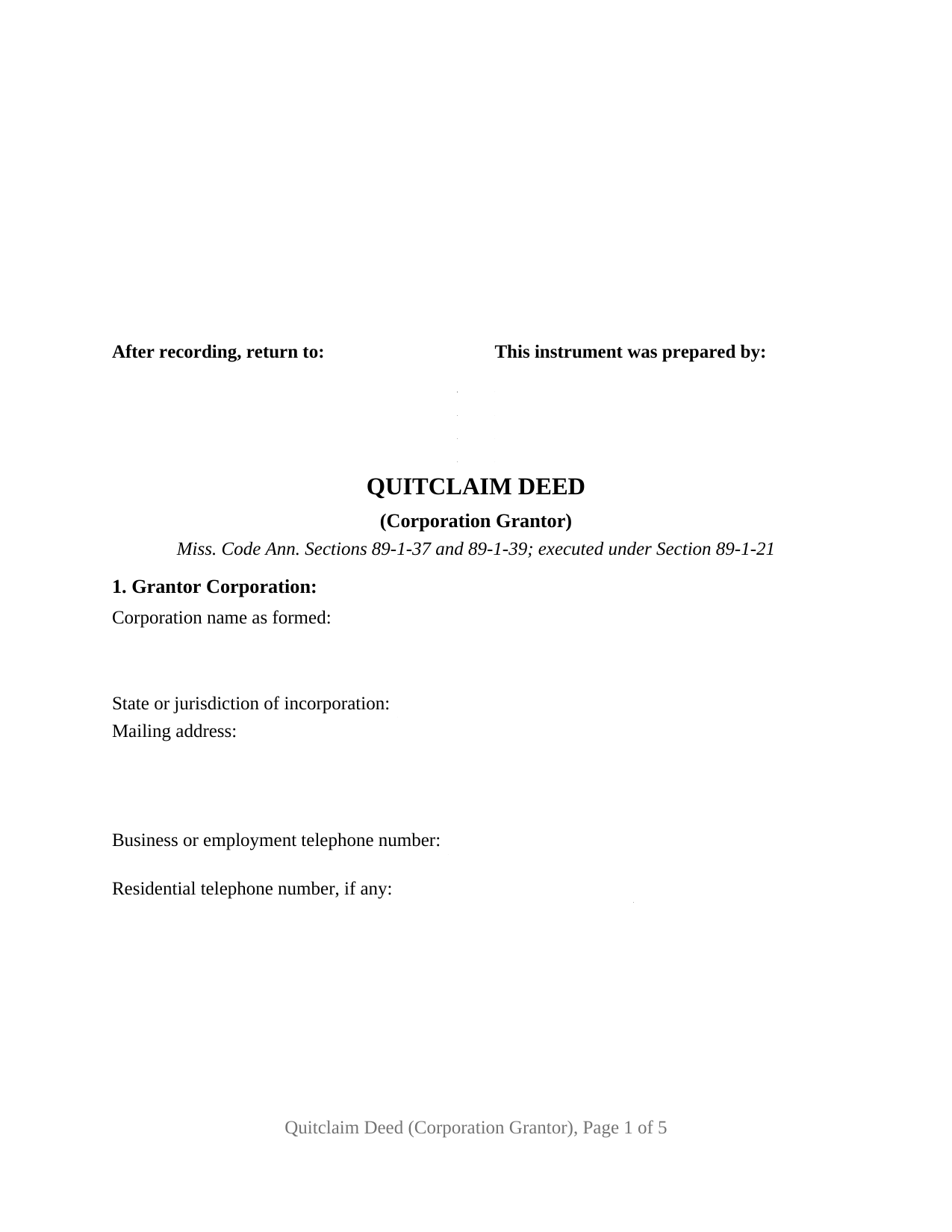
Mississippi still asks a public corporation to convey land under its corporate seal. A private corporation needs no seal at all: Miss. Code Ann. Section 89-1-21 lets it convey by a conveyance signed in its name by an officer, and this fillable quitclaim deed is drawn to it. One corporation is the grantor, one officer signs in the corporate name, and the deed passes whatever right, title, and interest the corporation holds, without warranty.
A sentence written for corporate grantors
Section 89-1-21 says that any private corporation may convey lands by a conveyance signed in its name by an officer or by an authorized agent or attorney in fact, that the person signing may acknowledge the execution, and that the absence of the corporate seal does not affect validity. Three points follow. The corporation is the grantor, not the officer. One signature in the corporate name carries the conveyance. And a missing seal is expressly harmless, so the execution block asks for an office and a printed name, not a wafer and a scroll.
Corporate power, and the authority behind one signature
The Mississippi Business Corporation Act supplies what the deed cannot. Section 79-4-3.02 gives a corporation an individual's power to sell and convey its property, Section 79-4-8.01(b) places the exercise of corporate powers under the authority of the board of directors, and Section 79-4-8.40 leaves the roster of offices to the bylaws or to board designation. Section 79-4-12.01 asks for no shareholder approval where a disposition runs in the usual and regular course of business; Section 79-4-12.02 does ask for it where the disposition would leave the corporation without a significant continuing business activity. So the deed records the answer: Section 4 takes the signer's name, the office held, and the authority relied on, such as a dated board resolution, a corporate record obtained separately and not included.
Without warranty, with an estoppel
The operative section uses no warranty words, which is what fixes its character. Section 89-1-37 makes a conveyance without warranty operate as a quitclaim and release of the grantor's title and possession, and Section 89-1-39 passes every estate the grantor may lawfully convey while estopping the grantor and its heirs from later asserting an adverse title. A capitalized paragraph names the five covenants Section 89-1-33 folds into the word warrant and states that the corporation makes none of them; recorded deeds of trust, judgment liens, easements, and mineral reservations survive the transfer.
One corporation, one officer, one certificate
The form recites exactly one corporate grantor and exactly one individual signing for it. The grantor entry takes the corporate name as formed, with the word or abbreviation Section 79-4-4.01 requires, and the jurisdiction of incorporation, naming the party on file with the Secretary of State. A single signature block carries the office on its printed name line, followed by one notarial certificate in the Section 89-3-7(2) short form, whose representative wording names the individual, the office, and the corporation acted for. Section 11 states that the signer acts in the corporate name and not individually, joins in no covenant, and warrants nothing. A corporation releasing whatever interest a predecessor by merger left in its name, an administratively dissolved corporation deeding out a parcel that Section 79-4-14.21 keeps conveyable, and a corporation incorporated elsewhere clearing its Mississippi record interest under Section 79-4-15.02 all present the entity conveyance this deed recites. The form is not set up for an individual grantor, for two corporations signing together, or for a nonprofit corporation, whose powers come from Section 79-11-151. A search for a quit claim deed by a corporation, in the two word spelling, reaches this instrument.
Drafted to Mississippi intake
Page one keeps its top three inches clear for the chancery clerk and carries what Section 89-5-24(2) assigns to that page: the return and preparer blocks, the title, each party's name, mailing address, and telephone numbers, and the indexing instruction, the legal description opening the second page under the statute's continuation sentence. A corporation answers the Section 27-3-51 address and telephone requirement with its business address and telephone, and the Section 89-5-33(3) indexing instruction sits in its own numbered section. Recording runs twenty five dollars for five pages or fewer under Section 25-7-9; this deed prints in four.
Three files arrive together: the blank corporate quitclaim deed as a fillable PDF, a filled Lauderdale County example, and a plain language guide to the numbered sections, corporate signing, and recording. The materials are informational and are not legal advice.
Important: County-Specific Forms
Our quitclaim deed (corporation grantor) forms are specifically formatted for each of the 82 counties in Mississippi.
After selecting your county, you'll receive forms that meet all local recording requirements, ensuring your documents will be accepted without delays or rejection fees.