Mississippi Quitclaim Deed (Individual Grantor by Attorney-in-Fact or POA)
County Specific Legal Forms Validated as recently as October 4, 2026 by our Forms Development Team
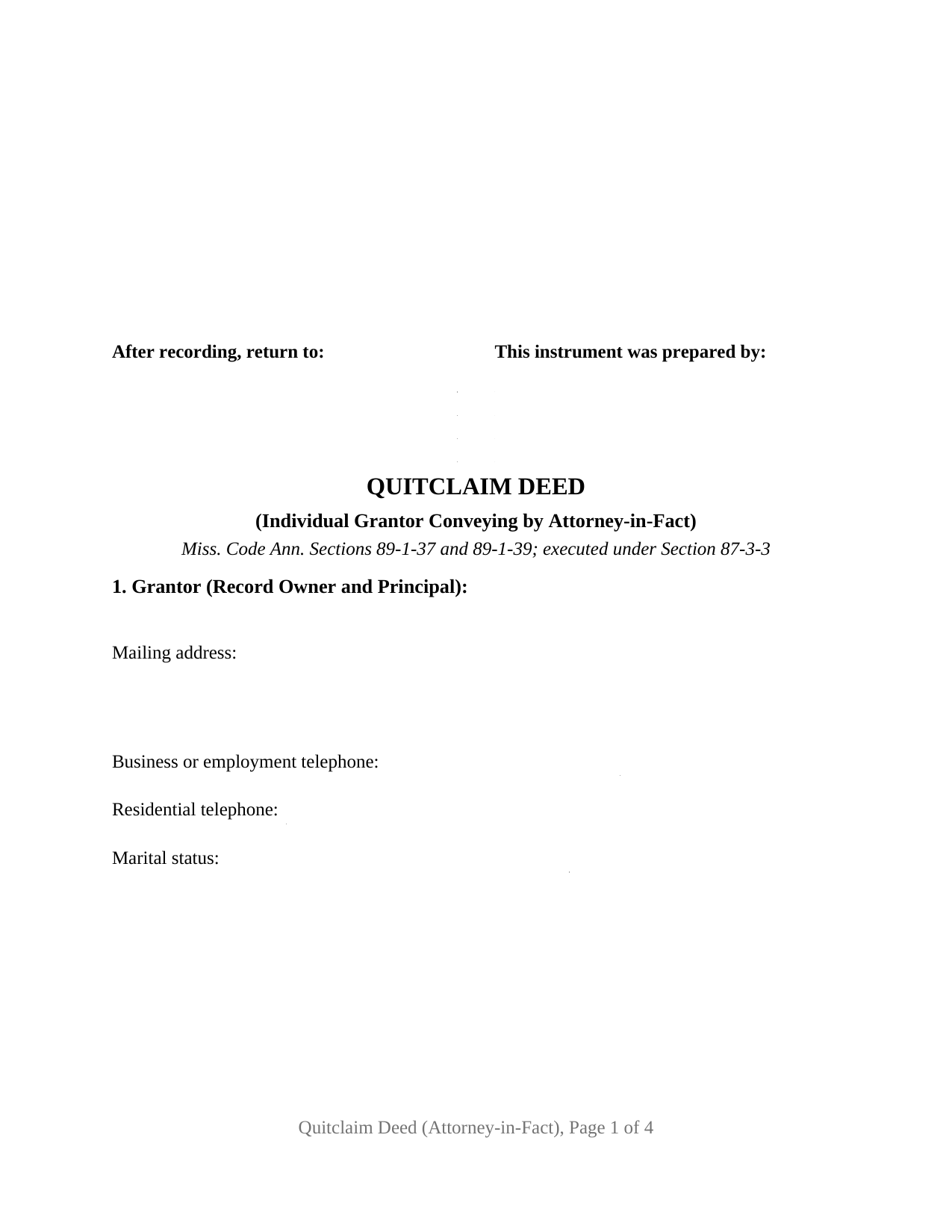
About the Mississippi Quitclaim Deed (Individual Grantor by Attorney-in-Fact or POA)
How to Use This Form
- Select your county from the list
- Download the county-specific form
- Fill in the required information
- Have the document notarized if required
- Record with your county recorder's office
What Others Like You Are Saying
"Thank you! Including the Guide and completed example was especially helpful."
"I am very grateful for this service! But I was quite surprised to see the fees went up over 50%! The…"
"easy to use"
"Best idea ever for completing an on-line government form. And it came with instructions!!!!! Thank y…"
"THIS WAS A USER FRIENDLY FORM, WAS ABLE TO COMPLETE WITHIN A SHORT TIME. THANK YOU"
4.8/5 from 4,832 reviews. Read all
Mississippi answers the agent-signed deed question in one sentence of its power of attorney chapter, and this fillable quitclaim deed is built on it. One individual record owner is the grantor; the signer is that owner's attorney-in-fact, under a power of attorney the deed identifies by date and recording data. What passes is whatever interest the owner holds, without warranty.
A deed the owner never signs
Miss. Code Ann. Section 87-3-3, Conveyances by attorney in fact, does two things. A conveyance of land executed by an attorney in fact for the principal, duly acknowledged or proved, has the same force and effect as if the principal had signed and acknowledged it. Its second clause reaches the signature line itself: where a conveyance by an attorney is in execution of letters of attorney acknowledged or proved and recorded, it passes the principal's interest though not formally executed in the principal's name. Section 8 borrows that phrase, reciting a conveyance made in execution of the power of attorney identified in Section 4.
Why the form asks where the power of attorney is recorded
Section 87-3-1 lets letters of attorney used in this state be acknowledged or proved as a land conveyance is, then recorded in like manner. That is how the protection in Section 87-3-3 becomes available, so Mississippi practice files the power of attorney with the chancery clerk of the county where the land lies, often alongside the deed. Section 4 collects the result: the agent's name and address, the date of the power of attorney, and its recording reference. Scope stays with that document, which Section 87-3-7(1) says need only express plainly the authority conferred; it is recorded separately and not included.
Durability, and the day the agent signs
Mississippi never adopted the 2006 uniform act on powers of attorney. Agency over property runs on the older Uniform Durable Power of Attorney Act, Sections 87-3-101 through 87-3-113, under which Section 87-3-105 makes a power durable only where express words say so. Section 87-3-107 binds the principal for acts done under a durable power during incapacity, and Section 87-3-111 shields good-faith action taken without actual knowledge of a revocation or of the principal's death.
What the conveyance moves, and what stays put
No warranty words appear in the operative section. Section 89-1-37 makes a conveyance without warranty words operate as a quitclaim and release of the title and possession the grantor holds, and Section 89-1-39 hands on every estate that grantor could lawfully part with, shutting off a later claim under a title acquired afterward. Section 10 names in capitals the five covenants Section 89-1-33 keeps inside the word warrant and disclaims each.
One owner, one agent, one certificate
The form recites one grantor and one signer. A single signature block carries the signer's capacity on its printed name line, followed by one notarial certificate in the Section 89-3-7(2) short-form wording, whose representative acknowledgment names the individual who appeared and the principal acted for. Section 2 takes one grantee or several, with a vesting entry beneath the names. An owner living out of state while a Mississippi parcel stays in that owner's name, an owner whose durable power is operating during incapacity, and an owner abroad releasing a fractional interest through an agent all present the agency conveyance this deed recites. It is not set up for two record owners, for a company as principal, for an agent holding record title, for a guardian acting under a court order, or as a homestead conveyance by a married owner living with a spouse, which Section 89-1-29 makes a two-signature deed. A search for a quit claim deed signed under a POA, in the two-word spelling, arrives here.
Drafted to the chancery clerk's intake
Page one keeps its top three inches free for the clerk, and everything Section 89-5-24(2) assigns to that page sits beneath the reserve: preparer block, return address, title, the owner and grantee entries with the address and telephone data of Section 27-3-51, and the Section 89-5-33(3) indexing instruction, holding Section 3 to itself. The legal description opens page two under the statute's continuation sentence. The deed prints in four pages, inside the twenty-five dollar charge Section 25-7-9 sets for five.
Three files download together: the blank deed as a fillable PDF, a completed Lee County example running from preparer block to certificate, and a plain-language guide to the numbered sections, the power of attorney entries, and recording. The materials are informational and are not legal advice.
Important: County-Specific Forms
Our quitclaim deed (individual grantor by attorney-in-fact or poa) forms are specifically formatted for each of the 82 counties in Mississippi.
After selecting your county, you'll receive forms that meet all local recording requirements, ensuring your documents will be accepted without delays or rejection fees.