Mississippi Quitclaim Deed (Interspousal One Spouse, as Sole Owner, to Both Spouses)
County Specific Legal Forms Validated as recently as October 1, 2026 by our Forms Development Team
About the Mississippi Quitclaim Deed (Interspousal One Spouse, as Sole Owner, to Both Spouses)
How to Use This Form
- Select your county from the list
- Download the county-specific form
- Fill in the required information
- Have the document notarized if required
- Record with your county recorder's office
What Others Like You Are Saying
"Love Deeds.com! I was a little confused as to how to go about Quitclaiming, but you made it very eas…"
"Great!! Helps me out"
"Easy to use. Documents as stated."
"I was actually quite pleased with the ease of use of this site. I really, really liked the step by s…"
"Very important information and easily accessable."
4.8/5 from 4,829 reviews. Read all
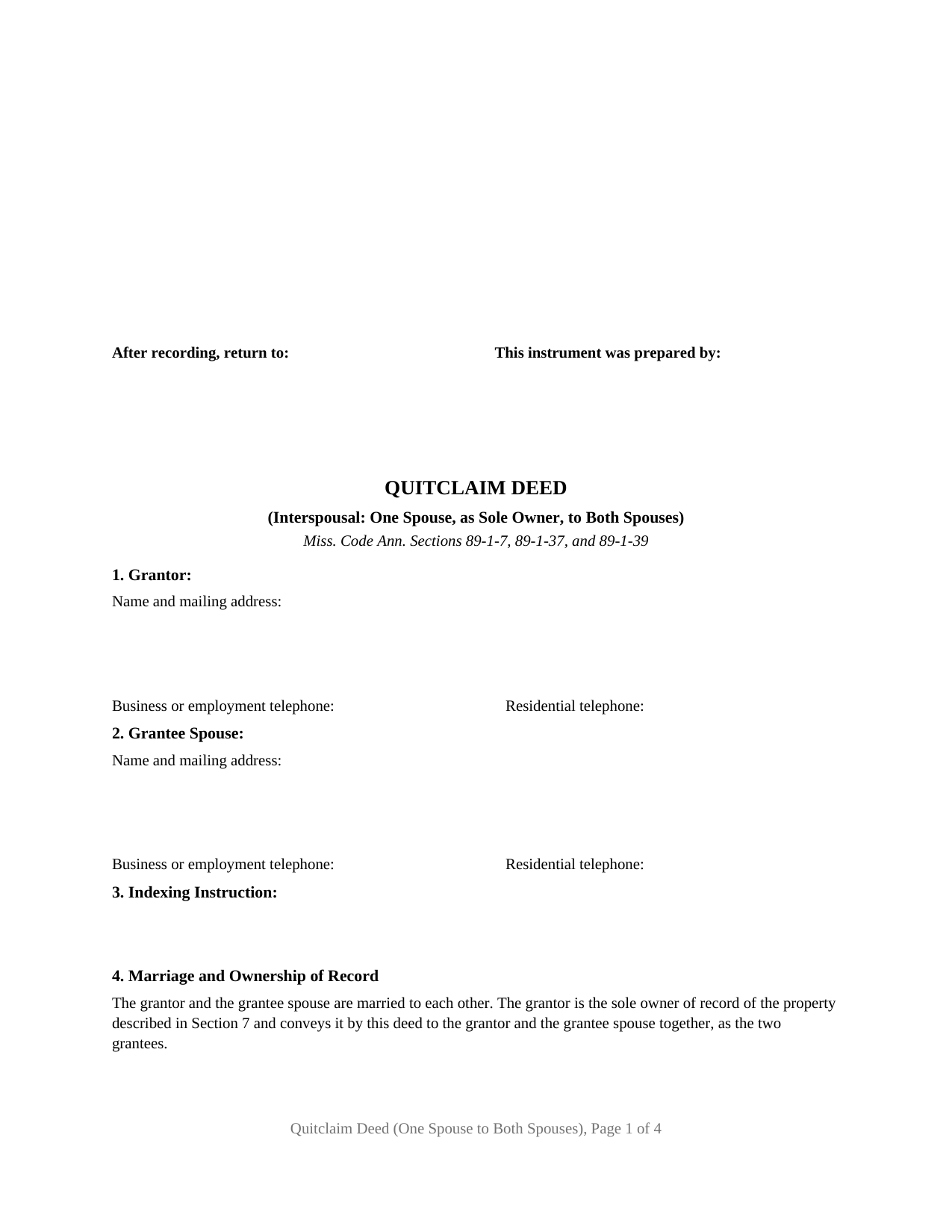
Record title stands in one spouse's name, and the couple wants it in both. Older conveyancing treated a deed from an owner to that same owner and another as a puzzle and ran the title through a third person first. Mississippi wrote the answer into Miss. Code Ann. Section 89-1-7, and this fillable quitclaim deed is drawn on it: a married sole owner of record conveys to that owner and the other spouse together, without warranty of title.
The sentence that lets an owner convey to that owner and another
The first sentence of Section 89-1-7 makes every deed to two or more people an estate in common unless an intent to create a joint tenancy or a tenancy by the entirety with right of survivorship manifestly appears from the instrument. The second sentence lets such an estate be created by a conveyance from the owner to himself and others, which is what a sole owner deeding to that owner and a spouse does, and Section 10 of the deed says so. The form of co-ownership turns on the words written in Section 5 after the grantees' names; the completed example writes as tenants by the entirety with right of survivorship and not as tenants in common, and an entry without survivorship words leaves an estate in common.
Why the receiving spouse signs too
Section 89-1-29 makes a conveyance of a homestead exempted from execution invalid unless signed by the owner's spouse where the owner is married and living with that spouse. Welborn v. Lowe, 504 So. 2d 205 (Miss. 1987), treats a homestead deed missing that signature as void, and Kelly v. Ocwen Loan Servicing, LLC, 363 So. 3d 935 (Miss. 2021), applied the statute's plain words over a purpose-served argument. The decisions excusing that signature on a deed between spouses concern a conveyance to the other spouse alone. This deed conveys to both spouses, so it carries a GRANTEE SPOUSE signature block beside the GRANTOR block, and Section 11 recites that the signature supplies the one Section 89-1-29 describes, whether or not the parcel is homestead, and that the grantee spouse conveys nothing.
Without warranty, and the grantor stays on the title
No warranty words appear in the deed, so under Section 89-1-37 it operates as a quitclaim and release of the grantor's title and possession, and Section 89-1-39 carries every estate the grantor can lawfully convey. The grantor is also a grantee, so what changes is not who owns the land but how many hold it and in what form; a deed of trust the grantor signed remains a lien, and a capitalized paragraph states that the grantor makes none of the five covenants Section 89-1-33 folds into the word warrant.
One married owner, one grantee spouse, two certificates
The form recites exactly one grantor and one grantee spouse. Section 4 states the marriage and the sole ownership of record as fixed text, Section 5 names the grantees and carries the co-ownership words, and a signature block for each is followed by an acknowledgment certificate in the Section 89-3-7(2) short form. A house one spouse bought before the wedding and now places in both names, land one spouse inherited alone that the couple takes as an entirety estate, and a refinance whose title commitment calls for both spouses of record present the pattern this deed recites. It is not set up for a conveyance to the other spouse alone, for both spouses deeding to someone else, or for a signer acting as agent or trustee. Searches for a deed adding a spouse to the title, or a quit claim deed to husband and wife in the two-word spelling, reach this instrument.
A first page the chancery clerk can index
Section 89-5-24(2) places the preparer, the return address, the title, each party's contact data, and the indexing instruction on the first page below the three inches reserved for the clerk, and this deed lays out all of them there, the legal description following on page two under the statute's continuation rule, and Sections 1 and 2 carry the address and telephone numbers Section 27-3-51 requires for both spouses. Four pages, inside the twenty-five dollars Section 25-7-9 charges for five.
Three files download together: the blank deed as a fillable PDF, a completed Lowndes County example carried through both certificates, and a plain-language guide to each numbered section, the forms of co-ownership, signing, and recording. These materials describe Mississippi law in general terms and are not legal advice.
Important: County-Specific Forms
Our quitclaim deed (interspousal one spouse, as sole owner, to both spouses) forms are specifically formatted for each of the 82 counties in Mississippi.
After selecting your county, you'll receive forms that meet all local recording requirements, ensuring your documents will be accepted without delays or rejection fees.