Mississippi Quitclaim Deed (Partnership or Limited Partnership Grantor)
County Specific Legal Forms Validated as recently as October 4, 2026 by our Forms Development Team
About the Mississippi Quitclaim Deed (Partnership or Limited Partnership Grantor)
How to Use This Form
- Select your county from the list
- Download the county-specific form
- Fill in the required information
- Have the document notarized if required
- Record with your county recorder's office
What Others Like You Are Saying
"very simple and complete"
"While most of the material is available elsewhere, this puts it all together and can save a lot of t…"
"Quick and Easy"
"Able to find the information that I needed."
"Quick, easy, affordable, eliminated the need for a lawyer."
4.8/5 from 4,829 reviews. Read all
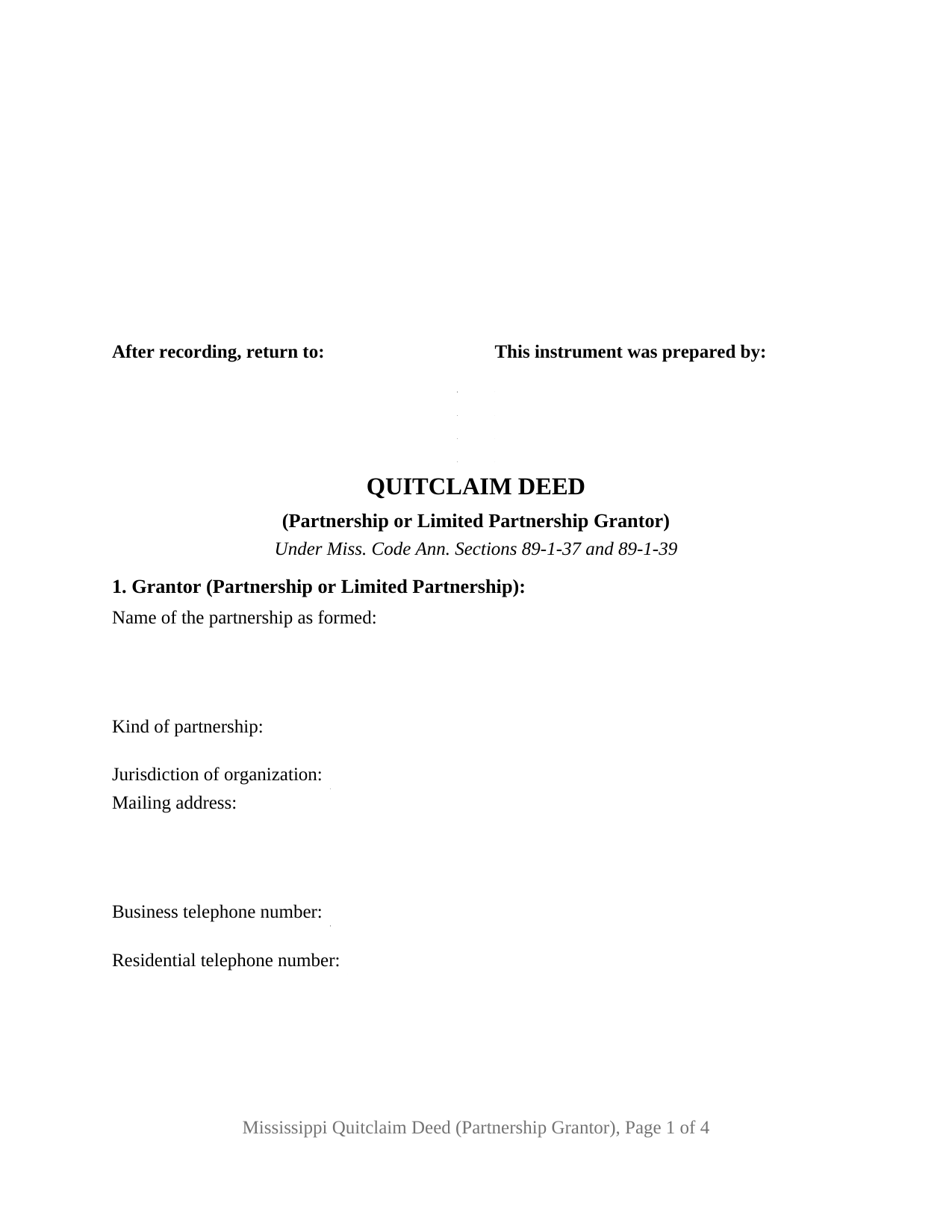
Mississippi keeps its partnerships in two separate chapters of the business code, and a deed out of a partnership has to answer to one of them. This deed prepares that conveyance for a single partnership grantor, without warranty of title, and the deed's own face carries the answer: blanks for the kind of partnership, the individual signing in the partnership name, and the authority relied on.
Two chapters, and a blank instead of an assumption
A general partnership and a limited liability partnership answer to Title 79, Chapter 13, the Uniform Partnership Act (1997), effective January 1, 2005. A limited partnership and a limited liability limited partnership answer to Chapter 14, the Mississippi Uniform Limited Partnership Act, enacted in the 2015 Regular Session and effective July 1, 2015. Section 79-14-114 even polices the name, requiring the words limited partnership or the abbreviation LP or L.P. Section 1 therefore takes the kind of partnership beside the name as formed and the jurisdiction of organization.
Where a single signature gets its force
Section 79-14-402(a) makes each general partner an agent of a limited partnership, so a general partner's act, including signing a record in the partnership's name, in the apparent ordinary course of its activities binds the partnership unless that partner lacked authority and the person dealt with knew or had notice of it. Section 79-14-406(b)(3) then requires every partner's consent to dispose of all, or substantially all, of the partnership's property outside the usual and regular course. Hence Section 4, which records a capacity and a named authority: a dated provision of the partnership agreement, a consent of the partners, or a statement of partnership authority under Section 79-13-303, obtained separately and not included here.
Without warranty, and an estoppel that runs one way
No warranty words appear in the operative section, and in Mississippi that omission fixes the deed's character. Section 89-1-37 gives a deed drawn without warranty the character of a quitclaim and release, reaching the title and possession the grantor holds and nothing beyond it, while Section 89-1-39 carries whatever estate the grantor may lawfully convey and estops the grantor and the grantor's heirs from asserting a later-acquired adverse title. A capitalized section lists the five covenants Section 89-1-33 packs into the word warrant, states that the partnership makes not one of them, and keeps the phrase grant, bargain, sell off the page, since Section 89-1-41 loads those words with covenants of their own. Liens, easements, mineral reservations, and a deed of trust the partnership signed ride through intact.
One partnership, one signer, one certificate
The form recites exactly one partnership grantor and exactly one individual signing in its name. A single signature block carries the signing capacity on its printed name line, and one acknowledgment certificate follows in the short-form wording the Revised Mississippi Law on Notarial Acts brought to Section 89-3-7(2). Section 11 fixes the signer's role: acting in the partnership name and not individually, in no covenant, and giving no warranty of title. A family limited partnership distributing a parcel to a partner while winding up, and a partnership clearing a fractional record interest left from an earlier purchase, both present the entity conveyance this deed recites. It is not drafted for an individual grantor, for two partnerships conveying together, or for a limited liability company or corporation, each answering to its own organic statute. A search for a quit claim deed by a partnership, in the two word spelling, arrives here as well.
What the chancery clerk reads first
The first page keeps its upper three inches free for the clerk's stamp, and every item Section 89-5-24(2) assigns to page one sits underneath: return address, preparer, title, both parties' contact data, and the indexing instruction, the legal description opening page two under the statute's continuation sentence. Section 27-3-51 conditions recording on a mailing address and telephone numbers for every party, which an entity answers with its business address and telephone; a clerk may refuse a deed that omits them. Section 89-5-33(3) directs that the indexing instruction be distinctly set apart, so it holds a numbered section of its own. The deed runs four pages, inside the twenty-five dollars Section 25-7-9 charges for five.
Three files download together: the blank partnership quitclaim deed as a fillable PDF, a completed Hinds County example running from the preparer block to the notarial certificate, and a plain-language guide to the numbered sections, signing, and recording. The package describes Mississippi law generally and is not legal advice.
Important: County-Specific Forms
Our quitclaim deed (partnership or limited partnership grantor) forms are specifically formatted for each of the 82 counties in Mississippi.
After selecting your county, you'll receive forms that meet all local recording requirements, ensuring your documents will be accepted without delays or rejection fees.