Mississippi Quitclaim Deed (Trustee Grantee)
County Specific Legal Forms Validated as recently as October 4, 2026 by our Forms Development Team
About the Mississippi Quitclaim Deed (Trustee Grantee)
How to Use This Form
- Select your county from the list
- Download the county-specific form
- Fill in the required information
- Have the document notarized if required
- Record with your county recorder's office
What Others Like You Are Saying
"The service was VERY quick, simple and, easy. I would definetly use this service again."
"Excellent website with examples on how to fill out forms. Even better was the help from the office o…"
"First time user. Was pleased with the easy of use and the step-by-step directions provided by the we…"
"Great service, well worth the $15 fee. Especially helpful was the review of my documentation and the…"
"quick and easy to use, thank you"
4.8/5 from 4,828 reviews. Read all
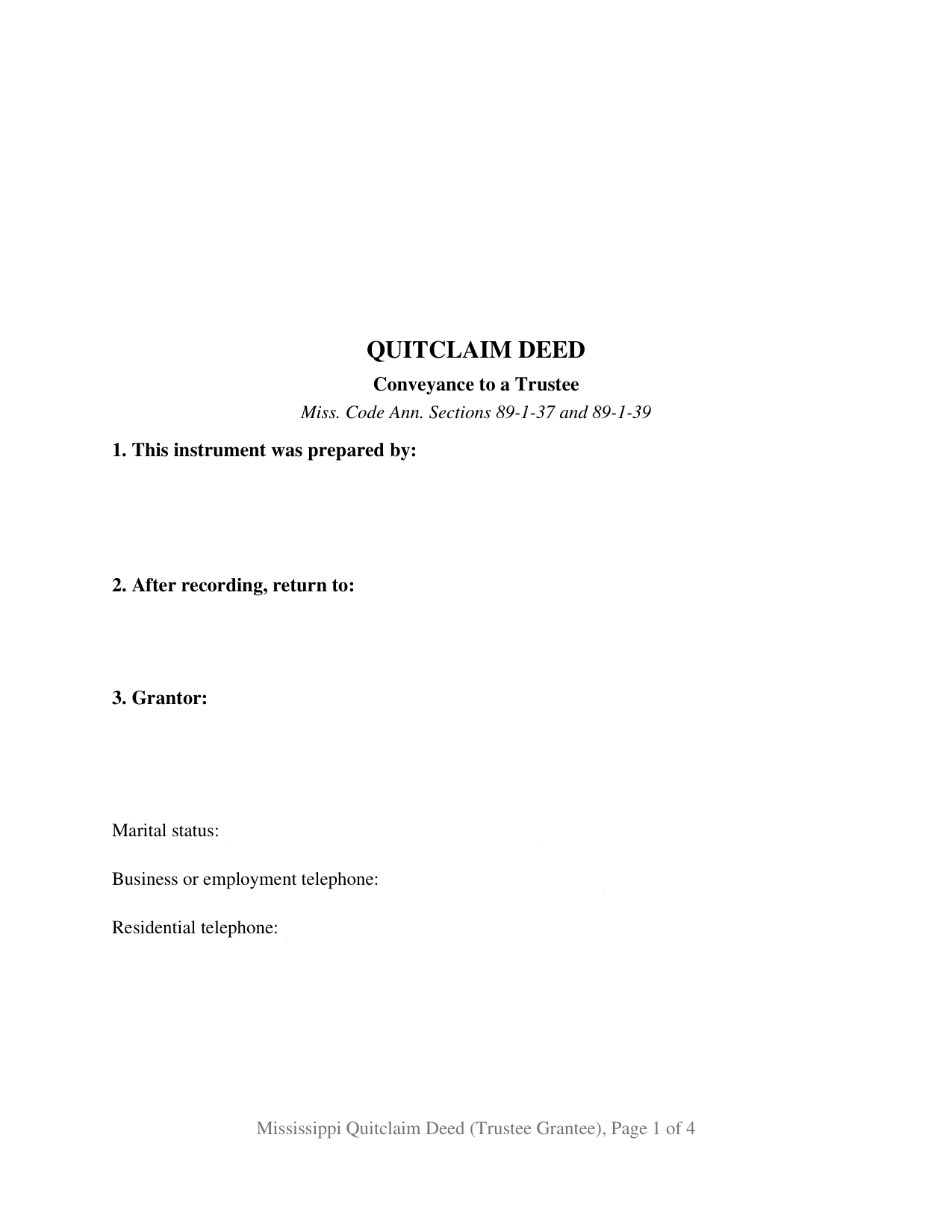
The grantee on this Mississippi quitclaim deed is a trustee, and that single fact governs how the instrument reads. One grantor conveys, without warranty, whatever interest that grantor holds, and the deed states the trust, its date, and the capacity in which the trustee takes title, ready for recording with the chancery clerk of any Mississippi county.
A grantee who holds for someone else
Most deeds hand a grantee ownership to keep; this one hands it to a fiduciary. Miss. Code Ann. Section 91-8-401 counts a transfer of property to another person as trustee among the methods by which a trust may be created, and a 2016 amendment added that a transfer in the name of the trust is legally sufficient too. This deed makes the capacity explicit: Section 2 states the trust name and date and identifies the trustee or cotrustees who take, and Section 9 provides that the grantee takes as trustee and not individually, that title vests in that capacity, and that it runs on to the successors in trust. Two or more people named there hold as cotrustees of one trust under Section 91-8-703, so the Section 89-1-7 tenancy in common default is not what the records show.
The deed is half of the record
Mississippi treats a trust of land as a writing that belongs in the land records. Section 91-8-407(b) provides that no trust of or in real property is created except by a written instrument signed by the party who declares it, that the writing may be acknowledged and filed with the clerk of the chancery court where the land lies, and that a memorandum of trust may be filed instead, serving as constructive notice of the trust's existence and terms. That memorandum may be recorded before or after the deed. It is its own instrument, prepared separately, and not part of this package.
What a quitclaim carries into a trust
The conveyance uses no warranty words. Under Section 89-1-37 a conveyance without warranty transfers the grantor's title and possession as a quitclaim and release, and Section 89-1-39 moves whatever estate the grantor may lawfully convey while barring the grantor and the grantor's heirs from setting up an after-acquired title against it. A recorded deed of trust rides through, and so do judgment liens, easements, and mineral reservations. A capitalized section names the five covenants that Section 89-1-33 gathers into the word warrant and states that the grantor makes not one of them.
One grantor, one certificate, one trust named on the face
The form recites exactly one grantor, with one signature line, the printed name beneath it, and one notarial certificate in the wording of the individual short form at Section 89-3-7(2). Section 1 collects the grantor's marital status beside the contact data, so the record shows why a lone signature stands. An heir releasing an inherited undivided interest to the trustee who holds the balance of family land, an owner conveying unimproved acreage to the trustee of a trust established for a child, and an owner releasing a fractional record interest to the trustee already holding the parcel all present the pattern this deed writes. It is not set up for two owners signing together, for a married owner conveying homestead where Section 89-1-29 calls for a spouse's signature, or for a grantee taking beneficially. A search for a quit claim deed to a trustee, in the two-word spelling, arrives here too.
At the chancery clerk's counter
The first page leaves its top three inches to the chancery clerk and carries the statutory items underneath, in the arrangement Section 89-5-24(2) lays out: who prepared the deed, where it goes after recording, the title, the grantor and trustee sections with their addresses and telephone numbers, and the indexing entry, the legal description opening the second page under that section's continuation sentence. Section 27-3-51 lets a clerk turn away a deed that omits a party's address or telephone numbers, so the grantor section and the trustee section each gather them, and the indexing entry Section 89-5-33(3) wants distinctly set apart holds Section 3 alone. At twenty-five dollars for five pages under Section 25-7-9, this four-page deed records at the base fee.
Three files download together: the blank trustee grantee quitclaim deed as a fillable PDF, a completed example carrying a Lamar County conveyance from page one through the certificate, and a plain-language guide to the numbered sections, signing, and recording. These materials describe Mississippi law generally and are not legal advice.
Important: County-Specific Forms
Our quitclaim deed (trustee grantee) forms are specifically formatted for each of the 82 counties in Mississippi.
After selecting your county, you'll receive forms that meet all local recording requirements, ensuring your documents will be accepted without delays or rejection fees.