North Carolina Quitclaim Deed (Interspousal)
County Specific Legal Forms Validated as recently as October 7, 2026 by our Forms Development Team
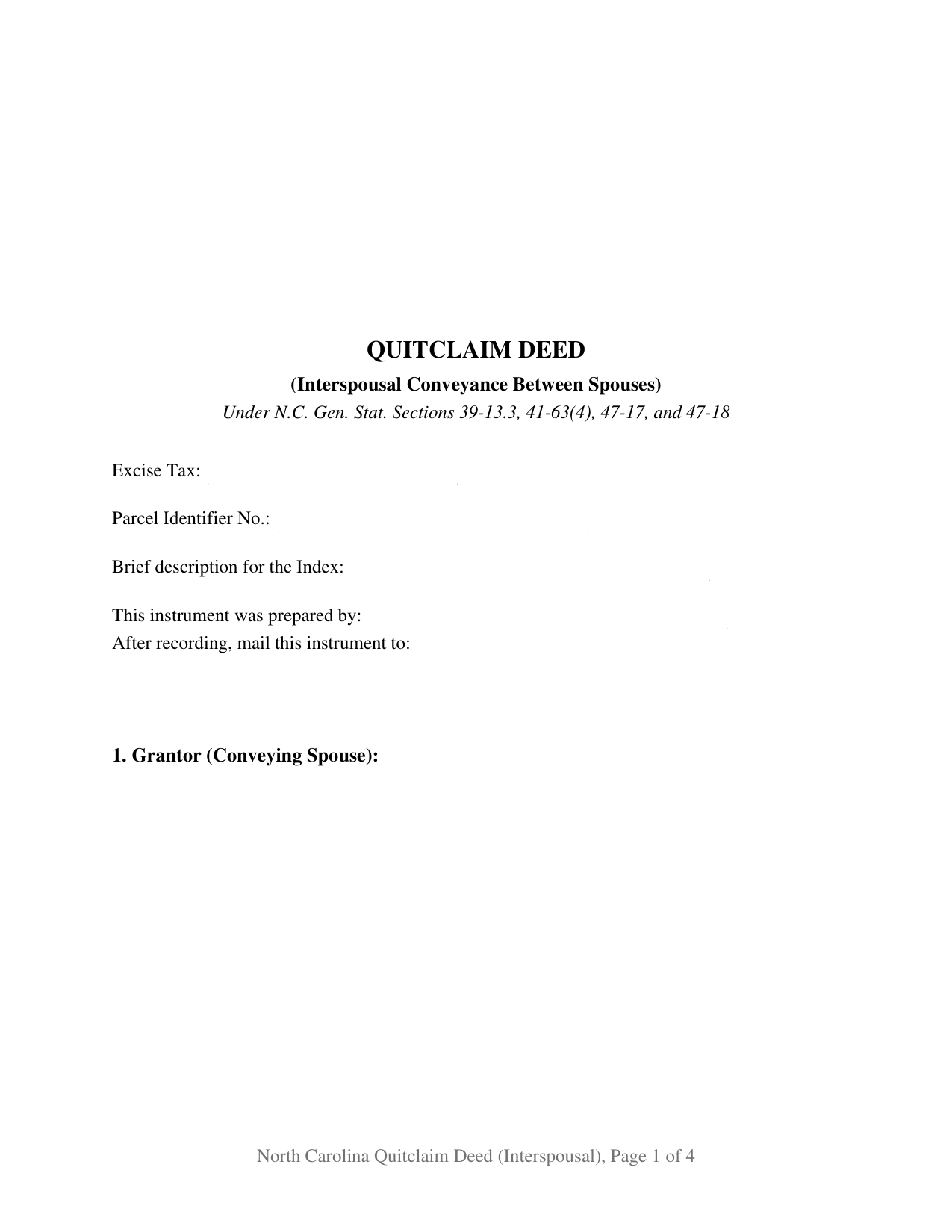
About the North Carolina Quitclaim Deed (Interspousal)
How to Use This Form
- Select your county from the list
- Download the county-specific form
- Fill in the required information
- Have the document notarized if required
- Record with your county recorder's office
What Others Like You Are Saying
"very easy to download, works great"
"Deeds was easy to use and worked as specified; they got the recording I needed done finished in one …"
"This was a very easy and pleasant experience using your website. I needed a legal document and with …"
"Ordering and directions were easy. The only thing missing in the instructions was how to record by m…"
"I was referred to you by a recording service for Walton County, Florida. I registered on your websit…"
4.8/5 from 4,828 reviews. Read all
A deed between spouses does two jobs at once in North Carolina: it moves whatever interest one spouse holds to the other, and it settles what becomes of the marital rights the conveying spouse keeps in that land. This fillable North Carolina quitclaim deed is drawn for exactly that transfer. One married record owner signs as Grantor, that owner's husband or wife is named as Grantee, and the instrument carries an express waiver of the elective life estate the Grantor would otherwise hold in the property conveyed.
The spouse who receives title signs nothing
Most North Carolina deeds out of a marriage answer to a joinder rule. This one answers to an exemption from it. G.S. 39-13.3(d) states that joinder of the spouse of the grantor is not necessary in a conveyance made under that section, and G.S. 41-63(4) says the same where the interest released is one spouse's share of entirety property. So the deed recites one Grantor with one signature line, one printed name line for the register's index, and a single acknowledgment certificate. The Grantee's name sits in the grantee blank and nowhere near a signature rule.
The waiver the conveyance does not supply by itself
Handing a parcel to a spouse and handing over the marital claims that attach to it are separate acts, and G.S. 39-13.3(a) keeps them separate. A conveyance from one spouse to the other does not waive the grantor spouse's right to an elective life estate under G.S. 29-30 unless the instrument expressly waives that right, in the terms G.S. 29-30(a)(2a) describes. Session Law 2025-25 rewrote both statutes effective October 1, 2025: a general release of marital rights buried in a deed is not the express waiver the statute looks for. Section 10 of this form states that waiver as its own numbered section, and states the limit on the other side as well, since G.S. 39-13.3(a)(2) provides that a claim to equitable distribution under G.S. 50-20 is not released in an instrument of conveyance.
Two title positions this form recites
The form recites one conveying spouse, one receiving spouse, and a statement that the two are married to each other. Both interspousal positions in the North Carolina records fit that language: a parcel one spouse owns alone, which vests in the other spouse under G.S. 39-13.3(a), and one spouse's interest in entirety property, which under G.S. 41-63(4) ends the entirety and leaves the whole in the Grantee. A Source of Title blank carries the book and page of the deed that created the position, where a title examiner reads which of the two it is. Configurations presenting this shape include a refinance whose title work calls for one spouse to stand outside the chain, and a couple consolidating an inherited parcel in the name of the spouse who inherited it. The form is not set up as a conveyance to both spouses, the pattern G.S. 41-56(b) addresses, and recites no joinder line and no second conveying owner.
The no warranty side of a transfer inside a marriage
No North Carolina statute prescribes a quitclaim deed, so this instrument, also searched as a quit claim deed or a non-warranty deed, works through its own words: the Grantor remises, releases, and forever quitclaims the Grantor's right, title, and interest, if any, without covenant or warranty of title. Under G.S. 39-1 the conveyance passes the Grantor's whole estate unless the deed plainly shows a lesser one, and a deed of trust on the land rides through the transfer untouched.
A gift between spouses and a zero on the excise line
The first page gathers what the register of deeds reads: an entry naming the drafter, which G.S. 47-17.1 turns into a condition of acceptance; the excise figure; the parcel identifier; and the return address. G.S. 105-228.29 lists transfers outside the excise tax, among them a gift and a transfer for which no consideration is due or paid, the classes most conveyances between spouses fall in. The body states each party's mailing address and whether the property takes in the primary residence of a grantor, as G.S. 105-317.2 asks.
The download holds the interspousal quitclaim deed as a fillable PDF, a completed example worked through a Durham County gift from one spouse to the other, and a plain language guide that takes the deed section by section and covers the waiver statutes, the excise treatment of a spousal gift, and the recording trip. These materials are informational and are not legal advice.
Important: County-Specific Forms
Our quitclaim deed (interspousal) forms are specifically formatted for each of the 100 counties in North Carolina.
After selecting your county, you'll receive forms that meet all local recording requirements, ensuring your documents will be accepted without delays or rejection fees.