North Carolina Quitclaim Deed (Two Grantors)
County Specific Legal Forms Validated as recently as October 16, 2026 by our Forms Development Team
About the North Carolina Quitclaim Deed (Two Grantors)
How to Use This Form
- Select your county from the list
- Download the county-specific form
- Fill in the required information
- Have the document notarized if required
- Record with your county recorder's office
What Others Like You Are Saying
"Example deed given did not apply to married couples as joint owners with both being grantors. The ex…"
"Great website to have your buyer's deeds done correctly! I highly recommend this website to anyone i…"
"great"
"I found it pretty easy to navigate, all worked well. Need a better example of excise tax. Lastly, yo…"
"I loved that there was a sample with the downloads. It made it much easier to fill out the document …"
4.8/5 from 4,828 reviews. Read all
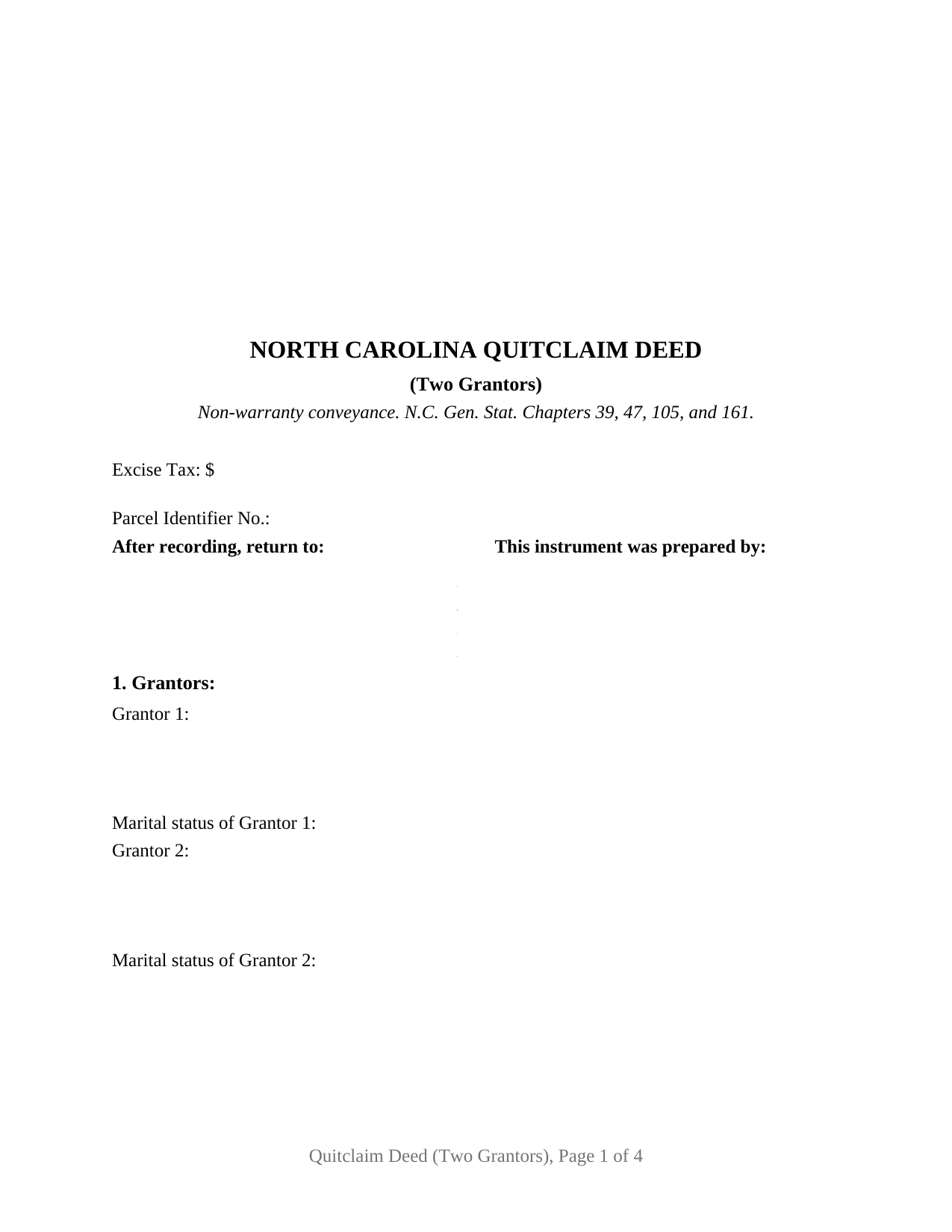
When two people hold interests in the same North Carolina real estate and both interests are moving to a single new owner, one instrument can carry both releases. This fillable quitclaim deed is built for exactly two individual grantors: each conveys whatever right, title, and interest that grantor may hold, with no covenant of title and no warranty attached, and the grantee takes the combined record position of both signers as it actually stands.
Two releases in one instrument
North Carolina supplies no statutory form for a quitclaim, so the deed does its work through its own words: the grantors remise, release, and forever quitclaim their interests, and the text then states plainly that no warranty of title travels with the conveyance. Each grantor passes only that grantor's own interest. Under Chapter 41, Article 7 of the General Statutes, a tenant in common may convey an undivided share by that cotenant's sole act, and a deed purporting to convey the whole still passes only what its signers hold. Stacking both releases in a single instrument means one recording, one excise tax computation under G.S. 105-228.30, and one set of first-page recording data for the register of deeds to read: the drafter entry G.S. 47-17.1 demands, the excise tax report, the parcel identifier, and the return address.
Married grantors and the entirety estate
The two-grantor layout earns its keep where the signers are married to each other. A conveyance to two people who are then married ordinarily vests the property in them as tenants by the entirety under G.S. 41-56, and under G.S. 41-58 neither spouse alone may convey or encumber it; a deed executed and acknowledged by both spouses carries the written joinder inside the instrument itself. Divorce converts an entirety estate to a tenancy in common under G.S. 41-63, so former spouses winding up co-ownership after a divorce sign as the two tenants in common they have become. Either way, the record presents two grantors, and the deed supplies two signature lines to match.
Two signers, two certificates
The form recites two individual grantors, each with a name, a mailing address, and a marital status line stating the status that grantor asserts, one grantee, and the statement G.S. 105-317.2 requires about whether the property includes the primary residence of a grantor. Two signature lines with printed names feed the register's index, and an acknowledgment certificate follows for each signer, carrying the substance of the G.S. 10B-41 certificate, so the two grantors may appear before different notaries, on different days, or in different counties. Configurations in the record that present this shape include two heirs conveying inherited shares to one family member, spouses conveying entirety property, and two co-owners releasing their undivided interests to a third party. The form is not set up as a single-grantor deed, a deed for three or more grantors, or a vehicle for a joinder signature by a spouse who is not named as a grantor; it recites exactly two conveying owners.
Registration and the race to the courthouse
Under G.S. 47-18, an unrecorded deed is not good against lien creditors or purchasers for value from the grantors; validity against third parties dates from registration in the county where the land lies, and between competing instruments the first to record wins. The uniform statewide fee under G.S. 161-10 runs twenty-six dollars for a deed of fifteen pages or fewer and four dollars per page after that, and the register collects the excise tax of one dollar per five hundred dollars of consideration before recording, with gift transfers falling in the exempt classes of G.S. 105-228.29. The document itself meets the layout rules of G.S. 161-14(b), reserving three blank inches at the top of page one and stating the instrument type below, so it records at the standard fee.
Inside the download
The purchase delivers the two-grantor quitclaim deed as a fillable PDF, a completed example filled in for a Guilford County fact pattern in which two heirs convey an inherited house to their brother, and a plain-language guide covering each numbered section, the vesting choices open to grantees, the notarization and spousal-signature rules, and the county-level recording prerequisites. Searchers reach this instrument as a quit claim deed, a quitclaim, or a non-warranty deed; whatever the label, the materials describe North Carolina law generally and are not legal advice.
Important: County-Specific Forms
Our quitclaim deed (two grantors) forms are specifically formatted for each of the 100 counties in North Carolina.
After selecting your county, you'll receive forms that meet all local recording requirements, ensuring your documents will be accepted without delays or rejection fees.