North Carolina Quitclaim Deed (Individual Grantor by Attorney-in-Fact)
County Specific Legal Forms Validated as recently as October 21, 2026 by our Forms Development Team
About the North Carolina Quitclaim Deed (Individual Grantor by Attorney-in-Fact)
How to Use This Form
- Select your county from the list
- Download the county-specific form
- Fill in the required information
- Have the document notarized if required
- Record with your county recorder's office
What Others Like You Are Saying
"This is the first time I am filling out a legal form downloaded from a website. Throughly impressed …"
"Easy to use especially with instruction page and examples. Thank you!"
"Thanks for your service. I recieved my documents on time and package information as promise."
"One stop shopping for your Deed needs. Downloaded the forms and filled them out with ease following …"
"Great, quick and easy to use"
4.8/5 from 4,836 reviews. Read all
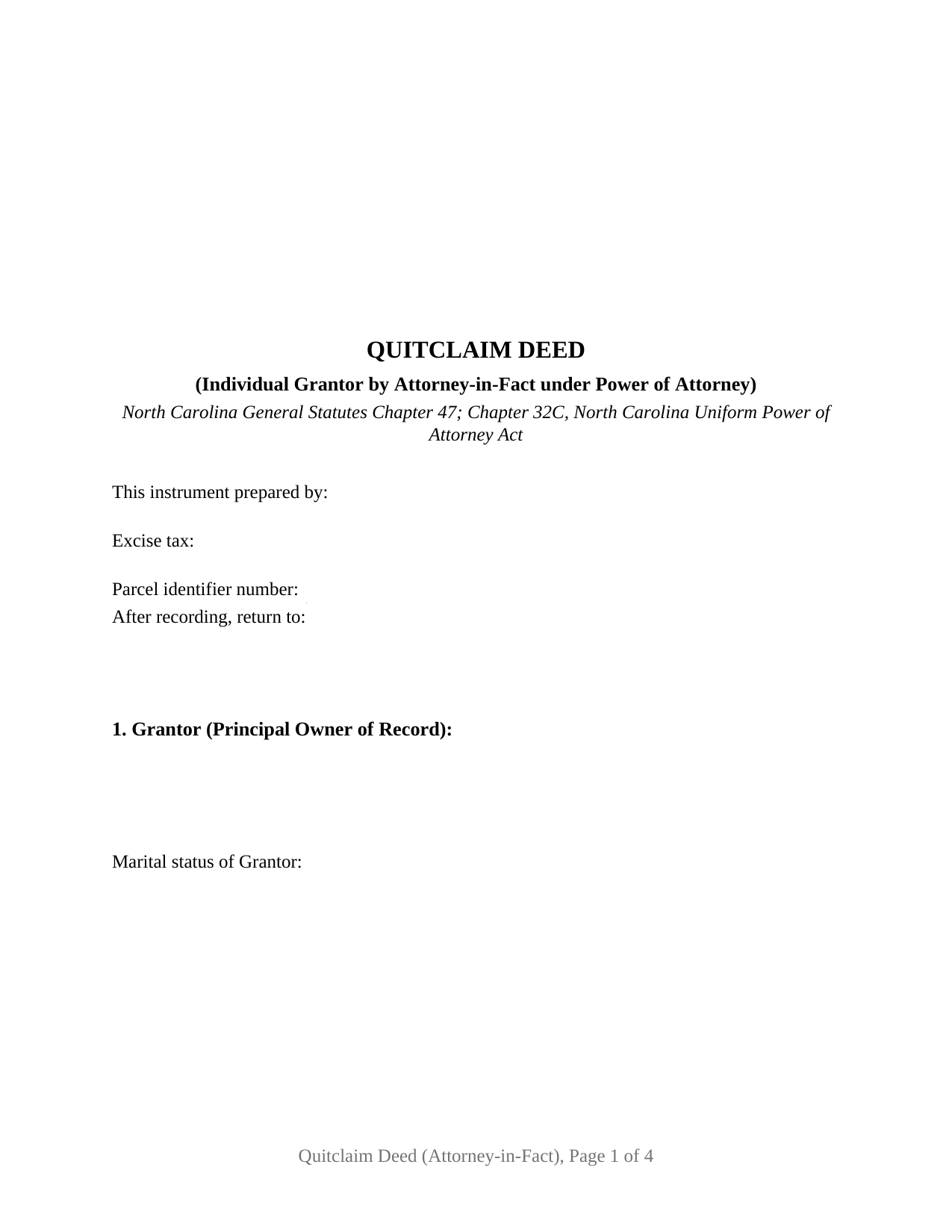
The person who signs this deed is not the person named as its Grantor. Here an agent holding a power of attorney conveys for the record owner: one agent signature made in the owner's name, one certificate written for that signature, and a release of whatever interest the owner holds, with no covenant of title attached. The fillable form is set up for that configuration alone, on land located in North Carolina.
The authority reaches the record before the deed does
Most deeds reach a North Carolina registry alone. This one arrives second. Under G.S. 47-28, before any transfer of real property executed by an agent empowered by a Chapter 32C power of attorney, that power of attorney or a certified copy of it is registered where the principal is domiciled or where the land lies. When the deed is then recorded in a different county, it carries the book, page, and county of that registration, and Section 3 of the form collects those entries with both dates. Subsection (b) softens the sequence: registration after the deed is allowed where the agent was empowered when the conveyance was made.
One signature, made in the owner's name
G.S. 47-43.1 accepts two shapes for the signature: in the name of the principal by the agent, or as agent for the principal. This deed prints the first, and says in a sentence of its own that the agent signs in that capacity and not individually. The form recites one record owner as Grantor with a marital status line, one agent, one grantee side, one signature block, and one acknowledgment certificate beneath it. Positions in the records that present this configuration include an owner living in another state whose agent closes a sale here, an owner on extended assignment abroad whose agent signs at the closing table, and a successor agent finishing a transfer the first agent left off. The form is not set up for two record owners, an entity grantor, an owner signing personally, or a joining spouse line.
A certificate written for an agent's signature
North Carolina writes a certificate for this instrument. In the G.S. 47-43 form the agent appears before the officer and, being duly sworn, states that the agent executed the instrument on behalf of the principal, identifies where the power of attorney is recorded, and acknowledges its due execution for the purposes expressed. The certificate here carries that substance, so an oath and an acknowledgment are taken together, and G.S. 10B-40(g) treats the Chapter 47 forms as compliant with Chapter 10B.
Where Chapter 32C draws its lines
General authority over real property under G.S. 32C-2-204 reaches selling or otherwise disposing of an interest in land and changing the form of title. Two entries on this deed can cross into authority that G.S. 32C-2-201(a)(1) places behind an express grant: a transfer for no consideration, which is a gift, and a grantee clause creating survivorship between two grantees. G.S. 32C-1-110 ends a power of attorney at the death of the principal. The guide walks those provisions and the Chapter 41 vesting menu the grantee blank opens.
A release, not a promise about title
No North Carolina statute prescribes a quitclaim form, so the words do the work: the deed remises, releases, and forever quitclaims whatever right, title, and interest the Grantor holds, with no covenant of title, express or implied. Under G.S. 39-1 a conveyance passes a fee simple estate unless it plainly shows a lesser one, enlarging nothing. Searchers find it as a quit claim deed, a quitclaim, or a non-warranty deed; whatever the label, deeds of trust and easements ride through.
What page one reports
Beneath the three inch stamp space of G.S. 161-14(b), with the instrument type named under it, page one gathers the drafter name that G.S. 47-17.1 puts on a first page, the excise figure set by the G.S. 105-228.30 rate and reported under G.S. 105-228.32, a parcel identifier blank for the county systems of G.S. 161-30, and the return address. Registration in the county holding the land is the moment G.S. 47-18 makes the release good against lien creditors and later purchasers for value.
Inside the purchase: this deed as a fillable PDF, an example filled in for an Iredell County release signed by an agent under a registered power of attorney, and a plain language guide covering each section, the registration and authority statutes, excise treatment, and recording. It describes North Carolina law in general terms and is not legal advice.
Important: County-Specific Forms
Our quitclaim deed (individual grantor by attorney-in-fact) forms are specifically formatted for each of the 100 counties in North Carolina.
After selecting your county, you'll receive forms that meet all local recording requirements, ensuring your documents will be accepted without delays or rejection fees.