North Carolina Quitclaim Deed (Trustee Grantee)
County Specific Legal Forms Validated as recently as October 15, 2026 by our Forms Development Team
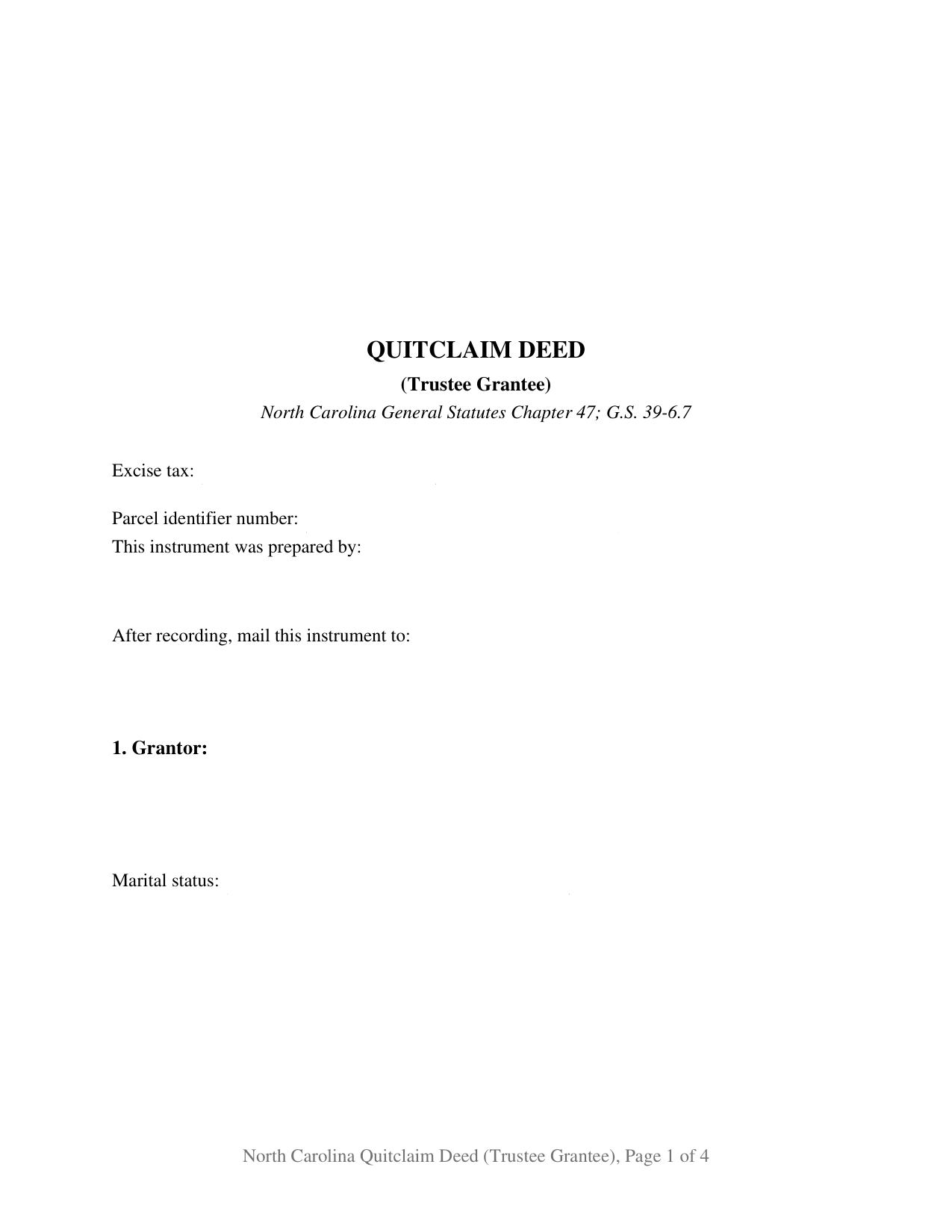
About the North Carolina Quitclaim Deed (Trustee Grantee)
How to Use This Form
- Select your county from the list
- Download the county-specific form
- Fill in the required information
- Have the document notarized if required
- Record with your county recorder's office
What Others Like You Are Saying
"Very easy to download and appreciated the other information and affidavits."
"Delivered the exact documents I wanted, and included a filled out form for guidance. It also include…"
"Excellent service and quick turnaround time.I ordered a copy of my property deed and I received a do…"
"Thank you for making this so easy to use. I had looked all over the internet and yours was the most …"
"These guidelines and form helped me lot in preparing quit deed to add my spouse's name in tittle pro…"
4.8/5 from 4,828 reviews. Read all
On this fillable North Carolina quitclaim deed the grantee blank asks for more than a name. It asks for a capacity: the trustee or trustees taking title, the name of the trust, and the date of the trust instrument. One individual grantor signs, releasing whatever interest that grantor holds, and the deed reaches the register of deeds already carrying the three trust identifiers a later title search looks for.
Naming the trustee, or naming the trust
Deeds arrive at North Carolina registries worded both ways, and the General Statutes anticipate it. G.S. 39-6.7(a) provides that an instrument purporting to transfer property to a trust is deemed a transfer to the trustee or trustees of that trust, and subsection (d) lets the trustee convey as trustee later even where the earlier deed ran to the trust by name. Section 8 prints that construction on the face of the instrument instead of leaving it to be argued afterward, while the blanks above are laid out for the cleaner version: the trustee named first, the trust identified by name and date beneath.
One grantor signs, and the trustee does not
The form recites exactly one individual grantor, with a mailing address and a line stating the marital status the grantor asserts, and one receiving side. Because a grantee does not sign a North Carolina deed, the trustee has no signature line, and the instrument carries one signature block and one acknowledgment certificate to match its single signer. Ownership patterns presenting this shape in the record include a sole owner moving a residence already titled in her own name into her revocable living trust, an owner shifting a rental parcel into a family trust signed years earlier, and a settlor finishing the funding of a trust when one parcel was left out. The form is not set up for two conveying owners, for a joinder signature by a spouse holding no record title, or for a parcel held by the entirety, where G.S. 41-58 calls for both spouses to join in writing before the estate moves.
Why cotrustees are not joint tenants
Naming two people as grantees usually opens the North Carolina co-ownership menu. Naming two trustees does not. G.S. 41-75(1) states that the joint tenancy Article does not apply to executors or trustees in their representative capacity, so cotrustees hold one title in that capacity, and what happens when one stops serving is answered by the trust instrument and the Uniform Trust Code: G.S. 36C-7-703(b) lets the remaining cotrustees act on a vacancy, and G.S. 36C-7-704(f) vests a successor trustee with the title to property of the former trustee. The trust instrument itself stays private. Where a buyer, lender, or insurer later wants the trustee's authority documented, G.S. 36C-10-1013 supplies a certification of trust, which subsection (j) allows to be executed for registration in the county where the land lies, prepared and recorded separately and not included in this package.
A release, not a warranty
North Carolina prescribes no quitclaim form, so this instrument, searched by some as a quit claim deed and by others as a non-warranty deed, works through its own words: the grantor remises, releases, and forever quitclaims all right, title, and interest, if any, to have and to hold to the grantee and the grantee's successors in trust, without covenant or warranty of title. G.S. 39-1 carries the grantor's whole estate unless the deed plainly shows a smaller one, so the trust takes the record position exactly as it stood, liens and all.
What the first page reports
Page one keeps the three inch recording space, states the instrument type below it, and gathers the drafter entry that G.S. 47-17.1 makes a condition of acceptance, the parcel identifier, the return address, and the excise figure. Trust funding transfers commonly land in the classes listed at G.S. 105-228.29, a gift or a transfer where no consideration is due or paid, and the reported figure is then zero. The body states each party's mailing address and whether the land takes in a grantor's primary residence, as G.S. 105-317.2 asks.
The package delivers this deed as a fillable PDF, a completed example worked through a New Hanover County transfer into a revocable living trust, and a plain language guide covering each numbered section, the trustee entries, the vesting menu, the excise treatment, and the county recording steps. The materials describe North Carolina law in general terms and are not legal advice.
Important: County-Specific Forms
Our quitclaim deed (trustee grantee) forms are specifically formatted for each of the 100 counties in North Carolina.
After selecting your county, you'll receive forms that meet all local recording requirements, ensuring your documents will be accepted without delays or rejection fees.