North Carolina Quitclaim Deed (Reserving Life Estate)
County Specific Legal Forms Validated as recently as September 25, 2026 by our Forms Development Team
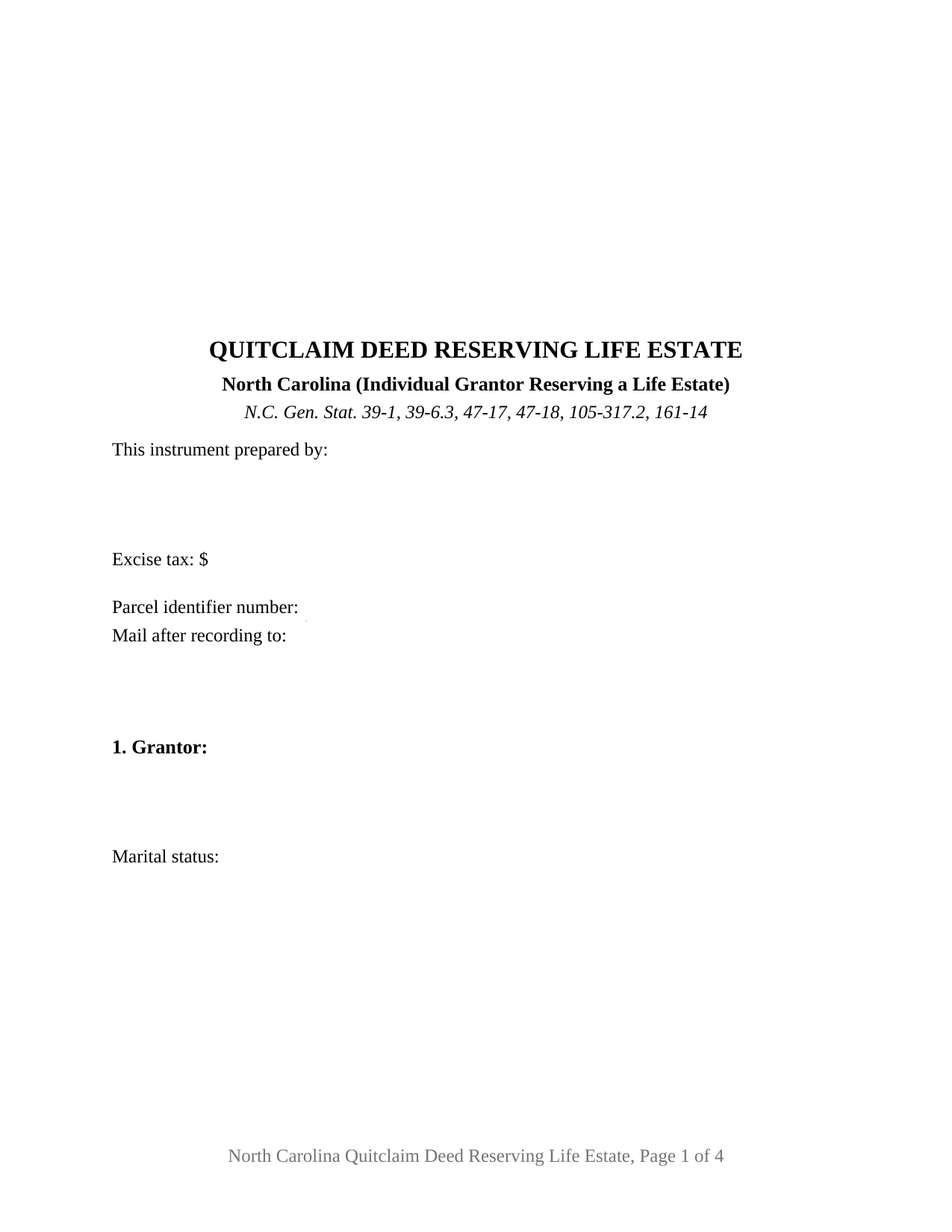
About the North Carolina Quitclaim Deed (Reserving Life Estate)
How to Use This Form
- Select your county from the list
- Download the county-specific form
- Fill in the required information
- Have the document notarized if required
- Record with your county recorder's office
What Others Like You Are Saying
"It was a wonderful experience. Thank you for your help."
"Great..."
"GREAT! site, had everything we needed to complete our estate planning for our children"
"They are amazing. So fast and friendly."
"Thanks for you help to get me out of a quick problem. Downloads were great. I recommend this service…"
4.8/5 from 4,829 reviews. Read all
This deed divides ownership along the calendar rather than along a boundary line. The owner keeps the property for life and moves the rest today: Section 8 reserves a life estate for the term of the Grantor's own natural life, and Section 9 quitclaims the remainder to the named Grantee, with no covenant of title traveling with it. The fillable North Carolina form is drawn for that single configuration.
Two estates cut from one instrument
North Carolina writes no form for a life estate deed and none for a quitclaim, so the operative words carry both jobs. The reservation holds back a present estate measured by the Grantor's life, with the possession, use, rents, and profits during that term; what leaves the Grantor is the remainder in fee that follows it. G.S. 39-6.3 supplies the footing for the interest that moves: a conveyance of an existing future interest is not ineffective on the sole ground that the interest conveyed is future or contingent. G.S. 41-6.3, abolishing the rule in Shelley's case for transfers taking effect on or after October 1, 1987, leaves a remainder limited to a named person standing as one.
Vesting now, possession later
The timing is the point of the instrument. The remainder vests in the Grantee when the deed is delivered; only possession waits for the life estate to end. The reservation is an ordinary life estate and no more, carrying no power to sell, mortgage, appoint, or revoke. North Carolina has tested what follows. In Willis v. Willis, No. 457A11 (2012), an owner who had reserved a life estate and conveyed the remainder to a son sought reformation after the son died and the remainder passed to his children; the Supreme Court of North Carolina held that reformation for a grantor's unilateral mistake, absent fraud, is unavailable as a matter of law.
One Grantor, one signature block, one certificate
The form recites exactly one individual as Grantor, with a mailing address and a marital status line; one receiving side, whose blank takes the remainder holders' names and any tenancy designation; the primary residence statement G.S. 105-317.2 asks of every deed; and one signature block with one acknowledgment certificate carrying the substance of the G.S. 10B-41 certificate. Positions in the records presenting this shape include a sole owner moving the remainder in a residence to an adult child while keeping the right to live there, and an owner of timber land passing the remainder to a niece while keeping the income for life. The form is not set up for two conveying owners, an entity Grantor, a signature made by an agent, a life estate measured by another person's life, or a reservation favoring someone who does not sign, and it prints no joinder line for a spouse holding no record title, the configuration G.S. 39-7 and G.S. 41-58 address.
The duties that ride with a reserved life estate
Possession carries obligations. G.S. 105-302(c)(8) treats the life tenant as the owner for listing purposes, G.S. 105-355(a)(1) makes the taxes a lien on the fee as well as the life estate, and G.S. 105-384 places payment on the life tenant, letting a remainderman who pays sue to recover. Chapter 1, Article 42 supplies the waste remedies, G.S. 1-533 allowing judgment for damages, forfeiture, and eviction. G.S. 46A-79 adds that a life estate does not bar a partition sale of the remainder, though it cannot disturb the life tenant's possession.
What page one reports
Beneath the three inch recording space of G.S. 161-14(b), with the instrument type named under it, the first page gathers the drafter entry G.S. 47-17.1 makes a condition of acceptance, the excise figure computed under G.S. 105-228.30 and collected before recording under G.S. 105-228.32, a parcel identifier blank for the county systems of G.S. 161-30, and the return block. A remainder given without payment lands among the exempt classes of G.S. 105-228.29 and reports at zero. Registration in the county holding the land is what makes the conveyance good against lien creditors and later purchasers under G.S. 47-18.
The download carries this life estate deed as a fillable PDF, a completed example worked through an Alamance County gift of a remainder with a reserved life estate, and a plain language guide covering each section, the vesting menu, excise treatment, and recording. Searchers reach it as a quit claim deed, a quitclaim, a non-warranty deed, or a life estate deed; under any label, these materials describe North Carolina law generally and are not legal advice.
Important: County-Specific Forms
Our quitclaim deed (reserving life estate) forms are specifically formatted for each of the 100 counties in North Carolina.
After selecting your county, you'll receive forms that meet all local recording requirements, ensuring your documents will be accepted without delays or rejection fees.